
Cited in sermons
Matthew Poole
287 sermons · All people cited

Clip: God isn't crippled, hindered, silent, or absent
The sovereignty of God over creation and providence is the proper ground of confident, bold prayer. Drawing on Acts 4 and Psalm 2, this excerpt shows how the apostolic church prayed not to a God diminished by circumstance but to the God who made and governs all things — including the threats of the Sanhedrin against the early church. The vantage point of God's absolute sovereignty is what makes petition coherent and emboldening rather than desperate.

The Healing of Naaman

The healing of Naaman in 2 Kings 5 exposes a pagan military commander who possesses everything except the one thing he needs: cleansing from leprosy and reconciliation to the living God. The passage traces the providence of God in orchestrating Naaman's encounter with Elisha, Naaman's fury at the simplicity of the cure, his genuine conversion and humble confession of faith in Yahweh alone, and finally the greed of Gehazi, whose attempt to put a price on God's free grace earns him the very disease Naaman was healed of. The sermon presses toward these gospel applications: sovereign grace humbles its recipients rather than inflating them, salvation is by grace alone through faith alone with nothing added, and God's grace is not a commodity to be bought, manipulated, or supplemented with human achievement.
Clip: God isn't crippled, hindered, silent, or absent
The early church in Acts 4:23–31 prayed not as though God had been caught off guard by persecution, but as though the God who created and governs all things remained sovereignly in control of even the threats of the Sanhedrin. This clip draws out the church's invocation of divine sovereignty as the theological ground of confident petition: to pray is to address the one with absolute ability to fulfill what he has promised and purposed. The application is direct — believers do not come to a God who is crippled, hindered, or absent, but to the sovereign Lord who holds the hearts of all men in his hand.
The Prayer of the Persecuted Church
When the early church faced arrest and official prohibition of gospel preaching, its first instinct was corporate prayer — not political agitation or fearful compliance. This exposition of Acts 4:23–31 traces the structure of that prayer: an invocation of God as sovereign Creator, an exposition of Psalm 2 applied to the conspiracy against Christ and his people, and a pointed supplication not for safety or comfort but for boldness to declare the word. The sermon calls the contemporary church to the same God-centred prayer, understanding persecution as something always beneath the sovereign hand of God, and faithfulness in proclamation as the unchanging vocation of every Christian steward.

The Crucifixion of Jesus, Part 5
The death of Christ on the cross was not a bare historical event but a theologically charged act that immediately reshaped the covenant order between God and man. This sermon expounds Matthew 27:51–56, examining the three signs that followed the crucifixion — the torn temple veil, the earthquake and split rocks, and the resurrection of the saints — as divine testimony to the efficacy of Christ's atoning work and the inauguration of the New Covenant. The witnesses to that death, both the confessing Roman soldiers and the faithful women who had followed Jesus from Galilee, confirm that the one crucified is truly the Son of God. Believers are called to rest in Christ's completed atonement, which has opened access to the Holy of Holies for all who come through him, and to look forward to the bodily resurrection he has secured for his people.
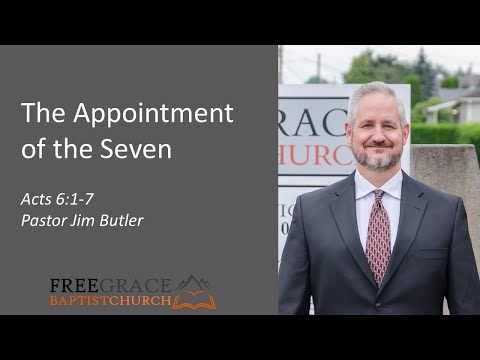
The Appointment of the Seven
Acts 6:1–7 records the Jerusalem church's response to a logistical crisis that threatened to pull the apostles away from prayer and the ministry of the Word. The passage establishes the diaconate in seed form: men of good reputation, full of the Holy Spirit and wisdom, appointed to serve the practical needs of the congregation so that those charged with preaching and teaching may be undistracted. Expounding 1 Timothy 3:8–13 alongside the Acts text, this sermon examines the qualifications, function, and appointment of deacons, and the connection between a biblically ordered church — with both elders and deacons — and the advance of the gospel.

Exodus 19
Exodus 19 records Israel's arrival at Sinai and God's formal entry into covenant with the nation — a covenant that functions as a republication of the covenant of works, in which Israel, like Adam before them, is called to obedience and fails, thereby pointing forward to the last Adam, Jesus Christ. The chapter unfolds in three movements: the exhortation to faithfulness through the covenant terms (vv. 1–8), the consecration of the people for readiness (vv. 9–15), and the theophanic demonstration of divine glory (vv. 16–25). The Sinai theophany, with its thunder, fire, and death-boundary around the mountain, teaches that God's people require a mediator — a lesson that finds its fulfillment in Christ, the Mediator of the New Covenant. The church, as the true Israel of God, inherits the vocation of Exodus 19:6 — a royal priesthood, a holy nation — and is therefore called to proclaim the praises of God with reverence befitting the consuming fire she approaches in worship.

The Testimony Concerning Christ's Supremacy
John 3:31–36 contains John the Baptist's climactic testimony concerning the supremacy and authority of the Lord Jesus Christ. The passage presses two inseparable realities: Christ's origin from above establishes his absolute supremacy over every earthly voice, and the Father's gift of all things into the Son's hand grounds his authority to bestow everlasting life on believers and to execute wrath on those who remain in unbelief. The sermon traces how the Baptist's testimony in these verses is of one piece with the prologue of John's Gospel, the high-priestly prayer of John 17, and the whole drift of Scripture concerning the triune God. Hearers are called to look in faith to Christ, the Lamb of God, understanding that regeneration by the Spirit is the necessary precondition for that faith, and that to reject the Son is not neutrality but the tacit accusation that God is a liar.

Exodus 18 - Jethro
Exodus 18 presents two interconnected events: the conversion of Jethro, priest of Midian, and his practical counsel to Moses on delegating judicial authority. The conversion of Jethro follows the pattern of one called out of polytheistic darkness into the knowledge of the true and living God — marked by joy, praise, confession of Yahweh's supremacy, and worship through sacrifice. The passage further grounds civil government in the fear of God and the rule of law, teaching that qualified civil rulers must be able, God-fearing, truthful, and free from covetousness — qualities that remain the standard for righteous governance in any age.

The Discourse on God's Salvation, Part 3
John 3:17–21 declares that the Son of Man's incarnation was a redemptive, not a condemnatory, mission — yet the world He entered was already under condemnation by virtue of Adam's sin and its own actual transgressions. The passage moves from the declaration of man's condemned state (vv. 17–18) to the demonstration of it (vv. 19–21): fallen humanity resists the light of Christ, loves moral darkness, and avoids exposure — the classic scriptural portrait of total depravity confirmed across Genesis, the Psalms, the Prophets, and the New Testament. The necessity of regeneration by the Holy Spirit follows directly: because sinners are constitutionally hostile to the light, they cannot come to Christ unless the Spirit first makes them alive and grants the graces of faith and repentance.
Exodus 16 - Bread from Heaven
Exodus 16 records Israel's complaint in the wilderness and God's provision of quail and manna, revealing that grumbling against His appointed servants is ultimately grumbling against God Himself. The chapter is expounded under three headings: the promise of bread (vv. 1–12), the presence of bread (vv. 13–31), and the preservation of bread (vv. 32–36). The manna narrative carries a Sabbatarian argument — the double portion on the sixth day presupposes Sabbath observance that predates Sinai, pointing back to Genesis 2 and forward to Exodus 20 and Hebrews 4. The episode also functions typologically, anticipating Christ as the true bread from heaven in John 6, and calls God's people in every covenant administration to daily dependence on their Provider rather than grumbling against His providence.

Exodus 15 - Song of Moses
Exodus 15 records the Song of Moses, a celebration of divine redemption and righteous judgment sung by Israel after the destruction of Pharaoh's army in the Red Sea. The sermon expounds the threefold structure of the song — the triumph of the Lord, the defeat of the Egyptians, and the majesty and incomparability of God — before tracing its prophetic reach into the nations' fear of Yahweh and the ultimate goal of covenant dwelling. The bitter waters of Marah complete the chapter, exposing Israel's reflexive grumbling as a failure to trust the God who had already done the greater work of redemption. Hearers are called to praise God for both his saving mercy and his just judgment, and to pass that doxological heritage to the next generation.

The Discourse on God's Salvation, Part 1
Jesus answers Nicodemus's question — 'How can these things be?' — by pointing to three realities: his own incarnation as the one who descended from heaven, the Old Testament typology of the bronze serpent in Numbers 21, and the necessity of his crucifixion as the antitype to whom sinners must look in faith. The sermon works through John 3:11–15, examining Christ's authority to speak of heavenly things, the doctrine of the hypostatic union and the communication of idioms, and the parallel between Israel's look-and-live prescription in the wilderness and saving faith in the crucified Son of Man. The application is direct: the antidote to sin is not moral reformation but faith in the lifted-up Christ, who alone secures justification and eternal life for believing sinners.

Exodus 14
Exodus 14 records the crossing of the Red Sea — a chapter whose driving theme is not merely Israel's deliverance but God's self-glorification over Pharaoh and his army. The exposition works through two main movements: the plan of God (vv. 1–14), in which God sovereignly directs Israel's route and hardens Pharaoh's heart so that He may gain honor, and the power of God (vv. 15–31), in which divine promise, protection, and action result in the salvation of Israel and the destruction of Egypt. Israel's fear and complaint throughout the chapter expose a chronic lack of faith, while Moses' brief but confident exhortation — 'Do not be afraid; stand still and see the salvation of the Lord' — models the response that faith in God's promises produces.

The Crucifixion of Jesus, Part 3
Matthew 27:45–46 records the fourth of Christ's seven words from the cross — the cry of dereliction, 'My God, my God, why have you forsaken me?' — and its interpretation demands both exegetical precision and doctrinal care. The darkness from the sixth to the ninth hour was not a solar eclipse but a supernatural sign of divine judgment, recapitulating the ninth plague pattern and marking the moment the Passover antitype was slain. The cry itself does not imply any ontological division within the Trinity, any dissolution of the hypostatic union, or the suffering of all three persons; rather, it expresses the withdrawal of divine consolation from the Son according to his true humanity as he bore, in our place as surety, the full weight of penal wrath. Believers are called to ground their assurance not in felt divine presence but in the covenant faithfulness of the God to whom Christ still cried 'my God' even in the depth of his substitutionary suffering.

The Meeting with Nicodemus, Part 2
John 3:4–10 confronts every hearer with the absolute necessity of regeneration before any entrance into the kingdom of God. Working through Nicodemus's proud misunderstanding and Christ's patient explanation, this exposition argues that the new birth is entirely God's sovereign work — initiated by the Holy Spirit, prefigured in Ezekiel 36 and Deuteronomy 30, and entirely prior to saving faith. The sermon also draws out the Trinitarian theology embedded in Christ's wind analogy, showing that the Spirit's sovereign, effectual work in regeneration reveals who God is, not merely what He does.
Exodus 13 - The Consecration of the Firstborn
Exodus 13 grounds the consecration of Israel's firstborn in the redemptive logic of the tenth plague: because God spared Israel's firstborn while striking Egypt's, Israel's firstborn belong to him — to be set apart, sacrificed if clean, or redeemed if human or unclean. The chapter's twin emphases on perpetual remembrance through the Feast of Unleavened Bread and the catechetical instruction of children press the same truth across generations: God's people are defined by what God has done for them, not by their own merit or strength. The typological weight of substitutionary redemption — one life in the place of another — finds its terminus in the Lamb of God who takes away the sin of the world, making these ordinances intelligible only in light of Christ. Practically, the sermon calls the congregation to remember the mighty works of God, to sacrifice freely in gratitude for redemption received, and to pass this theological inheritance faithfully to the next generation.

Exodus 12, Part 2
Exodus 12:29–51 records the execution of the tenth plague, the departure of Israel from Egypt, and the regulations governing who may participate in the Passover. The death of every firstborn in Egypt—from Pharaoh's throne to the dungeon—is presented not as arbitrary cruelty but as the righteous retribution of a holy God against a nation that had enslaved and slaughtered His people, fulfilling the promise made to Abraham in Genesis 15. The Passover ordinance, with its requirements of circumcision for participation and the prohibition against breaking the lamb's bones, functions typologically to point forward to Christ, who is our Passover sacrificed for us, whose bones were not broken at the crucifixion.

Exodus 12 - Part 1
Exodus 12 presents the institution of the Passover and the Feast of Unleavened Bread as a blood ritual pointing forward to Christ, the anti-type of the Passover lamb. The chapter is expounded in three movements: the specific blood-ritual instructions God gives to Moses and Aaron (vv. 1–13), the regulations for the memorial Feast of Unleavened Bread (vv. 14–20), and Moses's transmission of those instructions to the elders of Israel (vv. 21–28). The blood on the doorposts was not a sign for an omniscient God who needed locating data, but an outward expression of the faith of those who believed Yahweh's word — a pattern fulfilled when Christ, the blemish-free Lamb, shed his blood so that the wrath of God passes over all who trust in him. The study closes by drawing out the catechetical purpose embedded in the Passover ordinance: that each generation would rehearse the redemptive acts of God and understand that without the shedding of blood there is no remission.

The Crucifixion of Jesus, Part 2
Matthew 27:39–44 records the threefold mockery of Christ on the cross — by passing bystanders, by the chief priests and scribes, and by the robbers crucified alongside him. Each taunt — that he could not save himself, that his kingship was fraudulent, that his claim to divine sonship was false — is shown to be an ironic confirmation of the very things the mockers deny: Christ's identity as temple builder, King of Israel, and Son of God. His refusal to descend from the cross is not weakness but the perfect obedience of the covenant of redemption, the very means by which he saves his people from their sins. The sermon closes with the conversion of the penitent thief as a trophy of sovereign grace and an argument for faith in a willing Savior.

1 Peter 1:6-9

The paradox of simultaneously rejoicing and grieving marks the Christian life as Peter describes it in 1 Peter 1:6–9. Trials are not accidents of providence but a necessary divine instrument: God uses suffering to prove and purify a faith that is more precious to Him than refined gold is to men, and that tested faith will issue in praise, honor, and glory at the revelation of Jesus Christ. The principle for maintaining joy amid suffering is not mere willpower but a growing, knowledge-grounded faith fixed on Christ — His cross, His resurrection, and the inheritance He has secured — so that joy becomes the constant fruit of right focus rather than a fluctuating response to circumstances.

The First Disciples of Jesus
John 1:35–51 records the calling of the first disciples of Jesus — Andrew, Simon Peter, Philip, and Nathanael — and the passage frames their coming to Christ as the inevitable fruit of John the Baptist's preparatory ministry and the sovereign grace of God. The sermon traces how each disciple is drawn to Christ, how each immediately brings another, and how the accumulating titles given to Jesus in this section — Lamb of God, Rabbi, Messiah, Son of God, King of Israel, Son of Man — build a Christological portrait that mirrors the prologue's declaration that the Word was God. Christ's omniscience in knowing Nathanael and his royal authority in renaming Simon Peter underscore that these disciples are not choosing a teacher but being conquered by a divine Savior. The pattern of Andrew fetching Peter and Philip fetching Nathanael becomes the sermon's model for evangelism: those saved by sovereign grace become, without coercion or manipulation, propagators of that same grace.

The Crucifixion of Jesus, Part 1
Matthew 27:32–38 records the crucifixion of the Lord Jesus Christ with studied brevity, and this expository sermon works through each verse to show that every detail — from the place called Golgotha to the division of garments and the charge above his head — is the deliberate fulfillment of Old Testament Scripture, not an accident or afterthought in the plan of God. The sermon traces the thread from the proto-gospel of Genesis 3:15 through the typological head-wounds of Israel's enemies to Christ's death blow against the devil at the place of the skull. Three concluding applications draw out the pastoral weight: the unwitting testimony of Pilate, the triumph of the skull-crushing seed of the woman, and the immeasurable love of the Savior who was stripped naked, numbered with transgressors, and crucified so that his people might be clothed with his righteousness, received in glory, and given everlasting life.

The Testimony of John the Baptist, Part 1
John 1:19–28 records the official interrogation of John the Baptist by a delegation sent from Jerusalem to establish his identity and authority. The Baptist's threefold denial — he is not the Christ, not Elijah bodily returned, not the prophet of Deuteronomy 18 — is matched by his positive confession as the voice of Isaiah 40, the forerunner who prepares the way of Yahweh and thereby implicitly confesses the deity of Jesus. The sermon traces the Baptist's testimony through Luke 1's prophecy of Zacharias, the Transfiguration account in Matthew 17, and the prologue of John 1, showing that the Baptist preached not only repentance but the remission of sins through the coming Messiah — that is, justification by faith alone. The governing application is that Christ's people exist to proclaim His preeminence, following the Baptist's model of humble, courageous, light-and-heat ministry that makes nothing of self and everything of Jesus.

The Mission of the Word, Part 1
John 1:6–9 introduces John the Baptist not as an independent figure but as a divinely commissioned witness whose entire ministry exists to point to the Word made flesh. This sermon examines the origin, nature, and function of that witness ministry, demonstrating that the Baptist's testimony belongs to a network of overlapping witnesses — Father, Son, Holy Spirit, Scripture, and signs — that ground saving faith in historical reality rather than a blind existential leap. The function of John's witness is inseparable from its purpose: that sinners would believe on Christ as the Lamb of God who takes away the sin of the world, not merely imitate him as a moral example. The sermon closes with a call to keep law and gospel in their proper places, so that sinners driven by the law's killing power may look by grace to the one who is both the true light and the only hope of the world.

The Divinity of the Word, Part 2
John 1:3–5 teaches that the eternal Word is the creator of all things, establishing Christ unmistakably on the divine side of the creator-creature distinction. The sermon works through the Trinitarian doctrines of inseparable operations and appropriations, showing from Genesis 1, Psalm 33, Job 26, Colossians 1, and Hebrews 1 that creation is the undivided act of the one God, yet scripture distinctively attributes it to the Son. Because Jesus is creator, sustainer, and enthroned Lord, his people need not be paralyzed by circumstance — and the darkness, however violently it resists the light, cannot overcome it.

The Ethics of Motherhood
Titus 2:3–5 sets older women in the church as instructors of younger women in the domestic virtues that honor the created order and adorn the doctrine of God. Against a cultural moment that treats the word 'mother' as offensive and obliterates God-wrought gender distinction, the passage calls women to love husbands and children, to exercise discretion, chastity, and diligence in the home, and to submit to their own husbands — not as cultural accommodation but as a reflection of the eternal created order grounded in Genesis and reaffirmed by Christ's redemption. The overarching rationale Paul supplies is theological: the conduct of women in household and church either blasphemes or adorns the Word of God before a watching world. The sermon closes by grounding every duty in grace alone through faith alone in Christ alone, warning that no degree of faithful motherhood constitutes grounds for justification.

The Divinity of the Word
John 1:1–5 opens not in a Bethlehem stable but in eternity, establishing the Word's co-eternality, personal distinction from the Father, and full consubstantiality with the Father before a single creature existed. This sermon works through the first clause of John's prologue under five sub-points drawn from verse 1: the eternity, distinctiveness, and consubstantiality of the Word with the Father, the repetition of that glory in verse 2, and (deferred to the following week) the Word as creator of all things. The doctrine of the Trinity — one in essence, three in subsistence — is shown to be not an academic luxury but the very foundation of all communion with God and the indispensable framework for understanding why the incarnation is the supreme act of grace.

The Practice of the Church
Acts 2:41–47 describes the first-century church's response to apostolic preaching and, when read in light of the whole New Testament, is prescriptive for churches today. The sermon traces two main movements: the power of the gospel that produces faith, repentance, and baptism, and the fourfold practice of the church — steadfast continuation in the apostles' doctrine, fellowship, the breaking of bread, and prayer. Cessationism is applied to the signs and wonders of the apostolic era, while the ongoing marks of the church are drawn from the Belgic Confession's articles on the true church and the obligations of her members. The practical burden is that believers must resist both the reduction of church life to entertainment and the temptation to substitute online participation for embodied, corporate worship.

The Christian Sabbath, Part 1
The Fourth Commandment's call to Sabbath observance is grounded not in Mosaic legislation alone but in the created order itself, the pattern of divine rest in Genesis 2, and the logic of redemption running through both Testaments. This sermon, the first in a series on the Christian Sabbath, expounds Deuteronomy 5:12–15 alongside key Old Covenant passages — Genesis 2, Exodus 16, Isaiah 56 and 58, and Jeremiah 31 — to argue that Sabbatarianism is a moral, perpetual, and trans-covenantal obligation rooted in creation and confirmed by covenant. The confession of the Second London Baptist Confession chapter 22 frames the doctrinal parameters, and the sermon closes with a call to receive the Sabbath not as a burden but as a blessed provision of God for his creatures.