
Cited in sermons
Martyn Lloyd-Jones
77 sermons · All people cited

The Qualifications for Elders, Part 4

The qualifications for elders in 1 Timothy 3:2 include a single gift amid a catalog of virtues: the ability to teach. This sermon examines what that aptness to teach requires — a thorough knowledge of Scripture, sound theology, and historical doctrine — and then surveys the apostolic theology of preaching from Romans 10, 1 Corinthians 1, and 2 Timothy 4, demonstrating that faithful preaching is the ordained means by which Christ Himself speaks to His people and faith is produced. The sermon concludes by calling the church to pray for, examine, and install biblically qualified men who will convince, rebuke, and exhort with longsuffering, unashamed before God rather than men.

Ask FGBC #58: How to Start Reading the Bible?
How should a person begin reading the Bible — and how should they read it once they have opened it? This Q&A exchange addresses both the unbeliever encountering Scripture for the first time and the new believer seeking a starting point, recommending the law of God as a mirror of sin and the Gospels as the answer to that conviction. The discussion extends to the manner of reading: attending to the sense intended by the divine author rather than the nakedness of individual words, reading within the interpretive community of the church, and approaching the text through prayerful dependence that guards against the pride produced by knowledge acquired without humility. Practical counsel on guarding reading habits against the fragmenting effects of social media closes the exchange.

The Believer's Joy and Moderation
Philippians 4:4–5 contains two imperatives that together define the outward shape of the Christian life: a command to rejoice in the Lord always, and a command to let moderation — or equity — be known to all men. The sermon argues that joy is not a feeling to be waited upon but a non-negotiable duty grounded in the objective realities of justification, sanctification, and glorification. The Greek word rendered 'gentleness' (epieikēs) is examined through Aristotle, Zanchi, and Gill to establish that it denotes reasonableness in judging and willingness to forgo one's rights in interpersonal matters — not a blanket disposition of quietness that would contradict the examples of Joshua, Elijah, Christ driving out the money-changers, and Paul's anathema on false gospels. Both commands are made possible only through the imputed righteousness of Christ received by faith and the indwelling Spirit.
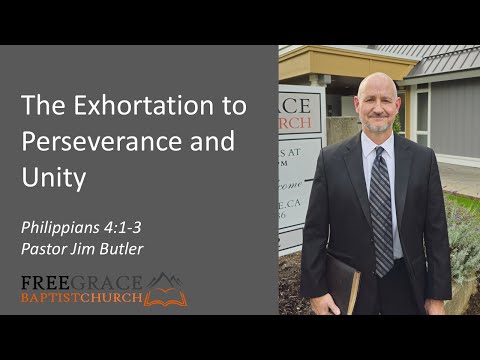
The Exhortation to Perseverance and Unity
Philippians 4:1–3 sets before the church two inseparable obligations: standing fast in the Lord and pursuing unity among the saints. Working through the apostle's affection for the Philippians, his call to perseverance, and the concrete dispute between Euodia and Syntyche, this sermon shows that the absence of unity both destroys the church and renders perseverance a near-impossible task. The biblical remedy for conflict — private confrontation, appeal to witnesses, and involvement of the church — is traced from Proverbs 18 and Matthew 18:15–20, with a complementarian reading of 1 Timothy 2 clarifying the nature of Euodia and Syntyche's gospel labor. Hearers are called to fasten their grips on Christ, his doctrines, and one another for the long haul of the Christian life.

A Psalm of Thanksgiving
Psalm 103 is a psalm of David that models the discipline of deliberate thanksgiving — speaking to one's own soul rather than merely listening to its despondency. This exposition works through three movements: the reminder to bless God (vv. 1–2), the reasons to bless God catalogued as gifts, their recipients, and their giver (vv. 3–18), and a reflection on the sovereign kingdom of God (vv. 19–22). The chief benefit heading David's list is the forgiveness of sins — the one blessing that remains constant through every external adversity — and the sermon calls hearers to fight melancholy with the specific, rehearsed goodness of God rather than merely silencing the soul's complaints.

The Sixth Commandment, Part 5
The sixth commandment, 'You shall not murder' (Deuteronomy 5:17), is grounded not in mere legal convention but in the theological reality that man bears the image of God — an image that persists from conception through old age, in sickness and health, in the handicapped and the mentally ill. Drawing on Genesis 1, 5, and 9, alongside Jesus' exposition in Matthew 5:21-22 and John's application in 1 John 3, this study traces the commandment's reach inward to unwarranted anger and character assassination, and outward to the present cultural crises of abortion, euthanasia, and the neglect of capital punishment. Because the image of God is the theological rationale for both the prohibition of murder and the mandate of capital punishment, opposition to abortion and support for the death penalty are not contradictory positions but necessary corollaries of the same conviction about the sanctity of human life.

The High Priestly Prayer, Part 4
What grounds the prayers Jesus offers for his people, and why does he explicitly exclude the world from his intercession? Working through John 17:9–11a, this sermon examines the focus and rationale of Christ's high priestly intercession: he prays specifically for the elect whom the Father gave him, not for the reprobate world, and he does so as the mediating priest who both sacrifices and intercedes on behalf of his own. The mutual possession declared in verse 10 — 'all mine are yours and yours are mine' — establishes the full equality of the Son with the Father, while 'I am glorified in them' frames the church as a trophy case of divine grace displayed before angels and nations. The sermon closes with an exhortation to treasure the blessedness of election: a Savior who intercedes, a triune God who is known, and a security that nothing can sever.

The Conversion of Matthew
Matthew 9:9-13 presents the sovereign call of Christ to Matthew, a tax collector despised in first-century Jewish society as a collaborator with Gentile oppressors and a companion of sinners. The sermon traces three movements in the passage: the authoritative call that produced immediate discipleship, the feast Matthew threw to honor Christ and evangelize his former associates, and Christ's threefold response to the Pharisees' complaint — identifying himself as a physician to the sick, appealing to Hosea 6:6 against mere external religion, and declaring his mission to call sinners to repentance. The central application is that no sinner is too notorious to be received by Christ, and Matthew's immediate rising and following is held up as the pattern for genuine repentance and faith.

Ask FGBC - Dec 2024 Podcast with Pastors Butler and Porter, Batch 4
A panel of two pastors works through a batch of listener-submitted questions spanning baptism and the Lord's Supper, the eternity of hell, church membership, faith and fear, the unpardonable sin, images of Christ, dry preaching, and extra-biblical theological vocabulary. Across each topic the answers are grounded in Scripture and the 1689 London Baptist Confession, with particular attention to second-commandment concerns, the nature of saving faith, and the perseverance of the saints. Listeners are urged to anchor their assurance not in the strength of their own grip on Christ but in the immutable decree of election and the intercession of the Triune God.

The Servant and Master Relationship
Ephesians 6:5–9 concludes Paul's household code by addressing the obligations of both bondservants and masters in first-century Greco-Roman society. The passage insists that redemption in Christ does not dissolve temporal social obligations: the slave must obey with a heartfelt, Christ-centered, and eschatologically grounded sincerity, while the master must forsake threatening and govern with the knowledge that he too stands under an impartial heavenly Master. The sermon applies this to the modern employer-employee relationship through four principles drawn from Proverbs and the parallel passage in Colossians 3: the condemnation of laziness, the commendation of diligence, the consideration of Christ in all things, and the cultivation of self-control as the Spirit-wrought fruit that undergirds every godly social relation.

Death Penalty, Part 3
Romans 13:1–7 furnishes the New Testament's clearest warrant for civil government bearing the sword, including capital punishment — yet common objections, both biblical and pragmatic, continue to challenge this teaching. This third installment of a study arising from Leviticus 20 addresses the two most significant biblical objections: the pacifist misreading of Matthew 5:38–42 and the attempt to leverage John 8:1–11 against lawful execution. The sermon argues that Jesus in the Sermon on the Mount is correcting the misapplication of the lex talionis to personal relationships, not dismantling civil jurisprudence, and that his handling of the woman caught in adultery actually upholds Mosaic evidentiary law rather than nullifying capital punishment. Five pragmatic objections — that the death penalty is incompatible with Christian forgiveness, lacks mercy, risks executing the innocent, fails to deter, and forecloses salvation — are each answered from Scripture and reason.

Live Stream - October 15, 2023
Ephesians 5:15–17 calls believers to walk circumspectly — not as fools but as wise — by redeeming the time in days that are evil. The sermon distinguishes biblical wisdom from mere intellectual knowledge, defining it as the skillful application of God's word to the whole of life. The twin remedy against folly is the regular study of Scripture (with particular attention to the Book of Proverbs as a manual of wisdom) and persistent, faith-filled prayer for wisdom as commended in James 1. The new man in Christ is not left to himself but is given the pattern and the means to navigate a present evil age in a manner consistent with his calling.

A Psalm of Thanksgiving
Psalm 103 calls God's people to bless the Lord with the whole soul and to forget none of His benefits — a command that presupposes the constant human tendency toward spiritual amnesia and ingratitude. The sermon works through David's threefold structure: a reminder to bless God (vv. 1–2), the reasons to bless God (vv. 3–18), and a reflection on God's universal kingdom (vv. 19–22). The reasons are organized around the gifts God gives (spiritual and physical), the recipients of those gifts (the oppressed and covenant people), and the character of the giver Himself — merciful, gracious, slow to anger, and abounding in steadfast love. Thanksgiving is not a seasonal sentiment but the daily reflex of those who know their guilt before a holy God and have received forgiveness through the blood of Christ.

Introduction to the 1677/1789 2nd London Baptist Confession of Faith
The 1689 London Baptist Confession of Faith — formally composed in 1677 and adopted by particular Baptist churches in 1689 — stands in deliberate continuity with the Westminster Confession and the Savoy Declaration, adapting their language to reflect distinctively Baptist convictions while maintaining solidarity with the broader Reformed tradition. This introductory session traces the Confession's historical origins, its relationship to the First London Confession of 1644–46, and the legal and ecclesiastical context in which particular Baptists operated under the Act of Toleration. Six reasons are then advanced for why a 21st-century church should subscribe to a 17th-century confession: to define, defend, discriminate, discipline, distinguish matters of Christian liberty, and develop an appreciation for the history of the church. The session closes by urging that confessionalism, rightly understood, is not proud biblicism but the humble reception of gifts Christ has given to his church across the ages.

Livestream - The Basis for Love and Unity
Ephesians 4:4–6 presents seven 'ones' — one body, one Spirit, one hope, one Lord, one faith, one baptism, and one God and Father — as the objective, Spirit-wrought basis for the love and unity to which Paul exhorts believers in verses 1–3. The sermon argues that these seven unities are not aspirational ideals but present realities constituted by the Holy Spirit in the production of the church, and that believers are therefore called to steward, not generate, the unity already given. The practical weight falls on bearing with one another in love, contending for the faith once delivered to the saints, and recognising that the Triune God — not social trinitarianism — is the foundation of all communion and the basis for genuine ecumenism among confessional Christians.

The Children of the Devil, Part 3
John 8:44–47 records Christ's unflinching indictment of the unbelieving Jewish religious leaders as children of the devil, a verdict he confirms by exposing three marks of their paternity: they reject the truth he speaks precisely because it is truth, they cannot convict him of a single sin, and they do not hear God's words because they are not of God. The sermon draws out the theological weight of each mark — the devil as murderer and father of lies in contrast to Christ as life and truth — and applies these diagnostic tests to the question of assurance: those who are of God love Christ and love the Word. The exposition closes with a call to both the congregation and the unconverted to rest in the imputed righteousness of Christ, received by faith alone, as the only ground of a right relationship with God the Father.

A Psalm of Thanksgiving
Psalm 103 calls the redeemed to bless God with the totality of their being — not passively, but by deliberately rehearsing his mercies against the ever-present tendency to forgetfulness. The psalm moves from the forgiveness of sins as the chief and foundational benefit, through temporal preservation and physical provision, to the perfections of God himself — his mercy, his patience, his covenant faithfulness — as the inexhaustible ground of praise. The sermon presses the congregation to fight spiritual amnesia privately in prayer and publicly in corporate worship, and to understand that gratitude is not an optional ornament but a defining mark of those who walk worthily before God.

The Conduct of a Faithful Minister
Paul's charge to Timothy in 1 Timothy 4:12–16 sets forth the pattern for every faithful gospel minister: exemplary character, diligent public ministry, ongoing personal growth, and tenacious perseverance to the end. Preached at an ordination service for a newly commissioned pastor, this exposition works through each element of the apostle's command — from the six spheres of a minister's example (word, conduct, love, spirit, faith, purity) to the three pillars of public ministry (reading, exhortation, doctrine). The sermon insists that Christian virtue, however admirable, cannot save souls; it is the word of God, proclaimed boldly and accurately, that the Spirit uses as the instrument of salvation. The congregation is charged alongside the minister: receive the word with joy, reject heresy, prize the public means of grace, and honour those who watch for your souls.

The Greatest Commandments
Matthew 22:34–40 records a Pharisaic lawyer testing Jesus with the question of which commandment is greatest. Jesus answers by citing the Shema from Deuteronomy 6:4–5 and the neighbor-love command from Leviticus 19:18, thereby summarizing the entire Decalogue under two heads: love to God and love to man. This sermon argues that Christ's endorsement of these two commandments confirms the abiding validity of the moral law for New Covenant believers, who are called to keep it not as a means of justification but as the Spirit-wrought response of those already justified by faith alone. The hearer is pressed to recognize that the law's demand — to love God with the whole self and the neighbor as oneself — drives the believer perpetually to Christ, in whom alone that demand has been perfectly met.

The Prophet's Faith in a Time of Distress
Habakkuk 3 presents the prophet's response to the announced Babylonian invasion of Judah: not despair, but a structured movement from fearful petition through deliberate theological remembrance to confident refuge in God. The sermon traces three movements in the psalm — petition, remembrance of God's acts in redemptive history, and refuge — arguing that a perplexed faith steadies itself not by self-reflection but by rehearsing who God is and what He has done. The doctrine of justification by faith (Habakkuk 2:4), appropriated in the New Testament, is shown here in its practical dimension: the just do not merely begin by faith but continue to live and persevere by it through every extremity. The congregation is called to imitate the prophet by building their own 'collage' of God's mighty works in Scripture, thereby finding rest, joy, and stability in God alone when earthly supports fail.
The Prayer of the Persecuted Church
When the early church faced arrest and official prohibition of gospel preaching, its first instinct was corporate prayer — not political agitation or fearful compliance. This exposition of Acts 4:23–31 traces the structure of that prayer: an invocation of God as sovereign Creator, an exposition of Psalm 2 applied to the conspiracy against Christ and his people, and a pointed supplication not for safety or comfort but for boldness to declare the word. The sermon calls the contemporary church to the same God-centred prayer, understanding persecution as something always beneath the sovereign hand of God, and faithfulness in proclamation as the unchanging vocation of every Christian steward.

The Qualifications of Elders, Part 4
The elder's qualification 'able to teach' (1 Timothy 3:2) is not an arbitrary requirement but the inevitable expression of a word-centered religion. This sermon traces the centrality of the proclaimed Word from the Mosaic covenant through the prophetic institution, the earthly ministry of Christ, the apostolic mission, and the pastoral epistles, demonstrating that teaching and governing in the church have always been inseparable. The third main point applies this theology practically: men aspiring to eldership must demonstrate proven faithfulness as churchmen before the church recognizes, tests, and formally approves them by common suffrage according to 2nd London Confession chapter 26, paragraph 9.

The Meeting with Nicodemus
John 3:1–10 presents Jesus confronting Nicodemus — a ruler of the Sanhedrin sent by the Jerusalem religious leadership — with the doctrine of regeneration: that a man must be born again, born from above, before he can see or enter the kingdom of God. The sermon argues that the new birth is entirely a sovereign act of God Most High, not a command for the sinner to obey by his own power, and that regeneration logically precedes and produces saving faith rather than following it. Those born of God will evidence that new life through faith in Christ, a practice of righteousness, love for the brethren, and an overcoming of the world.

The Ministry of the Word
What is the basis and method of God's ordained means for saving sinners? This sermon on 2 Timothy 4:2 argues that the preaching of the Word stands as the primary instrument through which God saves the lost and builds his church, grounding that claim in the logical chain of Romans 10, the divine pleasure announced in 1 Corinthians 1, and the final apostolic charge of Paul to Timothy. The sermon challenges the contemporary drift toward audience-driven church strategies, calling both preachers and hearers to fidelity to the proclaimed Word as the irreplaceable means of grace.

The Good Soldier of Jesus Christ
The qualifications and character of faithful gospel ministry are examined through 2 Timothy 2:1–7, where Paul gives Timothy three interlocking commands: be strong in the grace of Christ, commit sound doctrine to faithful men who can teach others, and endure hardship as a soldier of Jesus Christ. Three metaphors — the devoted soldier, the disciplined athlete, and the diligent farmer — together with the dedication of the disciple, frame what faithfulness in pastoral ministry demands. The sermon presses both pastors and congregations to resist the pressure of cultural and governmental opposition, to identify and train men for ministry, and to understand that the dignity of gospel preaching warrants the highest standards of devotion, discipline, and endurance.

The Believer's Gratitude Toward God
Psalm 103 grounds thanksgiving not in vague sentiment but in the specific mercies of a covenant-keeping God toward those He has redeemed. Working through David's threefold structure — the reminder to bless God, the reasons for blessing God, and the reflection on God's kingdom — the sermon traces the chief benefit of divine grace as the forgiveness of sins accomplished in Christ, before moving outward to temporal providences, divine mercy measured against human frailty, and the universal summons of all creation to praise. The sermon draws on Deuteronomy's warnings against forgetting God's benefits and Paul's account of the worthy walk in Colossians 1 to show that detailed, specific thanksgiving is a mark of those who have received grace. The congregation is called to speak to their own souls, directing them away from self-absorption and toward the God whose mercy extends from everlasting to everlasting.

Sunday School - Sept 6 - Self-Defense, Part 1/2
What does Scripture teach about the right of individuals to use lethal force in self-defense? Working through Exodus 22:2–3, a range of Old Testament illustrations, and the teaching of Jesus in the Gospels, this study argues that defensive homicide is not murder and is consistent with the whole counsel of God's law. The session also draws on Francis Turretin's four conditions for lawful self-defense and the Westminster Larger Catechism's treatment of the sixth commandment, situating the biblical case within the broader Reformed and historic Christian tradition. The study closes by distinguishing private revenge — which Scripture forbids — from necessary defense of life, family, and property, which Scripture assumes and authorizes.

The Third Missionary Journey, Part 4
Acts 20:1–16 narrates Paul's closing movements on his third missionary journey — through Macedonia and Greece, into Troas where Eutychus falls to his death and is raised, and then south toward Jerusalem. The passage is used to argue that the early church's pattern of worship is not merely descriptive but carries prescriptive force: the Lord's Day (the first day of the week), corporate assembly, the Lord's Supper, and the preaching of God's Word are the God-ordained elements of Christian worship, regulated by Scripture alone. Cessationist and confessional commitments frame the reading throughout, and the sermon closes with a direct call to sinners to trust in Christ's imputed righteousness and atoning blood as the only ground of salvation.

The Third Missionary Journey, Part 3
Acts 19:21–41 records Paul's final days in Ephesus, culminating in a riot instigated by the silversmith Demetrius, whose financial interests were threatened by the gospel's advance against idolatry. The passage is examined under four headings: Paul's strategic plans for further ministry, the anger of the silversmiths rooted in profit dressed as piety and patriotism, the confused uproar in the theater, and the intervention of the city clerk whose cool legal reasoning protected the church. The exposition draws out the apologetic purpose of Luke's account — demonstrating that Roman civil authority found no legal fault with Christianity — and closes with an urgent call to forsake every idol and trust the righteousness of Christ alone.

Genesis 35
Genesis 35 traces Jacob's return to Bethel, the deaths of Rachel and Isaac, the treachery of Reuben, and the enumeration of Jacob's twelve sons. The chapter centers on God's sovereign renewal of His covenant with Jacob — reiterating the promises of seed and land given to Abraham and Isaac — at precisely the moment Jacob is most fearful and morally compromised. The sermon argues that God's repetition of covenant promises is not for His own memory but for the stabilization of His people's faith, and that the means of grace — Scripture, prayer, corporate worship, and the Lord's Supper — function as God's appointed conduits for fortifying His people to persevere through affliction, loss, and moral failure.