
Cited in sermons
Martin Luther
327 sermons · All people cited

The Bread of Life Discourse, Part 3

John 6:41–51 records the Jews' grumbling rejection of Jesus as the bread of life and his pointed rebuke of their unbelief. This sermon expounds that rejection in two movements: the nature of the Jews' complaint against Christ's divine origin, and Christ's twofold response — his assertion of the Father's sovereign, efficacious drawing of sinners and his appeal to the prophetic scriptures that learning from the Father issues in coming to the Son. The doctrines of total depravity and total inability are drawn from verse 44 and grounded in parallel texts from John 1, Romans 8, and Ephesians 2, establishing that salvation is possible only because the Father draws whom he will. The sermon closes with an exhortation to look to Christ in faith for everlasting life, the sole remedy for the problem of human sin.

The Gracious Purpose of the Father
Ephesians 1:3–6 opens with what the Apostle Paul calls a 'barakah' — a formal blessing of God followed by specific reasons for that praise. This sermon expounds the Father's role in the covenant of redemption: His sovereign, unconditional election of sinners in Christ before the foundation of the world, and His predestinating purpose that those chosen would be made holy and blameless. Election is the cause, not the consequence, of faith and repentance — sinners dead in trespasses and sins are chosen not because of foreseen merit but according to the good pleasure of God's will alone. The sermon calls believers to respond to the doctrine of election not with defensive polemic but with the doxological posture Paul himself models: praise, blessing, and adoration to God Most High.

2LCF Chapter 9 - Of Free Will
What does it mean that human beings have 'free will'? This confession-study exposition of 1689 London Baptist Confession chapter 9 argues that free will is real but always conditioned by the moral state of the heart — whether man is in original innocency, post-lapsarian sin, the state of grace, or the state of glory. The fourfold framework drawn from the Confession exposes the Pelagian and Arminian error of treating free will as unqualified and neutral, while grounding the sinner's inability and the believer's renewal entirely in sovereign, monergistic grace. The study closes with the pastoral application that even the believer's ongoing corruption is no surprise, and that the state of glory — not the present age — is where the will is at last perfectly and immutably free to good alone.

The 6th Commandment
Exodus 20:13 — 'You shall not murder' — is one of the briefest commands in the Decalogue, yet it carries profound theological and legal weight. This expository Bible study examines the precise Hebrew terminology that distinguishes murder from other forms of killing, establishes the internal disposition (hatred, unrighteous anger, character assassination) as equally condemned by the sixth commandment alongside the external act, and then surveys three exceptions to the prohibition: capital punishment, just war, and self-defense. Each exception is grounded in both Old and New Testament texts, with sustained attention to the Noahic Covenant, Romans 13, and Exodus 22, demonstrating that the civil magistrate's sword is a God-ordained instrument of justice rather than a violation of the commandment.

The Refuge for God's People
Psalm 46 sets the people of God in the midst of cosmic and political chaos and calls them to find their sole refuge in the Lord of hosts. This exposition works through four movements in the psalm — the assurance of God's presence, the demonstration of his power over creation and the nations, the invitation to rehearse his past works in redemptive history, and the command to be still and know that he is God. The sermon argues that Reformed Christians who rightly confess God's sovereignty in salvation must equally rest in that sovereignty under tyranny, pandemic, and war. The chief application is that the church must know God — his perfections, his names, his covenant fidelity — because it is the knowledge of God, not practical principles, that steadies the soul and fuels missionary confidence in the darkest of times.

The Confidence of the Believer
Micah 7 opens with a prophet's anguished cry — 'Woe is me' — over the collapse of covenant faithfulness in Israel: corrupt leadership, broken families, and the absence of godly community. The sermon works through three movements in the chapter: Micah's lamentation over the state of the covenant people (vv. 1–6), his counsel to the faithful remnant to look to God and trust his promises (vv. 7–13), and his petitions and doxology to the God who pardons iniquity, subdues sin, and casts all transgressions into the depths of the sea (vv. 14–20). The central corrective the prophet offers is the same one the just have always lived by: not optimism, not realism, but faith in the sovereign God of the covenant, whose compassions are new each morning and whose purposes for his remnant cannot be frustrated.

The Crucifixion of Jesus, Part 5
The death of Christ on the cross was not a bare historical event but a theologically charged act that immediately reshaped the covenant order between God and man. This sermon expounds Matthew 27:51–56, examining the three signs that followed the crucifixion — the torn temple veil, the earthquake and split rocks, and the resurrection of the saints — as divine testimony to the efficacy of Christ's atoning work and the inauguration of the New Covenant. The witnesses to that death, both the confessing Roman soldiers and the faithful women who had followed Jesus from Galilee, confirm that the one crucified is truly the Son of God. Believers are called to rest in Christ's completed atonement, which has opened access to the Holy of Holies for all who come through him, and to look forward to the bodily resurrection he has secured for his people.

Introduction to the Decalogue
Exodus 20:1–2, the preface to the Decalogue, reveals God as the sovereign Lawgiver who redeems before He commands — a pattern in which grace precedes obligation that runs from Sinai through the new covenant. The sermon examines three classical uses of the Ten Commandments (civil, pedagogical, and normative) and the threefold division of the law (moral, ceremonial, judicial), demonstrating that the moral law alone abides in its full binding force for all people and all ages. Believers are not justified by the law but are directed by it as the objective standard of sanctification, so that love for God and neighbor is never left undefined or sentimental.

The Qualifications of Elders, Part 4
The elder's qualification 'able to teach' (1 Timothy 3:2) is not an arbitrary requirement but the inevitable expression of a word-centered religion. This sermon traces the centrality of the proclaimed Word from the Mosaic covenant through the prophetic institution, the earthly ministry of Christ, the apostolic mission, and the pastoral epistles, demonstrating that teaching and governing in the church have always been inseparable. The third main point applies this theology practically: men aspiring to eldership must demonstrate proven faithfulness as churchmen before the church recognizes, tests, and formally approves them by common suffrage according to 2nd London Confession chapter 26, paragraph 9.
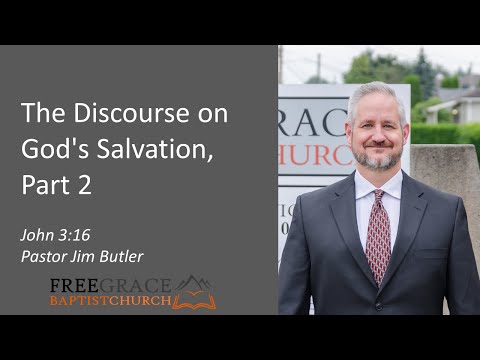
The Discourse on God's Salvation, Part 2
John 3:16 — Luther called it 'the Bible in miniature,' and this exposition treats it as precisely that: a compressed statement of the whole Christian gospel. The sermon moves through three divisions of the verse — the declaration of God's love, the demonstration of that love in the gift of the only begotten Son, and the description of those who receive God's redemptive love through faith. Central to the argument is the insistence that God's love is the source, not the consequence, of the atonement, and that 'the world' in John's vocabulary denotes persons from every tribe and tongue without ethnic distinction, not every individual without exception — a conclusion that grounds particular redemption in the wider theology of John's writings. The sermon closes with a direct appeal to unbelievers: the one way of salvation is to believe on Jesus Christ alone, whose active obedience supplies the righteousness that sinners need and whose substitutionary death removes the condemnation they deserve.

Exodus 15 - Song of Moses
Exodus 15 records the Song of Moses, a celebration of divine redemption and righteous judgment sung by Israel after the destruction of Pharaoh's army in the Red Sea. The sermon expounds the threefold structure of the song — the triumph of the Lord, the defeat of the Egyptians, and the majesty and incomparability of God — before tracing its prophetic reach into the nations' fear of Yahweh and the ultimate goal of covenant dwelling. The bitter waters of Marah complete the chapter, exposing Israel's reflexive grumbling as a failure to trust the God who had already done the greater work of redemption. Hearers are called to praise God for both his saving mercy and his just judgment, and to pass that doxological heritage to the next generation.

The Crucifixion of Jesus, Part 3
Matthew 27:45–46 records the fourth of Christ's seven words from the cross — the cry of dereliction, 'My God, my God, why have you forsaken me?' — and its interpretation demands both exegetical precision and doctrinal care. The darkness from the sixth to the ninth hour was not a solar eclipse but a supernatural sign of divine judgment, recapitulating the ninth plague pattern and marking the moment the Passover antitype was slain. The cry itself does not imply any ontological division within the Trinity, any dissolution of the hypostatic union, or the suffering of all three persons; rather, it expresses the withdrawal of divine consolation from the Son according to his true humanity as he bore, in our place as surety, the full weight of penal wrath. Believers are called to ground their assurance not in felt divine presence but in the covenant faithfulness of the God to whom Christ still cried 'my God' even in the depth of his substitutionary suffering.

The Pharisee and the Publican
This exposition of Luke 18:9–14 examines the parable of the Pharisee and the publican as a penetrating diagnosis of self-righteousness and a declaration of justification by faith alone. The sermon works through the occasion of the parable, the contrasted characters of the two men, and Christ's concluding verdict that the tax collector — not the Pharisee — went home justified. The central contention is that acceptance before God rests entirely on the imputed righteousness of Christ received through faith, not on any moral performance or religious accomplishment, and that those who understand this will be marked by humility rather than contempt toward others.

Not Ashamed of the Gospel

Paul's final letter charges Timothy — and every believer — not to be ashamed of Christ's gospel or of those who suffer for it. Expounding 2 Timothy 1:8–12, this sermon confronts the tendency to romanticize persecution in the abstract while failing to stand when actual pressure comes, drawing pointed application from recent governmental restrictions on church gatherings. The ground of unashamed endurance is the gospel itself: God's eternal purpose of grace, accomplished in Christ who has abolished death and brought immortality to light, and entrusted to a church that shall never finally fail. Christians are called to pray for courage in times of peace precisely so they do not waver when suffering arrives.

The Lord Jesus and the Demoniacs
Matthew 8:28–34 presents Christ's authority over demonic powers as a ground for confident trust in him as the Son of God. The demons' own confession — 'You Son of God' — exposes what the disciples have not yet grasped: that Jesus holds sovereign dominion over every spiritual power, including the devil himself. The exorcism at Gerasa is set within Matthew's sustained demonstration, across chapters 8–9, that the one who teaches with authority also acts with authority. If Christ has conquered death and the devil, every lesser affliction that threatens the people of God lies well within his sovereign reach.

The Ethics of Motherhood
Titus 2:3–5 sets older women in the church as instructors of younger women in the domestic virtues that honor the created order and adorn the doctrine of God. Against a cultural moment that treats the word 'mother' as offensive and obliterates God-wrought gender distinction, the passage calls women to love husbands and children, to exercise discretion, chastity, and diligence in the home, and to submit to their own husbands — not as cultural accommodation but as a reflection of the eternal created order grounded in Genesis and reaffirmed by Christ's redemption. The overarching rationale Paul supplies is theological: the conduct of women in household and church either blasphemes or adorns the Word of God before a watching world. The sermon closes by grounding every duty in grace alone through faith alone in Christ alone, warning that no degree of faithful motherhood constitutes grounds for justification.

The Practice of the Church
Acts 2:41–47 describes the first-century church's response to apostolic preaching and, when read in light of the whole New Testament, is prescriptive for churches today. The sermon traces two main movements: the power of the gospel that produces faith, repentance, and baptism, and the fourfold practice of the church — steadfast continuation in the apostles' doctrine, fellowship, the breaking of bread, and prayer. Cessationism is applied to the signs and wonders of the apostolic era, while the ongoing marks of the church are drawn from the Belgic Confession's articles on the true church and the obligations of her members. The practical burden is that believers must resist both the reduction of church life to entertainment and the temptation to substitute online participation for embodied, corporate worship.

All Of Christ For Justification

Philippians 3:1–9 presents the apostle Paul's radical revaluation of every religious credential he possessed, moving them all from the gain column to the loss column so that Christ alone might occupy the place of righteousness before God. This sermon expounds what it means to have no confidence in the flesh: that justification rests on Christ's perfect active obedience imputed to the believer, not on any combination of works, faith, and sincere effort. The loss column of sin is dealt with equally fully — Christ bearing the certificate of debt and nailing it to the cross, cancelling the debt in its entirety. Hearers are called to count all self-generated merit as rubbish and to rest, passively and completely, in Christ's righteousness received through faith alone.

The Lord's Prayer in Gethsemane
What does the agony of Christ in Gethsemane reveal about who He is and what He accomplishes? Expounding Matthew 26:36–46, this sermon traces the Savior's three prayers against the disciples' repeated failure to watch, showing that Christ's soul-sorrow is perfectly consistent with His true humanity, while His unwavering resolve to drink the cup of divine wrath flows from His eternal commitment as covenant mediator. The cup is not metaphor for mere suffering but the concentrated fury of God upon a sinless substitute — which explains both why martyrs die differently than Christ and why the imputation of His active obedience is as necessary as the forgiveness of sins. Believers are called to marvel at His sufficiency, to watch and pray with sobriety about their own weakness, and to rest entirely on the righteousness of Another.

The Ministry of Apollos
Acts 18:24–28 introduces Apollos of Alexandria as a case study in what faithful gospel ministry requires. Six marks characterize this man — eloquence grounded in scriptural mastery, accurate instruction in the way of the Lord, fervency of spirit governed by knowledge, precise teaching, bold proclamation, and humble openness to correction — and these same marks should shape the church's prayers for and training of men for public ministry. Luke's phrase 'believed through grace' discloses the ordo salutis: saving faith is itself the gift of God's sovereign grace to dead sinners. The sermon closes by pressing both the need for trained, bold preachers and the equally urgent need for obedient hearers, applying the gospel of justification by faith alone to any who have not yet come to Christ.
Psalm 46
Psalm 46 presents God as the impenetrable refuge and omnipotent strength of His people in the midst of natural catastrophe, national upheaval, and personal affliction. The study works through four heads: the assurance of God's presence (vv. 1, 7, 11), the demonstration of God's power (vv. 2–6), the invitation to behold God's works (vv. 8–9), and the command to rest in God's sovereignty (v. 10). Covenant theology is not merely a theoretical construct but the very ground of the believer's comfort — the God of Jacob is a covenant-keeping God whose purposes cannot be frustrated by any earthly power. The congregation is called to the practical discipline of theology proper: to know God deeply so that the soul is stabilized, not paralyzed, in times of trouble.

The Christian Husband/Father
The duties of the Christian husband and father are examined through the book of Proverbs, with Proverbs 4:1–9 as the anchor text and wide-ranging support from Deuteronomy and the New Testament. The sermon sets forth the godly husband as one who fears the Lord, deals with sin, provides for his household, protects his wife, communicates faithfully, and maintains sexual purity. The Christian father is then treated under four heads — being a godly man, loving his children, instructing them in word and life, and disciplining them with both verbal correction and, when necessary, the rod — all exercised in love rather than anger or indulgence. The closing application calls fathers to confess sin before their households, pray for and preach law and gospel to their children, and rest not in their own performance but in the imputed righteousness of Christ.

The Christian's Duty toward Non-Christians
Titus 3:1–3 sets out the Christian's duty toward both civil government and all people outside the church. The sermon traces the divine origin of civil government from Genesis 9 through Romans 13 and 1 Peter 2, arguing from Francis Turretin's two-kingdom framework that Christ rules both the civil and spiritual spheres, and that the civil state therefore has no authority to command the church as church. Verse 3's catalogue of pre-conversion vices — foolishness, disobedience, malice, hatred — is read as a theological reason for patient, peaceable, and humble conduct toward non-Christians: believers were once exactly what they now struggle to bear in others, and those others may yet become objects of the same sovereign grace.

The Manifestation of God's Grace
Titus 2:11–15 presents God's grace not merely as the ground of salvation but as the very teacher of holy living. This exposition traces four aspects of grace in the passage: its appearance in the incarnation and atoning work of Christ, its instruction toward denial of ungodliness and worldly lusts and pursuit of sober, righteous, and godly life, its demonstration in the deity of the returning Christ and the definite redemption he accomplished, and its proclamation through authoritative gospel ministry. The controlling hermeneutical key is the grammatical and theological priority of the indicative over the imperative: believers obey not in order to be saved but because they have been saved, and inverting that order collapses the gospel into moralism.
The Resurrection and Justification
Romans 4:25 declares that Christ 'was delivered up because of our offenses and was raised because of our justification' — a verse Charles Hodge called a comprehensive statement of the gospel and Matthew Poole called an abridgment of the whole. The sermon works through two inseparable redemptive realities: the substitutionary, particular atonement accomplished in Christ's death, and the five-fold testimony of the resurrection to the validity of that work. The central application is that a robust grasp of justification by faith alone — the imputation of Christ's righteousness received through faith — is the irreplaceable foundation for Christian stability, comfort, and peace with God.

The Governing Principle of Kingdom Life
Anxiety is not a private struggle but a theological failure — a contradiction of the sovereignty of God confessed in the pew but abandoned in the heart. Expounding Matthew 6:25–34, this sermon works through Christ's fourfold structure in the Sermon on the Mount: the command not to worry, the indictment of those who do, the contrast between Gentile anxiety and covenant-child confidence, and the governing principle that kingdom life is regulated by seeking first God's kingdom and righteousness. The sermon closes with eight dangerous fruits of worry and a call to trust that the God who is absolutely sovereign in salvation is equally sovereign over food, clothing, and every daily crisis.

The Council at Jerusalem, Part 2
The Jerusalem Council of Acts 15 confronts the Judaizing error that Gentile salvation requires circumcision and law-keeping in addition to faith in Christ. Drawing on Peter's testimony in Acts 15:6–12 and its grounding in the Cornelius episode of Acts 10, the sermon argues that God himself made no distinction between Jew and Gentile, purifying hearts by faith alone — making any human addition to the gospel a direct testing of God. Faith is shown to be the empty hand that receives Christ's righteousness, not a virtue that earns it, and the church is called to guard the law-free gospel against every cultural or ecclesiastical supplement that would corrupt it.

The Council at Jerusalem, Part 1
Acts 15:1–5 introduces the Jerusalem Council by presenting the Judaizing heresy in its starkest form: certain men from Judea taught that circumcision must be added to faith in Christ for salvation, striking simultaneously at the law's proper use and at the sufficiency of Christ's finished work. The passage is set in its chronological context, distinguishing the events of Galatians 2 from the council itself, and showing that the problem was not merely one of Jewish-Gentile social relations but a soteriological crisis with eternal consequences. Paul and Barnabas respond with uncompromising confrontation, the church at Antioch sends delegates to Jerusalem, and the passage closes with the same Judaizing demand surfacing within the Jerusalem church — demonstrating the universality and perpetuity of the tendency to add human merit to sovereign grace. The exhortation is to resist every form of works-righteousness and to preach the law and gospel in their proper distinction, so that sinners are directed to Christ alone.
The Qualifications for Elders (Part 1)
What qualifies a man to serve as an elder in the church of Jesus Christ? Expounding 1 Timothy 3:1–7 as an excursus from a series through Acts, this sermon establishes that the New Testament uses 'elder,' 'overseer,' and 'pastor' as synonymous titles for one office, and then works through five of the six qualifications Paul sets out for that office: the man's desire, his personal holiness, and his domestic faithfulness. The sermon is equally concerned with what these qualifications are not — they are not a standard of sinless perfection, nor a popularity contest, nor a direct transfer of worldly competence — and applies the passage by urging the church to vet candidates by Scripture alone, not by affection or likability.

The Death Penalty
Genesis 9:6 grounds the biblical mandate for capital punishment in the image of God: to shed human blood unlawfully is to assault God himself, and the prescribed penalty reflects the weight of that offense. This sermon works through the Noahic covenant as a common-grace ordinance never abrogated, traces the continuity of capital punishment into the New Testament through Romans 13, and then systematically answers both biblical and pragmatic objections — including the mistranslation of Exodus 20:13, the pacifist reading of Matthew 5:38–42, and the woman caught in adultery in John 8. Believers are called to submit to the whole counsel of God on this issue, even where it cuts against cultural sentiment, because consistency with Scripture requires affirming what God has commanded for the governance of civil society.