
Cited in sermons
Louis Berkhof
40 sermons · All people cited

The Supper on Betrayal Night

On the night of his betrayal, Christ instituted the Lord's Supper within the context of the Passover meal — a deliberate act of covenantal timing that pressed upon his disciples the reality of what his broken body and shed blood would accomplish. This sermon works through Luke 22:19–20 under two heads, the bread and the wine, tracing the biblical theology of each element: the bread overturning the curse of Genesis 3 by providing divine nourishment freely, and the cup of the new covenant corresponding to the third Passover cup of redemption in Exodus 6. The sermon calls Christians away from coldness and neglect of the Lord's Supper toward a warm, particular reception of the truth that Christ's body was given for you and his blood was shed for you.

The Preface to the Ten Commandments

Deuteronomy 5:1–6 opens the Ten Commandments not with a command but with a declaration of divine redemption — 'I am the Lord your God, who brought you out of the land of Egypt, out of the house of bondage.' This study works through the summons to covenant obedience, the grace-grounded preface to the Decalogue, and the uniqueness of the moral law as trans-covenantal and abiding. The threefold division of the law — moral, ceremonial, and judicial — is examined through the confession, the prophets, the Gospels, and the epistles, equipping believers to distinguish what abides in the new covenant from what was fulfilled and abrogated in Christ.

CTF 2025 - Session 2 - Divine Simplicity

Divine simplicity — the doctrine that God is without parts of any kind, physical or metaphysical — is the necessary precondition for God to be the absolute first cause of all things confessed in Romans 11:36. This lecture, drawn from 2LCF Chapter 2 Paragraph 1, works through the logic of composition and dependence to show that any being composed of parts is doubly dependent: upon those parts and upon whatever unifies them, and is therefore disqualified from being the uncreated Creator. Divine infinity is then treated as a corollary of simplicity: because God has no compositional structure of finitude, his being is actual, unbounded, and without lack, which is the only reliable ground for absolute trust and worship.
Ask FGBC #39: What Does The Bible Mean By The Unforgiveable Sin?
What is the unforgivable sin, and should a troubled conscience fear having committed it? Drawing on Matthew 12:31-32 and the apostasy warnings of Hebrews 6 and 10, this Q&A response argues that blasphemy against the Holy Spirit is not a momentary verbal offense but a wholesale, persistent rejection of the redemptive work of God in Christ — impugning the Spirit's testimony to Christ's works and glory. The defining mark of a genuine apostate is not anguish or doubt but a hardened, unrepentant contempt, like those who cried 'crucify him.' Anyone asking whether they have committed this sin gives evidence by that very asking that they have not.

Ask FGBC - Dec 2024 Podcast with Pastors Butler and Porter, Batch 4
A panel of two pastors works through a batch of listener-submitted questions spanning baptism and the Lord's Supper, the eternity of hell, church membership, faith and fear, the unpardonable sin, images of Christ, dry preaching, and extra-biblical theological vocabulary. Across each topic the answers are grounded in Scripture and the 1689 London Baptist Confession, with particular attention to second-commandment concerns, the nature of saving faith, and the perseverance of the saints. Listeners are urged to anchor their assurance not in the strength of their own grip on Christ but in the immutable decree of election and the intercession of the Triune God.

2LCF Chapter 1 - Of the Holy Scriptures, Part 2
What does it mean to interpret the Bible correctly, and how does the 1689 London Baptist Confession of Faith guide that task? Working through paragraphs 5 to 10 of Chapter 1, this study introduces the discipline of hermeneutics — the science of biblical interpretation — by tracing six principles the Confession sets forth: the scope of Scripture (the glory of God in the salvation of sinners through Christ), the sufficiency of Scripture (expressly stated and necessarily implied), the perspicuity of Scripture (clear enough for the unlearned on all saving matters), the translation of Scripture (grounded in divine inspiration and providential preservation), the interpretation of Scripture (the analogy of Scripture and the analogy of faith), and the finality of Scripture (Holy Scripture as the supreme judge over all councils, creeds, and private opinion). The practical burden is that a faulty hermeneutic produces bad doctrine, and that reading the Old Testament through the lens the New Testament apostles themselves provide is not optional but the pattern Christ himself commanded.

The Identity of the Good Shepherd
John 10:22–30 records the climactic confrontation in Solomon's Porch during the Feast of Dedication, where Jesus answers the persistent demand to declare his identity plainly. He does so not with new information but by pressing what he has already said — through his works, his doctrine, and his relation to the Father — culminating in the declaration 'I and my Father are one,' a statement the unbelieving Jews rightly understood as a claim to full divine essence. The sermon traces five movements in verses 25–30: the declaration, confirmation, rejection, recognition, and affirmation that Jesus is the Christ, with extended treatment of the sovereignty of God in salvation, the security of the sheep grounded in both the Son and the Father, and the ontological unity of Father and Son against both Arian and Sabellian error. Believers are called to rest in the particular, efficacious, and irrevocable redemption accomplished by the Good Shepherd, and those outside Christ are called to hear his voice and believe.
The Warning Against Apostasy
Hebrews 10:26–31 contains one of the New Testament's starkest warnings, and the question it raises is precise: who has committed the sin of willful apostasy, and can it be the believer who struggles with remaining corruption? This sermon works through the nature and judgment of apostasy, distinguishing between the sensitive saint who sorrows over indwelling sin and the apostate who openly tramples the Son of God underfoot, counts the blood of the covenant a common thing, and insults the Spirit of grace. Drawing on Calvin, Owen, Gill, and Ursinus, the sermon argues that the persons in view are not struggling believers but outright rejecters of the gospel — in the original context, Hebrew Christians who publicly renounced Christ to return to the Levitical system. The chief comfort the passage affords is precisely this: the believer who fears he has committed the unpardonable sin almost certainly has not, and is called to draw near, hold fast, and consider one another in the confidence of a once-for-all sacrifice that saves to the uttermost.

2LCF Chapter 7 - Of God's Covenant, Part 2
1689 London Baptist Confession of Faith, Chapter 7, paragraph 3 sets out three theological covenants — the covenant of grace, the covenant of redemption (pactum salutis), and the covenant of works — as the structural architecture of all Scripture. This sermon expounds each in turn, demonstrating from texts in Genesis, Isaiah, Hosea, Galatians, and Romans that the covenant of grace is founded on an eternal transaction between the Father and the Son, and that it is God's provision for sinners rendered incapable of acceptance with God since Adam's fall. The covenant of works is shown to be indispensable to a right understanding of justification: without it, the imputed righteousness of Christ collapses into either moralism or antinomianism, and the distinction between forgiveness and imputation is lost. Covenant theology is pressed not as academic machinery but as the very ground of the believer's comfort, assurance, and stability before God.

2nd London Baptist Confession of Faith (1689) - Sunday School Study - July 18, 2021
The self-authenticating authority of Scripture cannot be separated from sound principles for reading it. This 1689 London Baptist Confession of Faith Sunday school study works through chapter one, paragraphs five through ten, drawing out the hermeneutical principles the divines embedded there: the scope of Scripture (all glory to God through Christ), the sufficiency of Scripture (confined to God's glory, man's salvation, faith, and life), the perspicuity of Scripture (salvation truths are plain even to the unlearned), and the availability of Scripture in translation. The session also addresses textual criticism, the transmission history of the biblical manuscripts, and the distinction between necessary inference and explicit statement as sources of scriptural authority. Hearers are called to come to the biblical text with humility, the illumination of the Spirit, and a due use of ordinary means rather than intellectual pride or lazy avoidance.
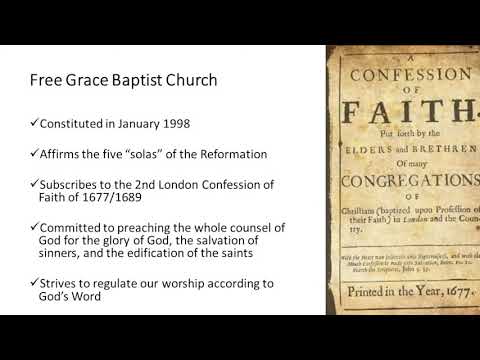
Introduction to the 1689 Second London Baptist Confession of Faith
Why should a church bind itself to a confession of faith? This introductory lesson on the Second London Baptist Confession of 1677/1689 grounds the answer exegetically in Ephesians 4 — where Christ gives gifted men to the church so that the body attains doctrinal unity and is no longer tossed about by every wind of teaching — and then traces the historical origins of the 1689 among the Particular Baptists, distinguishing them from Anabaptists, Presbyterians, and Congregationalists. Four functions of a confession are developed: defining, defending, discriminating, and disciplining with reference to the doctrine of the church. The lesson closes by distinguishing Reformed theology (Calvinism plus covenant theology plus the regulative principle) from mere five-point Calvinism, and by defending the confession's silence on matters of Christian liberty as a feature, not a defect.

Genesis 35
Genesis 35 traces Jacob's return to Bethel, the deaths of Rachel and Isaac, the treachery of Reuben, and the enumeration of Jacob's twelve sons. The chapter centers on God's sovereign renewal of His covenant with Jacob — reiterating the promises of seed and land given to Abraham and Isaac — at precisely the moment Jacob is most fearful and morally compromised. The sermon argues that God's repetition of covenant promises is not for His own memory but for the stabilization of His people's faith, and that the means of grace — Scripture, prayer, corporate worship, and the Lord's Supper — function as God's appointed conduits for fortifying His people to persevere through affliction, loss, and moral failure.

The Warning Against Apostasy
Hebrews 10:26–31 is one of the most pastorally misread warning passages in the New Testament, and this expository sermon works carefully to distinguish the sin of apostasy from the ordinary, ongoing sin of weak believers. The apostate is not a struggling saint who confesses and seeks mercy; he is one who, having made an outward profession of faith, openly and obstinately repudiates Christ — trampling the Son of God underfoot, counting the blood of the covenant a common thing, and insulting the Spirit of grace. The sermon draws on Owen, Calvin, Gill, and Ursinus to establish that apostasy is a total, willful renunciation of the gospel, not any species of sin for which Christ has made atonement. Believers burdened by remaining corruption are urged to distinguish themselves from apostates by the very instinct that drives them to the throne of grace — and to make full use of the means of grace God has appointed to preserve them from the apostasy the passage warns against.

The Joy of Keeping God's Law
Proverbs 29:18 sets before us two contrasting conditions: the lawlessness that follows the absence of God's revealed word, and the happiness that accompanies obedience to that word. This sermon works through the classic Reformed threefold use of the law — civil/political, pedagogical, and normative — applying the first two uses to the unbeliever and the third to the justified believer. The practical conclusion is that keeping God's law is simultaneously a consequence of justifying faith, a means of promoting assurance of salvation, and an expression of gratitude to God for sovereign grace.
The Glory of the Father and the Son
John 17:1–5 opens Christ's high priestly prayer with a petition that the Father glorify the Son so that the Son may glorify the Father — a reciprocal glorification whose goal is the glory of God Most High. The sermon works through three grounds for this petition: the salvation of the elect given to the Son in the covenant of redemption, the accomplishment of Christ's active and passive obedience as the basis of justification, and the restoration of the Son's pre-incarnate glory. The full deity of Christ is defended against subordinationist readings by surveying New Testament texts where the title theos is applied directly to Jesus, and the sermon closes with the call to pursue the knowledge of God and Christ as the very essence of eternal life — through Scripture reading, prayer, and faithful attendance upon the means of grace.

Genesis 2:15-17
Genesis 2:15–17 presents Adam not merely as a gardener but as a priest-guardian of a garden-temple, placed under a divine probation that Reformed theology identifies as the Covenant of Works. The study defends the presence of a genuine covenant in this passage despite the absence of the word 'covenant,' marshalling the elements of covenant structure, the covenantal name Yahweh Elohim, and later biblical commentary in Hosea 6:7, Isaiah 24, and Romans 5. The argument presses to a pointed soteriological conclusion: a deficient understanding of the Covenant of Works predictably produces a deficient understanding of the Covenant of Grace, opening the door to the error of faith plus works in justification. The remedy is to see the Covenant of Grace as the Covenant of Works kept for sinners by the Lord Jesus Christ, whose active and passive obedience is imputed to all who believe.

The Doubter Turned Confessor
Thomas's refusal to believe the disciples' eyewitness testimony of the risen Christ is one of the most emphatic denials of the resurrection in the New Testament — not mere doubt, but obstinate, threefold rejection of Scripture, Christ's own words, and apostolic witness. When Jesus appears and meets Thomas's exact conditions, Thomas confesses 'My Lord and my God,' bookending John's Gospel with the same declaration of Christ's deity found in its opening verse. The sermon expounds John 20:24–31 in two movements: the post-resurrection appearance to Thomas and the stated purpose of John's Gospel — that all who read it might believe and have life in Christ's name. Hearers are urged to stop placing conditions on God, to confess with Thomas that Jesus is Lord and God, and to avail themselves of the church's theological resources to grow beyond a superficial grasp of cardinal doctrines such as the Trinity.

Free Grace Baptist Church - October 8, 2017 PM
What happens when a believer sins against a holy God? Expounding 1 John 2:1–2 within the broader context of 1 John 1:5–10, this sermon answers that question under two headings: Christ as advocate and Christ as propitiation. The advocate language draws on the high-priestly intercession of Christ at the Father's right hand — distinct from, yet complementary to, the Spirit's advocacy on earth — while the doctrine of propitiation is traced through the Old Testament sacrificial vocabulary of kippur to show that Christ both turns away divine wrath and removes guilt. The sermon closes with a direct call to unbelievers to flee to Christ, the only one under whose blood the wrath of God is turned away and peace with God secured.
2LCF Chapter 16 - Of Good Works
1689 London Baptist Confession chapter 16, 'Of Good Works,' teaches that good works are defined exclusively by God's revealed word, flow necessarily from justification and sanctification, and are enabled entirely by Christ as the believer's vine. The chapter distinguishes scriptural good works — requiring the right matter, root, manner, and end — from both the meritorious works Rome supposes possible and the common-grace works of the unregenerate, which, lacking a heart purified by faith and the goal of God's glory, cannot please God. Believers are exhorted to pursue good works not as the ground of their acceptance before God, but as the fruit of a living faith, performed in Christ's strength and received by God through Christ despite their imperfection.
Of Sanctification (2LCF 13)
What does it mean to be sanctified, and how does that work itself out in the Christian life? Working from 2LCF Chapter 13 and Ephesians 4:17–24 as a core text, this teaching distinguishes definitive sanctification — the once-for-all, irreversible breach with the dominion of sin that occurs at union with Christ — from the progressive sanctification that follows as the Spirit applies Christ's death and resurrection to the believer's daily conflict with the flesh, the world, and the devil. The confession's three paragraphs frame the exposition: the inception and source of sanctification in Christ's virtue, the imperfect yet real struggle with indwelling sin, and the certain progress of grace toward evangelical obedience. Believers are called to reckon themselves dead to sin, take up the means of grace daily, and press on toward holiness as those who are already God's special possession.
Of Christ the Mediator 2 (2LCF 8)
The person and work of Christ as Mediator, as confessed in chapter 8 of the 1689 London Baptist Confession of Faith, is the most central locus in all of Christian theology — to be wrong here is damnable. This session surveys paragraphs 3 through 10 of that chapter, tracing Christ's anointing and suitability for office, the active and passive obedience by which He fully satisfied divine justice, the retrospective application of His redemption to the elect of all ages under the old covenant, the communication of idioms in His two natures, and the effectual application of salvation to His people by His Spirit and Word. The threefold office of prophet, priest, and king supplies precisely what the elect need in their ignorance, alienation, and inability — and no other mediator may share or transfer any part of that office.
Of Christ the Mediator 1 (2LCF 8)
The person and work of Christ as mediator stands at the center of Christian theology, as this study of 2nd London Baptist Confession chapter 8 makes clear. Working through all ten paragraphs of the chapter in overview, the session traces the pre-temporal appointment of Christ as mediator in the covenant of redemption, the historical stages of his mediatorial work, and the necessity of his threefold office as prophet, priest, and king. Particular attention falls on paragraph 2's account of the incarnation — the eternal Son taking true human nature with all its essential properties yet without sin — and paragraph 7's careful rule for reading Scripture passages that attribute what belongs to one nature to the other, guarding against both a divinized humanity (Lutheran ubiquitarianism) and a humanized deity. Hearers are called to hold fast the church's historic confession of Christ as one person in two natures, whole, perfect, and distinct, without conversion, composition, or confusion.
Of Covenant (2LCF 7)
2 London Baptist Confession of Faith Chapter 7 traces the whole architecture of Scripture through the lens of covenant theology, demonstrating that God's dealings with humanity are covenantal from creation to consummation. The chapter distinguishes three interlocking covenants — the covenant of works, the covenant of redemption, and the covenant of grace — and shows how each is necessary for a right understanding of the others. Particular attention is given to the progressive revelation of the covenant of grace from Genesis 3:15 through the historical covenants (Noahic, Abrahamic, Mosaic, Davidic) to its full discovery in the new covenant inaugurated by Christ. The practical stakes are high: a faulty grasp of the covenant of works will inevitably distort one's understanding of Christ's mediatorial obedience, justification by faith alone, and the covenant of grace itself.
Of the Holy Scriptures (2LCF 1.5-10)
The 1689 London Baptist Confession of Faith, paragraphs 5–10, sets out a comprehensive doctrine of Holy Scripture, and this study draws out the hermeneutical principles embedded in each paragraph. The scope of Scripture is theocentric and Christocentric — all of it tends toward the glory of God through the mission of Christ — and every other interpretive concern flows from that governing conviction. The sufficiency of Scripture encompasses both explicit texts and implicit doctrine derived by good and necessary consequence, while the perspicuity of Scripture assures even the unlearned that the things necessary for salvation are clearly propounded. The analogy of Scripture and the analogy of faith together form the infallible rule by which obscure passages are interpreted through clearer ones and through the theological sense of the whole.

The Ascension of Christ
The bodily, visible, local ascension of Christ into heaven forty days after his resurrection is not a peripheral doctrine but the hinge on which the entire exaltation of the Mediator turns. This sermon expounds Acts 1:9–11 in three movements: the historical reality of the ascension (real, visible, bodily, local, and glorious), its theological significance (fulfillment of Scripture, completion of Christ's priestly work, his enthronement at the Father's right hand, and the glory given to him as Mediator), and its practical benefits for the church (the gift of the Holy Spirit, the perpetual intercession of Christ, and the guaranteed second coming). Believers are called to draw courage from Christ's present reign, flee to the cross before the judgment that the ascension makes inevitable, and rest in the advocacy of the enthroned Savior who always lives to make intercession.
The Incarnation and True Humanity of Christ
Philippians 2:5–11 anchors a study of the incarnation and true humanity of the Lord Jesus Christ. Drawing on the Nicene, Constantinopolitan, Chalcedonian, and Athanasian creeds together with the 1689 London Baptist Confession of Faith, the study traces three aspects of the incarnation — assumption of human nature, the virgin birth, and the union of two natures in one person — before marshalling seven biblical proofs of Christ's full humanity. The central argument throughout is soteriological: the Son of God must be truly and perfectly man, body and soul, yet without sin, because only such a mediator can make propitiation for guilty sinners and be their faithful high priest.
The Deity of Christ
Who is Jesus Christ, and what does Scripture mean when it confesses that He is God? This Bible study on John 1:14–18 opens a series on Christology by examining the deity of Christ from three angles: its precise meaning, the breadth of its biblical testimony, and the doctrinal affirmations necessary for confessing it rightly. The study moves from definitional clarity—ruling out Arian, adoptionist, and Mormon distortions—through exegetical survey of Christ's self-identification, apostolic statements, Old Testament Yahweh texts applied to Christ, and divine attributes predicated of Him, before concluding with four essential affirmations: His essential identity with the Father, His personal eternal distinction as the eternally begotten Son, His unchanging post-incarnation deity, and the specific role His divine nature plays in assuming, personalizing, and sustaining His human nature.

The Covenantal Context of the Incarnation
The Incarnation of the Son of God was not an afterthought but the execution of an eternal, intra-Trinitarian covenant — the covenant of redemption — in which the Father gave the Son a definite number of elect people, and the Son willingly undertook to be their covenant surety and mediator. Drawing on Hebrews 10:5–10, John's Gospel, Isaiah 53, Romans 5, and Ephesians 1, this study presents three lines of biblical evidence: the relationship between the Father and the Son, the covenantal language applied to that relationship, and the pre-temporal foundation of the Son's redemptive work. The practical force is doxological and pastoral: believers are eternally secure because their salvation rests not on their own resolve but on a covenant sworn before creation, in which Christ bore a covenant of works on their behalf, obeying perfectly so that his righteousness might be imputed to them by faith alone.

The Redeemer of God's Elect
Galatians 4:4–7 presents the person and work of the Redeemer in covenantal context: Christ's pre-existent eternal Sonship, incarnation, and role as mediator under the law provide the basis for redemption, adoption, and the indwelling of the Spirit. The sermon traces the obsolescence of the Mosaic covenant as designed and purposed by God, giving way to the full privileges of sons in the new covenant. The triune God is shown to be the sole initiator and executor of salvation — the Father sending the Son, the Son accomplishing redemption, and the Spirit sealing the adopted heirs. The sermon closes with a call to robust Trinitarian theology as inseparable from knowing and worshipping the God who saves.
2LCF Chapter 16 - Of Good Works, Part 2
The second half of a two-part study on 1689 London Baptist Confession chapter 16 (Of Good Works) examines paragraphs four through seven, working through the doctrines of supererogation, the nature of merit, the acceptance of believers' works before God, and the status of works performed by the unregenerate. Supererogation — the Roman Catholic teaching that the saints perform meritorious works beyond what God requires, which the church then dispenses as indulgences — is refuted from Romans 3 as incompatible with the universal sinfulness of mankind and the nature of divine law. The study then distinguishes between condign merit (which belongs to Christ alone) and any informal divine reward, while grounding the acceptance of believers' imperfect works solely in their union with Christ and God's free grace. The works of unregenerate men, however outwardly decent, are shown to be spiritually dead, incapable of pleasing God, though greater external wickedness remains more displeasing to him than lesser.