
Cited in sermons
Leon Morris
8 sermons · All people cited

The Gospel Foundation for Corporate Prayer

The apostle Paul grounds the church's corporate prayer in a three-part theological rationale drawn from 1 Timothy 2:3–7: the nature of God, the office of Christ, and the ministry of Paul. The phrase 'all men' in verses 1–4 refers not to every individual without exception but to all kinds of men without distinction — Jew and Gentile, slave and king — a reading demanded by Paul's own doctrine of reprobation in Romans 9 and confirmed by the scope of his apostolic commission to the Gentiles. Christ's mediatorship is shown to require both a divine and a human nature, and his ransom is definite in its design — paid for all kinds of men, not all men without exception — precluding both universalism and any notion of unmet desires in God. The sermon closes by pressing the congregation to show up for corporate prayer, to pray specifically for the salvation of those in civil authority, and to exhort all around them to flee to Christ.
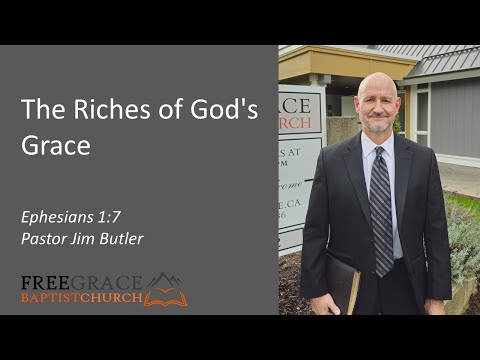
The Riches of God's Grace
Ephesians 1:7 declares that believers possess redemption through Christ's blood and the forgiveness of sins according to the riches of God's grace. This sermon works through the triune shape of salvation in Ephesians 1:3–14, arguing that the redeemed are not a class of morally capable people who needed modest assistance, but guilty sinners who required blood atonement, divine election, and the sealing of the Holy Spirit. The cross is shown to satisfy divine justice as well as display divine love — God is both just and the justifier of the one who has faith in Jesus, as Paul argues in Romans 3:21–26. The sermon closes with a direct application to baptism, presenting the ordinance as an outward declaration of the inward forgiveness and righteousness received through union with Christ.

The Redemptive Work of the Son, Part 1
Ephesians 1:6–7 sets forth the redemptive work of the Son within the triune economy of salvation, moving from the Father's electing purpose in eternity past to Christ's historic accomplishment of redemption in time. The sermon expounds two interlocking realities: the Father's sovereign initiative in bestowing grace upon the elect in the Beloved, and the Son's purchase of redemption through the shedding of his blood. Redemption is shown to be not a mere exercise of divine power but the payment of a ransom price, with the forgiveness of sins as its primary blessing — all flowing from the inexhaustible riches of God's grace. Hearers are called to respond with worship, gratitude, and increasing love for Christ, the Beloved of both the Father and the redeemed.

The Lukewarm Laodiceans
Revelation 3:14–22 confronts the church in Laodicea with a charge of spiritual lukewarmness — not outright apostasy, but ineffectual, self-satisfied religion that neither heals nor refreshes. Drawing on the city's historical wealth, its piped-in tepid water supply, and the covenantal language of Leviticus 18, this exposition argues that lukewarm Christianity is, in the end, no Christianity at all. Christ's threatened judgment is not arbitrary but covenantal, and his counsel to buy gold, white garments, and eye salve from him is an act of love that calls the church to honest self-assessment, renewed zeal, and genuine repentance.

The Mission of the Son of Man
Matthew 20:20–28 confronts the persistent problem of pride and the inverted logic of kingdom greatness. Against the backdrop of Christ's third passion prediction, the ambitious request of James and John exposes a desire common to all God's people: the crown without the cross. The sermon works through Christ's twofold instruction — rejecting the Gentile model of top-down authority and embracing servant-greatness — before landing on the theological heart of verse 28: the Son of Man gave his life as a ransom for many, a payment securing the definite salvation of his people and providing the interpretive key to the entire passion narrative of Matthew 21–27.
The Use of the Blood Money
Matthew 27:6–10 records the chief priests' disposal of the thirty pieces of silver used to betray Jesus — and Matthew's citation of this event as the fulfillment of prophecy attributed to Jeremiah. This sermon examines the rank hypocrisy of the religious leaders who scrupled over depositing blood money into the treasury while simultaneously orchestrating the judicial murder of an innocent man, exposing the self-condemning logic of ceremonial fastidiousness divorced from the weightier demands of the law. The sermon then defends the inerrancy of Matthew's composite citation of Zechariah 11 and Jeremiah 18–19, 32, showing how Matthew functions as a biblical theologian weaving together prophetic themes of rejection, judgment, exile, and restoration to demonstrate that the passion of Christ was the fulfillment of the entire prophetic witness. The application calls hearers to recognize their own guilt before a holy God and to flee to the imputed righteousness and atoning blood of the Lord Jesus Christ.
Christ and the Paralytic
The forgiveness of sins, not physical healing, is the central miracle of Matthew 9:1–8. Christ's pronouncement to the paralytic — 'Son, be of good cheer, your sins are forgiven you' — exposes sin as the problem worse than paralysis and declares the primary mission of Matthew's Gospel: Jesus saves His people from their sins. The scribes' charge of blasphemy is answered not refuted by argument but by the visible healing of the paralytic, which serves as public proof that the Son of Man possesses on earth the divine authority to forgive sins. The proper response to this authority is the response of the multitude: marvel and fear that together fuel genuine worship and praise.
Introduction to Galatians
Paul's letter to the Galatians stands as a polemic defence of justification by faith alone — a truth so foundational that its corruption, however subtle, constitutes the destruction of the gospel itself. This introductory exposition surveys the authorship, dating, and destination of the epistle, arguing for the South Galatian theory and an early date of AD 48–49, while tracing the theological threads that run through the letter: the integrity of the gospel, justification sola fide, the atoning work of Christ, and Paul's apostolic authority. The Judaizing error that provoked Paul's letter is shown to be perennially recurring — in Roman Catholic merit theology, in the New Perspective on Paul, in Federal Vision, and in the subtler forms of works-righteousness embedded in church culture. Hearers are called to rest their entire standing before God on the imputed righteousness of Christ received through faith alone, and to contend earnestly for that doctrine as Paul did.