
Cited in sermons
Lancelot Andrewes
4 sermons · All people cited

CTF 2025 - Session 8 – Q&A Panel

A Q&A panel from a theology conference on the doctrine of God addresses questions arising from the preceding lectures on classical theism. Three theologians field questions on divine impassibility (including whether God can be grieved), the eternal decree and the covenant of redemption, divine aseity and the Son's relationship to the Father, the nature of time in the eternal state, the role of philosophy and natural theology in arriving at the classical doctrine of God, and whether genuine evil exists within God's sovereign economy. The discussion throughout presses for formulations of doctrine that protect divine simplicity, immutability, and impassibility while preserving the integrity of biblical language and confessional categories.

The Gospel of Christ in the Valley of Elah
David's victory over Goliath in 1 Samuel 17 is not merely an episode in Israelite history but a Christological shadow pointing forward to the greater conquest of Christ over Satan at Golgotha. This sermon works through twelve points of typological correspondence between David and Christ — from Bethlehem's birthplace, to the shepherd-king, to vicarious representation, to the skull motif of Genesis 3:15 — demonstrating that the whole of Scripture is organically unified around the person and work of the Lord Jesus Christ. The exposition serves as a Lord's Supper meditation, calling believers to rejoice in their conquering substitute and urging the unconverted to flee to the champion who uses death itself to destroy death.
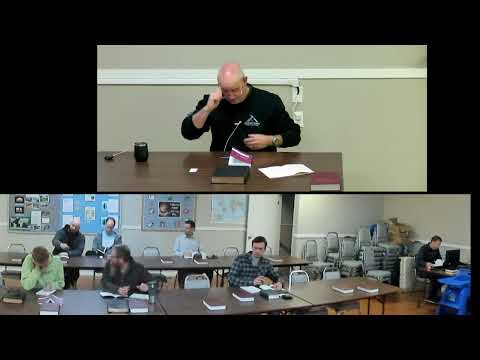
May 18 Sanders Holy Spirit and the Father
How does the Holy Spirit relate to God the Father, and what does that relationship mean for Christian worship and prayer? Working through a chapter on the Holy Spirit and the Father, this study traces the biblical pattern of 'from the Father, through the Son, in the Spirit' — and its liturgical reverse, 'in the Spirit, through the Son, to the Father' — as the framework for understanding both Trinitarian processions and the nature of true worship. The discussion addresses the Spirit's work in the old and new covenants, the cessation of the revelatory gifts at the completion of the New Testament canon, and the Spirit's role in empowering prayer, drawing particularly on John Owen's treatment of Ephesians 2:18 and Romans 8:26-27.

The Champion of the Howling Wilderness
Matthew 4:1–11 presents the temptation of Christ not primarily as a model for personal resistance to sin, but as the decisive act of single combat in which the Lord Jesus Christ, as the second Adam and the true Israel, vicariously perfects obedience for his elect people. Where Adam fell in the garden amid every provision and where Israel failed in the wilderness under divine care, the Son of God enters a howling wilderness—hungry, alone, and unarmed—and vanquishes the devil point for point through resolute dependence on the word of God. The rich typological connections to Adam's expulsion, Israel's forty years of wandering, Moses' fast on Sinai, and David's unarmed single combat against Goliath converge on the one claim the passage presses: Christ alone is the covenantally faithful champion, and salvation belongs exclusively to those who trust in his doing, dying, and rising. Christians are therefore called to rejoice in their champion rather than to reduce this episode to a moral technique for fighting temptation.