
Cited in sermons
John Piper
34 sermons · All people cited
Ask FGBC 67: Are Piper and MacArthur Reformed Baptists?

What separates a confessional Reformed Baptist church from a Calvinistic Baptist church associated with figures like John Piper or John MacArthur? This conversation argues that Calvinism, properly understood, is not reducible to the five points of Dort but entails a whole confessional heritage — covenant theology (including the covenant of works), cessationism, the regulative principle of worship, and adherence to one of the great Protestant confessions. The Second London Baptist Confession of 1689 is presented as the most mature expression of that heritage, providing a theological anchor that protects congregations from pastoral personality-driven ministry and binds them to the cumulative wisdom Christ has given his church through the ages.
The Use of the 2nd London Confession
A confession of faith is not a human addition to Scripture but a tool the church uses to define, defend, discriminate, discipline, and delimit its doctrine. Drawing on passages from the Pastoral Epistles, Jude, and Ephesians 4, this Sunday School address argues that the Second London Baptist Confession of 1689 serves the local church in six concrete ways: it establishes doctrinal boundaries, equips members for apologetics, vets candidates for ministry, grounds church discipline, protects Christian liberty by identifying what lies outside its purview, and anchors the church in the catholicity of the Reformed tradition. The session closes with a call to reject autonomous biblicism in favour of confessional theology understood as the fruit of the Spirit's ongoing work in the teaching ministry of Christ's church.

The Promise of Blessings and Curses (Part 1)
Leviticus 26:1–13 opens with a promise of blessing conditioned on Israel's obedience — a structure that raises the question of how the Old Covenant relates to the New. This study expounds the covenantal framework underlying Leviticus 26, arguing that the Old Covenant operated as a covenant of works at the national level, distinct from the covenant of grace realized in Christ. The blessings of rain, peace, and God's presence promised to Israel find their fulfillment in the New Covenant, where the obedience that secures blessing is Christ's own, imputed to his people by faith alone.

Restrictions on Levitical Priesthood
Leviticus 21–22 sets out restrictions governing the Levitical priesthood: whom priests may mourn, whom they may marry, what physical conditions disqualify them from service, who may eat from their food, and what animals are acceptable for sacrifice. The underlying logic in every category is the same — the holy God who dwells among his people demands a priesthood, a sacrifice, and a manner of worship that reflect his holiness and are not corrupted by defilement or defect. These chapters point typologically beyond themselves to the Lord Jesus Christ, who alone fulfils what the Levitical order only approximated: the perfect high priest who is holy, harmless, and undefiled, and the perfect sacrifice offered once for all. The superiority of the new covenant is seen precisely here — the exclusions of the old order (eunuchs, the maimed, the lame) give way to the great invitation of Christ to the broken and outcast to come to the wedding feast.

2LCF Chapter 14 - Of Saving Faith

Saving faith is the gracious gift of the Holy Spirit, worked in the hearts of the elect through the ministry of the Word, enabling them to trust in Christ alone for justification, sanctification, and eternal life. This study of 1689 London Baptist Confession chapter 14 distinguishes true saving faith from temporary or false faith, establishes that faith is built on knowledge rather than religious emotion or experience, and traces the three classical elements of faith — notitia, assensus, and fiducia — while guarding against both the mysticism that smuggles emotion into the essence of faith and the rationalism that mistakes bare intellectual assent for it. The practical burden throughout is that the proper object of saving faith is Christ and his work alone, and that assurance, while distinct from faith itself, grows through the appointed means of grace.

The Seventh Commandment
The seventh commandment, 'You shall not commit adultery' (Deuteronomy 5:18), governs not merely the act of adultery but the full range of sexual conduct God defines in Scripture. Preached against the backdrop of Canada's Bill C-4, this sermon grounds sexual ethics in the creation order of Genesis 2, expounds twelve prohibited acts — from adultery and fornication through homosexuality, transgenderism, and pornography — and confronts the state's attempt to criminalise biblical teaching on sexuality. The law is preached so that sinners will see their need for Christ, whose blood alone washes, sanctifies, and justifies those who come to Him in faith.

The Meeting with the Samaritan Woman, Part 2
John 4:16–26 presents Jesus exposing a Samaritan woman's sin through the law in order to drive her to the living water of eternal life, then correcting the corrupted worship of Samaria and declaring the arrival of new covenant worship. The sermon argues that true worship of God is irreducibly Trinitarian: the Father is the object, the Son is the mediator and the truth through whom access is granted, and the Holy Spirit is the enabling power. Jesus' self-disclosure as the great I Am — the fulfillment of Exodus 3:14 and the prophetic expectation of Deuteronomy 18 — confirms that the Messiah the woman anticipated is the very one speaking to her. Hearers are called to receive the living water freely offered and to engage in the distinctly Trinitarian worship that Christ here commands.
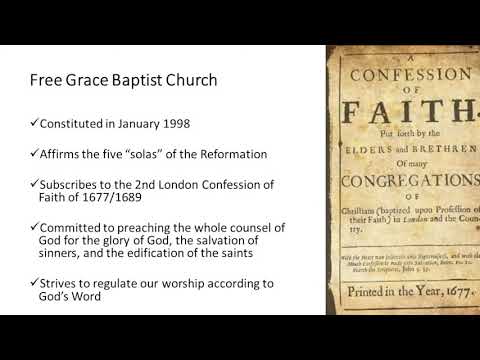
Introduction to the 1689 Second London Baptist Confession of Faith
Why should a church bind itself to a confession of faith? This introductory lesson on the Second London Baptist Confession of 1677/1689 grounds the answer exegetically in Ephesians 4 — where Christ gives gifted men to the church so that the body attains doctrinal unity and is no longer tossed about by every wind of teaching — and then traces the historical origins of the 1689 among the Particular Baptists, distinguishing them from Anabaptists, Presbyterians, and Congregationalists. Four functions of a confession are developed: defining, defending, discriminating, and disciplining with reference to the doctrine of the church. The lesson closes by distinguishing Reformed theology (Calvinism plus covenant theology plus the regulative principle) from mere five-point Calvinism, and by defending the confession's silence on matters of Christian liberty as a feature, not a defect.

All Of Christ For Justification
Philippians 3:1–9 presents the apostle Paul's radical revaluation of every religious credential he possessed, moving them all from the gain column to the loss column so that Christ alone might occupy the place of righteousness before God. This sermon expounds what it means to have no confidence in the flesh: that justification rests on Christ's perfect active obedience imputed to the believer, not on any combination of works, faith, and sincere effort. The loss column of sin is dealt with equally fully — Christ bearing the certificate of debt and nailing it to the cross, cancelling the debt in its entirety. Hearers are called to count all self-generated merit as rubbish and to rest, passively and completely, in Christ's righteousness received through faith alone.

The Justice of God and the Gospel
Proverbs 17:15 declares that justifying the wicked and condemning the just are alike an abomination to God — yet the gospel does precisely both: God condemned the sinless Christ and justifies ungodly sinners. This sermon works through the theological architecture that vindicates God from any charge of self-contradiction in the gospel, tracing the doctrines of covenant representation and imputation from Genesis through the Prophets and into Paul's argument in Romans 3–5. The three acts of imputation — Adam's sin to all mankind, the elect's sin to Christ, and Christ's righteousness to the elect — are shown to be the biblical answer to the problem Proverbs 17:15 raises, grounding assurance in an alien righteousness received by faith alone.
Psalm 33
Psalm 33 calls the people of God to praise the Lord for His sovereignty in creation and in history, grounding that praise in the character of a covenant-keeping God whose word is unfailingly right and whose purposes stand forever. The sermon moves through the psalm's three movements: the call to skillful, joyful worship; the manifold reasons for praise drawn from God's power over creation, His overruling of human counsel, and His providential care over His elect; and the psalmist's concluding resolution to wait on God alone as help and shield. Listeners are pressed to ask whether their worship reflects genuine delight in the sovereign God of Psalm 33 and whether their trust rests in Him rather than in any human means or strength.

The Inclusion of Wretches in God's Covenant
Ephesians 2:1–10 presents the full arc of redemption — from the total deadness of sinners to their gracious vivification in Christ — and this exposition traces that arc through the origin, objects, and execution of salvation. The sermon grounds the covenant of grace in the prior covenant of redemption (Ephesians 1:3–14), showing that the Father's election, the Son's redemption, and the Spirit's sealing together exclude every contribution of the sinner. Salvation is by grace alone through faith alone, with faith itself a gift conveyed by God to the spiritually dead — not a human instrument brought to the table that God then rewards. The exposition closes by distinguishing justification from sanctification and warning against both Roman Catholic and Federal Vision distortions of grace, anchoring the believer's final acceptance before God solely in the active and passive obedience of Christ.

2LCF Chapter 25 - Of Marriage
The 1689 London Baptist Confession chapter 25 sets forth a comprehensive theology of marriage as a monogamous, creational institution between one man and one woman, ordained for companionship, procreation, and the prevention of sexual immorality. This study walks through each paragraph of the chapter, examining the biblical case against polygamy, homosexuality, bestiality, and unequal yoking, while grounding each prohibition in specific Old and New Testament texts. The two paragraphs on divorce and remarriage that the Westminster Confession adds but the 1689 omits receive extended treatment, with the conclusion that Scripture's exception clauses permit dissolution of the marriage bond in cases of adultery and desertion, without penalising the innocent party. Hearers are exhorted to treasure their spouses, pursue marriage only in the Lord, and rear their children in the fear of God.
The Olivet Discourse, Part 12
Matthew 24:45–51 closes the first section of practical application in the Olivet Discourse with a parable of two servants: one faithful, one wicked. The parable's central question — 'Who then is a faithful and wise servant?' — is designed to arrest the conscience and promote eschatological self-examination. Watchfulness for Christ's return is not idle sky-gazing but active fidelity in one's God-appointed vocation, whether pastoral ministry or ordinary daily labor. The wicked servant's ruin flows directly from his denial of the master's return, a pattern the sermon presses against both unbelievers and professing Christians living as practical atheists.
The Whole Armor of God
Ephesians 6:10–18 calls believers to put on the whole armor of God — not for ceremonial display but for genuine hand-to-hand combat against principalities, powers, and the spiritual hosts of wickedness. The armor is not native to the believer but is provided entirely through union with Christ: truth, imputed righteousness, the gospel of peace, faith, and salvation constitute the defensive elements, while the Word of God is the offensive sword. The sermon argues that the Christian life is a lifelong fight requiring daily, persevering diligence — not passive rest — and closes by urging both believers and unbelievers to recognize that lasting victory over sin is possible only through the blood of atonement and the grace of the triune God.
The Instruction on Divorce, Part 1
Matthew 19:7–9 presents a Pharisaic challenge to Jesus on the Mosaic permission for divorce, and this sermon works through that challenge under two heads: the Pharisees' objection and Christ's response. The exposition moves through Deuteronomy 24:1–4, demonstrating that its protasis (verses 1–3) assumes the legitimacy of divorce and remarriage, while its apodosis (verse 4) prohibits only return to a first husband — not remarriage as such. Drawing on Leviticus 21, Ezra, Jeremiah 3, and the Westminster Confession 24.5, the sermon argues that porneia (sexual immorality broadly construed) constitutes a lawful ground for divorce and remarriage, and that to forbid what God's law permits is both antinomian and a burden God never intended to lay on innocent parties.
2LCF Chapter 11 - Of Justification, Part 2

The forensic doctrine of justification — God's one-time legal declaration that the sinner is righteous on the sole ground of Christ's imputed righteousness — faces persistent assault in every era. This session surveys three modern deviations: Arminian evangelicalism (which collapses faith into a meritorious work or relocates righteousness within the believer), the New Perspective on Paul (which reframes Paul's argument as a corrective for ethnic exclusivity rather than a remedy for the condemnation of sin), and the Federal Vision (which renders righteousness relational, conflates Christ's faithfulness with the believer's, and anticipates a future eschatological justification grounded in covenantal obedience). Against all three, Scripture and the confession insist that justification is a completed legal verdict, not a process, and that its ground is exclusively the active and passive obedience of Christ credited to the elect.

The Minister's Duty to Endure Hardship
Paul's command in 2 Timothy 2:3–7 that Timothy endure hardship is not a gentle suggestion but an apostolic imperative addressed to every minister of the gospel in every age. Working through three interlocking metaphors — the soldier, the athlete, and the farmer — this exposition shows that faithful gospel ministry requires the devoted single-mindedness of a soldier who lives to please his commander, the disciplined self-denial of an athlete training for an imperishable crown, and the diligent hard work of a farmer who knows that cause and effect govern his harvest. A fourth element, drawn from verse 7, calls the minister to be a dedicated disciple who meditates on apostolic doctrine and trusts the Lord to give understanding through that Word alone. The whole passage is set within the larger purpose of the ministry: the glory of God, the edification of the saints, and the salvation of sinners by sovereign grace.
Gideon's Victory Over the Midianites
Judges 7 records God's reduction of Gideon's army from 32,000 to 300 men before routing the Midianites — not because Israel marshalled superior strength, but precisely so that no Israelite could claim the glory of victory. This sermon traces four movements in the narrative: the assembling of enemies and the Spirit's coming upon Gideon, the divinely-ordered troop reduction, God's patient encouragement of a fearful Gideon through a pagan soldier's dream, and the midnight rout of Midian. The controlling thesis is that God perfects His strength through human weakness so that glory belongs to Him alone, a principle the sermon applies to the church's ongoing mission and to the gospel call addressed directly to unbelievers in the congregation.
Malachi 1
Malachi 1:6–14 indicts Israel's priests and people for offering blind, lame, and stolen animals at the altar — worship that was external in form but contemptuous in heart. This study works through three features of the passage: God's complaint against those who despise his name, the people's defensive response, and five observations about the nature of careless worship. The central application is that careless, heartless, or self-serving worship — whether in ancient Israel or the contemporary church — is not merely negligence but a form of evil that provokes the wrath of God, and that the blood-bought people of God ought to find the corporate worship of the Sabbath a delight, not a burden.
Words to Live By

Four terse imperatives close Paul's first letter to Corinth — 'be watchful, stand firm in the faith, act like men, be strong' — and each one names an indispensable quality of the Christian life. This sermon works through 1 Corinthians 16:13-14 by unpacking vigilance, faithfulness, courage, and strength as the four great principles believers must pursue, set against the twin dangers of a deceitful heart and a culture bent on denying God's reality and authority. The exposition concludes with 1 Corinthians 13, showing that all four watchwords must be permeated by love, lest strength become harshness and courage become aggression.
Prayer for Gospel Missions
Psalm 67 is a prayer for gospel missions structured around six petitions — three for the church and three for the world — and a two-fold promise of temporal and spiritual blessing. The church's mission to the nations flows necessarily from her own reception of divine mercy, blessing, and the manifest presence of God; a church that has not received these cannot rightly propagate them. The sermon argues that worship is the ultimate end of missions and evangelism, which are themselves the means by which God populates eternity with worshippers from every nation. Believers are exhorted to pray with this psalm regularly, interceding for the missionary enterprise and for the extension of Christ's kingdom to the uttermost parts of the earth.
The Followers of the Lamb
Revelation 14:1–13 places the 144,000 followers of the Lamb in direct contrast to the beast-worshippers of Revelation 13, offering the persecuted church a vision of what God's redeemed people look like and where they are headed. Ten indicative characteristics are drawn from the text — from bearing God's seal of ownership to speaking truth, keeping the commandments, holding the faith of Jesus, and resting in death — not as commands to perform but as descriptions of those redeemed by the blood of the Lamb. The sermon insists that these marks flow from grace alone through redemption alone, and calls every hearer to hold the faith of Jesus with grip and resolve, especially when liberty is enjoyed, so that it will not be surrendered when trials arrive.
Our Present Suffering vs. Our Future Glory
Romans 8:18 presents the Apostle Paul's carefully weighed reckoning of present Christian suffering set against the future glory promised to the children of God. This sermon expounds three dimensions of that verse: the nature of suffering in this present age, the content of the coming glory — reigning with Christ, being conformed to His image, and beholding Him face to face — and the accounting exercise by which Paul concludes that present afflictions are not worthy to be compared with what awaits the redeemed. Believers are exhorted to lift their eyes from present groaning to the certain inheritance secured in Christ, while the unconverted are warned that refusing Christ forfeits not only that glory but ensures a far worse eternal reckoning.
Blessed are the Merciful
Matthew 5:7 — 'Blessed are the merciful, for they shall obtain mercy' — is expounded as an indicative declaration about the character of kingdom citizens, not an imperative condition for earning divine favor. Mercy is defined as pity joined to active relief: grace addresses men in their sin, mercy addresses men in the misery that results from sin. The sermon traces mercy through its description, its illustration in the character of God and the ministry of Christ, its supernatural source in regenerating grace, its attractiveness in family, church, and world, and its eschatological promise. Those who have genuinely received Christ's mercy will manifest mercy toward others; the persistent absence of mercy is evidence that one has never truly known the grace of God.
The Missionary Enterprise
Psalm 67 is a missionary psalm that moves from petitions for the church to petitions for the world, grounding the entire missionary enterprise in the mercy, blessing, and presence of God. The psalmist prays first that God's people would know his mercy and communion so that they might then be a vehicle for publishing his salvation to the nations. Worship — not missions itself — is the ultimate end of gospel proclamation, for missions is a temporary necessity that ceases when the redeemed fall before the throne. The sermon calls the church to lift its eyes to the grand promises of Scripture, to pray earnestly for the nations, and to go forth in the authority and presence of the risen Christ.
The Arrival of the Messianic Kingdom
Matthew 4:18–25 records the arrival of the Messianic Kingdom through two decisive acts: Christ's sovereign call of four Galilean fishermen to discipleship, and his healing of multitudes throughout Syria, Galilee, and beyond the Jordan. The passage resists the expectation that kingdom advancement demands spectacular instruments — four local fishermen casting nets are the nucleus of a world-overturning apostolic ministry. The theological weight of Christ's healing ministry is not mere spectacle but the attestation of kingdom power; teaching, preaching, and healing together define the Messiah's work. Hearers are pressed to respond to the gospel call with the same immediacy as Peter, Andrew, James, and John, and to pursue faithful, determined, and patient witness in whatever station God has appointed.
The Beauty of Christ
Psalm 45 is a royal love song that the New Testament, in Hebrews 1:8, applies directly to the Lord Jesus Christ as the eternal God-man. The sermon works through four observations: the beauty of the Savior as stated by the psalmist, the beauty of his person as both fully human and fully divine, the beauty of his attributes or perfections, and the beauty of his works in advancing his kingdom. The closing application presses both believer and unbeliever: the same arrows of Christ's word that subdue sinners to saving faith will, for the impenitent, become the instrument of final judgment — the only question is whether one falls under him now in submission or later in condemnation.
The Altar We Have
Hebrews 13:7–17 brings the book's sustained exposition of Christ's priestly office to bear on the concrete obligations of the Christian life. Working through five exhortations, the sermon addresses the remembrance of faithful leaders, the immutability of Christ as the ground of doctrinal stability, the exclusive sufficiency of Christ's sacrifice over against all ritual systems, and the sacrifices that flow from the gospel: praise, good works, and submission to church leadership. The controlling argument is that because Christ suffered outside the gate to sanctify his people with his own blood, believers are called to leave behind every competing religious system, bear reproach, maintain a future orientation, and live as a praising and generous people.
The Identity of the Church
What is the church, and what is she for? Expounding 1 Timothy 3:14–16, this sermon sets out the identity and confession of the church under three descriptions Paul gives: the house of God, the church of the living God, and the pillar and ground of the truth. The church's unique institutional privilege — distinct from family and state — is to proclaim, defend, and propagate the gospel of Christ crucified and risen. The sermon closes with a call to resist pragmatism, hold fast to sound doctrine, and enter the house of God through Christ alone.