
Cited in sermons
John Owen
325 sermons · All people cited
2LCF - Introduction to the 1689 London Confession of Faith

The 1689 London Baptist Confession of Faith (properly the 1677 Confession) did not arise in a vacuum: it was a deliberate act of theological stewardship by particular Baptists who stood inside the Reformed Protestant consensus, followed the Westminster Assembly and the Savoy Declaration in structure and wording, and published their confession to correct heterodoxy, serve a new generation, and demonstrate solidarity with fellow persecuted Protestants. This introductory session reads the original epistolary preface to the confession in full and then surveys its argument under five headings — continuity, catholicity, candor, confirmation, and conversation — showing how the confessors understood creeds and confessions as the church's Berean effort to articulate what the Bible says, not to add to it. The session closes with a call to receive the confession in the same spirit in which it was written: not contention, but a whole-souled, humble, and Spirit-dependent owning of the faith once for all delivered to the saints.

The Qualifications for Elders, Part 3

What qualifies a man to oversee the household of God? Expositing 1 Timothy 3:4–7, this sermon works through three remaining qualifications for elders: domestic faithfulness (vv. 4–5), maturity in the faith (v. 6), and a good testimony among unbelievers (v. 7). The lesser-to-greater argument of verse 5 — that a man who cannot govern his own home has no business governing the church of God — anchors the domestic section, while the warning against novice elders grounds the call to spiritual maturity in the sobering parallel of the devil's own fall through pride. The sermon closes by insisting that imperfect ministers are not a failure of God's plan but its instrument, so that all excellence of power is seen to be of God and not of men.
2LCF Chapter 29 - Of Baptism
The 1689 London Baptist Confession chapter 29 sets forth a thoroughgoing Baptist doctrine of baptism: its nature as a New Covenant ordinance ordained by the incarnate mediator, its proper recipients as professing believers alone, its proper element and Trinitarian formula, and its proper mode as immersion. The study presses the case for believers-only baptism across five arguments — from covenant theology, federal headship, the doctrine of salvation, New Testament clarity, and the regulative principle of worship — demonstrating that paedo-baptism is not merely a secondary matter but a violation of Christ's express institution. The session closes with extended Q&A engaging questions about baptismal regeneration, the formula 'in the name of Jesus only,' and the standing of paedobaptist believers.
2LCF Chapter 26 - Of the Church
Chapter 26 of the 1689 London Baptist Confession of Faith ('Of the Church') teaches that Christ alone is the supreme and sovereign head of the church, from whom all authority for church governance flows. This session surveys five historical and contemporary models of church polity — Erastianism, Episcopalianism, Presbyterianism, Denominationalism, and Congregationalism/Independency — evaluating each against Scripture and the confession. The particular Baptist position is identified as plural elder-led associational congregationalism: each congregation of baptized believers governed by a plurality of elders under Christ alone, walking in voluntary associational communion with other churches for mutual edification, counsel, and support.

The Instructions of Calvary
Luke 23:32–43 presents, in twelve verses, a concentrated display of the doctrines that define the gospel: total depravity, effectual grace, justification by faith alone, the hypostatic union of Christ's two natures, assurance, and immediate conscious glory at death. The sermon traces seven theological loci arising from the conversion of the penitent thief, demonstrating that the entire redemptive narrative of Scripture converges at Calvary. The penitent thief is not an extreme case or a last-minute exception but a paradigm of every sinner who comes to Christ with nothing in hand and receives everything by sovereign, irresistible grace.

2LCF Chapter 25 - Of Marriage
The 1689 London Baptist Confession of Faith chapter 25 offers a concise yet comprehensive definition of marriage as a lifelong covenant between one man and one woman, established by God in creation for companionship, procreation, and the lawful expression of sexual relations. This study works through each paragraph of the confession's chapter on marriage, examining the monogamous nature of marriage, the major purposes for which it was ordained, and the lawful parties who may enter it. The session also draws on Westminster Confession chapters 24, paragraphs 5 and 6, together with Deuteronomy 24, Matthew 5 and 19, and 1 Corinthians 7, to argue that Scripture authorizes divorce on the grounds of porneia and desertion, and that a lawfully divorced innocent party is free to remarry. The Protestant 'permanence view' of marriage is examined and found to be both exegetically deficient and pastorally harmful to innocent parties whom God's own law was designed to protect.
2LCF Chapter 23 - Of Lawful Oaths and Vows
Lawful oaths and vows occupy a distinct place in Christian ethics, grounded in the third commandment's demand for reverence toward the divine name and the ninth commandment's prohibition of false witness. This confession-study exposition of 1689 LBCF Chapter 23 distinguishes oaths (horizontal promises between men, made before God as witness) from vows (vertical commitments made directly to God), explains why both the Quaker rejection and Catholic corruption of oaths are condemned, and works through five paragraphs covering definition, solemnity, carefulness, integrity, and the lawful use of vows. The governing application is that the integrity of speech in all of life — family, church, and civic — flows from a rightly ordered fear of the God in whose name oaths are taken.

2LCF Chapter 22 - Of Religious Worship and the Sabbath Day, Part 2
The perpetual moral obligation of the Christian Sabbath is grounded not in Sinai alone but in the creation ordinance of Genesis 2, where God blessed and sanctified the seventh day as a reflection of his own divine perfections. The 1689 London Baptist Confession of Faith chapter 22, paragraphs 7 and 8, frames the Sabbath as a positive-moral commandment — moral in its trans-covenantal, creation-rooted character, and positive in its covenantal form, shifting from seventh-day to first-day observance upon the resurrection of Christ as the inauguration of the new creation. The day belongs to God before it belongs to man: the governing question is not what may be avoided on the Lord's Day, but how near to God the worshipper may draw. Paragraph 8 calls for whole-souled preparation, rest from works, words, and thoughts entangled in worldly concerns, and the filling of the day with public and private worship, works of necessity, and works of mercy.

CTF 2026: Q&A Panel Discussion
A panel of Reformed Baptist and Reformed theologians fields audience questions on some of the most demanding loci in Reformed theology: federal headship and the fall, God's effective and permissive will in the hardening of Pharaoh's heart, the mystery of the first sin, free will as acting according to nature, hyper-Calvinism, the infralapsarian and supralapsarian debate, and the legitimacy of the free offer of the gospel under God's exhaustive decree. The discussion is frank about the limits of creaturely knowledge on questions the secret will of God has not resolved, while insisting that doctrinal humility and ordinary means of grace—not cage-stage polemics or churchless social media—are the proper context for growth in these truths.

CTF 2026 - Session 1: God's Decree in the Puritan Confessions

The doctrine of God's eternal decree, as confessed in the Westminster Confession of Faith, the Savoy Declaration, and the Second London Baptist Confession of 1677/1689, is not a single isolated chapter but a thread woven through the entire fabric of Reformed confessional theology. Drawing on Isaiah 46:8–11, this study traces the decree from its grounding in the doctrine of divine simplicity through creation, providence, the fall, covenant, redemption, the ordo salutis, perseverance, the spread of the gospel, and final judgment. The three Puritan-era confessions are shown to form a deliberate family — Westminster as parent, Savoy as child, and the Second London as grandchild — sharing common language and structure while registering careful Baptist and Congregationalist revisions. The study calls hearers not to speculative curiosity but to humble worship before the sovereign God whose decree is simply God decreeing.

CTF 2026 - Session 3: Is God the Author of Sin?

Two difficult theological questions frame this conference session: Is God the author of sin, and do a believer's sins work together for good? Drawing on 1689 LBCF 3.1, Acts 2:23, Acts 17:28, and Romans 8:28, the session argues that God's comprehensive, eternal decree encompasses all things — including sin — without making God personally culpable for evil, because sin is a privation of good rooted in the creature's deformed nature rather than in God's infinitely good being. The session closes by showing from Romans 8:28, with support from Robert Haldane and Genesis 50:20, that God's overruling providence turns even the believer's own sins toward their ultimate good and his glory — not as license to sin, but as ground for humility, dependence, and hope.

CTF 2026 - Session 4: Pastoral Sermon

Hebrews 2:10 declares that it was fitting for God — the source and goal of all things — to bring many sons to glory through the sufferings of Christ. This sermon traces the eternal decree of election to glory, showing that the predestined are appointed not only to grace but to the full unveiled sight of God in Christ. Drawing on Hebrews 1–2, 2 Corinthians 4, and Psalm 36, the preacher argues that regenerate eyes now see the glory of God refracted through creation, Scripture, and the means of grace, as a foretaste of the unmediated vision that awaits the saints. The exhortation is to resist stopping at the creature, tracing every creaturely beauty upward to God himself, and to hunger for the glory that outweighs all present suffering.

CTF 2026 - Session 2: Introducing "Of God's Decree"
What does it mean that God has decreed whatsoever comes to pass, and how should that staggering claim be approached without either flattening its force or drawing false conclusions from it? This lecture introduces 1689 London Baptist Confession chapter three ('Of God's Decree'), establishing three guiding principles for the study: the decree is not our duty to obey, it remains largely veiled in mystery despite its scriptural attestation, and it demands a robust creator-creature distinction throughout. Working through 2LCF chapters two through five as a unified doctrinal unit, the lecture distinguishes God's imminent work of decreeing from his transitive works of creation and providence, and sets up the question — to be addressed in the following session — of whether God's comprehensive decree makes him the author of sin.

Baptism in the Old Testament
The washings of the Old Covenant — priestly consecration, the Day of Atonement, and ritual purification — constitute the Old Testament type to which New Testament baptism is the antitype, not circumcision as pedobaptist argument typically asserts. This session of a three-part seminar argues that Jesus' baptism marked his public entry into priestly ministry, and that believers are baptized because they, too, are priests to God who must be consecrated for access into his presence. The session draws on Exodus, Leviticus, Numbers, Hebrews, and 1 Peter to build a biblical theology of water and cleansing, urging a recovery of genuine appreciation for baptism as a meaningful ordinance rather than a mere formality.

Chapter 22 - Of Religious Worship and the Sabbath Day
What is the acceptable way to worship the triune God, and who determines it? Working through paragraphs 1–6 of chapter 22 of the Second London Baptist Confession of 1689, this study establishes that while the light of nature discloses that God exists and is owed reverence, only special revelation determines how he is to be worshiped — the regulative principle. Religious worship belongs to the triune God alone, comes through the sole mediation of Christ since the fall, and consists of elements appointed by God himself, not devised by men. The Roman Catholic errors of saint-veneration, Marian intercession, and priestly mediation are examined and refuted at length, with particular application to the first element of worship: prayer offered in a known tongue, in the name of Christ, by the help of the Spirit.

Pastoral Preparation and Seminary Training for Church Leaders
What level of theological education does Scripture require of a pastor, and does the answer change depending on whether the role is full-time or supported by another vocation? Drawing on 1 Timothy 3 and 5, John 21, and the example of Ezra, this Q&A response argues that while formal seminary training is not an absolute biblical requirement, the pastoral calling demands rigorous, ongoing preparation in the Word and doctrine — not merely a pleasant personality or a willingness to serve. The discussion distinguishes between men called to primary preaching ministry and those serving in a supportive elder capacity, and closes with a frank exhortation that mediocrity in the pulpit has eternal consequences.

2LCF Chapter 21 - Of Christian Liberty and Liberty of Conscience
Christian liberty, as defined in chapter 21 of the Second London Confession of Faith (1689), consists in deliverance from the guilt, power, and punishment of sin — purchased by Christ and applied by the Spirit to every believer in every age. The chapter further distinguishes Old Covenant from New Covenant worship, affirming that while salvation blessings were shared across both covenants, New Testament believers enjoy freedom from the ceremonial law, greater boldness of access to God, and fuller communication of the Holy Spirit. Liberty of conscience means God alone is Lord of the conscience, freeing believers from ecclesiastical tyranny, civil totalitarianism, and the moral impositions of men — whether popes, parliaments, or fellow professors. Christian liberty is not license to sin but the freedom to serve God in holiness and righteousness, delivered unto righteous obedience rather than from obligation to it.

The Blessings of Obedience
Deuteronomy 7:12–26 sets before the second generation of Israel the blessings that follow covenant obedience — material prosperity, physical health, and military victory over Canaan — and the antidote to the fear that would tempt them to doubt God's promises. The passage is read within a covenant-theological framework in which the Mosaic covenant functions as a covenant of works for the nation, distinct from the covenant of grace that runs through the promise of Genesis 3:15 to its fulfillment in Christ, the true Israel of God. The sermon draws the New Covenant application that the God who did not spare His own Son will certainly sustain His people in every present trial, and calls hearers to destroy idolatry publicly, conquer it in the heart, and keep it out of the home.

The Glorious Proverb
The Gospel can be stated with stunning brevity: Christ Jesus came into the world to save sinners. Expounding the 'faithful saying' of 1 Timothy 1:15, this sermon examines why the apostolic proverb is trustworthy and deserving of universal acceptance — rooting its reliability in the character of the God who speaks it and the Christ who performs it. The condescension of the eternal Son is explored with care, guarding against any notion that the omnipresent God vacated heaven to visit earth, while insisting that he genuinely assumed human nature for the redemption of sinners. The sermon closes with three applications: the sinner may rest on this saying because its foundation is the faithfulness of the triune God, the Incarnation should produce deep humility, and no degree of personal sin places a soul beyond the reach of Christ's saving power.

The Dominion of the Incarnate Son
Psalm 8 is not merely a meditation on creation but a messianic prophecy concerning the dominion of the incarnate Son of God. The sermon traces the psalm's double register — the glory of God manifest in the created order and the glory of God manifest in the incarnation — grounding that interpretation in the two New Testament passages where Jesus and the Apostle Paul explicitly apply Psalm 8 to Christ: Matthew 21 and Hebrews 2. The exaltation of the God-man at the right hand of the Father, his conquest of the devil through death, and his propitiation for the sins of his people are shown to be the true fulfillment of the dominion language of verses 4–8. Believers are exhorted to silence the enemy's accusations against them by invoking the blood and righteousness of Christ, which is the ground of both justification and assurance.

Getting the Garden Right — Dr. Richard Barcellos | Why Genesis 1–3 Matters for Everything
Genesis 1–3 is not merely the Bible's opening chapter but the theological foundation upon which the covenant of works, the divine rest, and the entire eschatological structure of Scripture are built. Richard Barcellos surveys the argument of his book 'Getting the Garden Right,' contending that New Covenant theology and progressive covenantalism go wrong precisely where they fail to reckon with Adam's probationary status under the covenant of works and the eschatological significance of God's Sabbath rest as a state into which the obedient image-bearer was to enter. The discussion ranges from hermeneutical method — the necessity of allowing the New Testament to illuminate the Genesis narrative — to the typological continuity of the Sabbath from creation ordinance through the resurrection of Christ to the weekly Lord's Day. Listeners are pressed to take the primary sources of the Reformed tradition seriously and to see that whatever Adam failed to attain, Christ secured, bringing many sons to the glory that is better than the beginning.

2LCF Chapter 19 - Of the Law of God
What role does the law of God play for the Christian now that Christ has come and the old covenant has been superseded? This confession-study exposition of 2LCF Chapter 19 works through seven paragraphs on the law of God, distinguishing moral universals from positive precepts, tracing the threefold division of the law (moral, ceremonial, judicial), establishing the creational and trans-covenantal abiding validity of the moral law, and demonstrating its divinely designed obsolescence in its ceremonial and judicial aspects. The three uses of the moral law — civil, pedagogical, and normative — are then applied to the Christian life, with Christ's active and passive obedience shown to be the only ground of righteousness before God.

The Conclusion of the Decalogue
Deuteronomy 5:22–33 records Moses rehearsing the original giving of the law at Sinai, and this exposition draws out the divine origin, authority, comprehensiveness, finality, and permanence of the Decalogue as the trans-covenantal moral law of God binding on all men in every age. The threefold use of the law — civil, pedagogical, and normative — is traced through the New Covenant, with the imputed righteousness of Christ received by faith as the only ground of justification. The people's terror at the theophany on Sinai is commended as the proper response to God's majesty, and the sermon presses the distinction between slavish fear that flees from God and filial fear that flees to Him, urging the congregation to recover a robust doctrine of divine transcendence in their worship.

Who Are the Heirs of the Promise?
Galatians 3:29 and 4:6–7 together answer the question of who truly inherits the promises made to Abraham: not those physically descended from him, nor those who observe Mosaic ceremonies, but those who are united to Christ by saving faith. The sermon traces the covenant-theological distinction between Abraham's physical seed and his spiritual seed, showing that membership in the covenant of grace is coextensive with those who receive the definite atonement of Christ. The Trinitarian shape of redemption — the Father sending the Spirit of the Son into the hearts of adopted sons — seals the argument, and the sermon draws out implications for believer's baptism and the enlarged liberty of the new covenant age.

The Triumph of the Son of God
Revelation 12 provides a behind-the-scenes look at the cosmic conflict between the dragon and the seed of the woman, tracing the incarnation, ascension, and enthronement of Christ as the decisive defeat of Satan. The chapter identifies three parties — the woman (the covenant people of God), the dragon (Satan), and the male child (the Lord Jesus Christ) — and traces Satan's repeated, comprehensive failures to destroy Messiah and then to destroy the church. Christ's triumph at his first advent does not remove suffering from the church; rather, the defeated devil turns his fury upon Christ's people, who overcome by the blood of the Lamb, the word of their testimony, and a courage rooted in justification by faith alone. The sermon calls believers to resist Satan's tactics of deceit, accusation, and heresy by knowing the truth, and calls the unconverted to look in faith to the ascended Christ who promises rest to the weary.

2LCF Chapter 14 - Of Saving Faith
What is saving faith, where does it come from, and what does it rest upon? Working through Chapter 14 of the 1689 London Baptist Confession of Faith, this study examines saving faith under three headings: its nature (divine source, instrumental means, and fortifying ordinances), its object (the consequent acts of believing the Word and the principal acts of accepting, receiving, and resting upon Christ alone), and the variety and degree of faith across believers. The confession's teaching is grounded throughout in Scripture and the broader confessional architecture, demonstrating that saving faith is a purchased grace of the covenant of grace, given and sustained by the Spirit of Christ through the Word and the appointed means of the church.
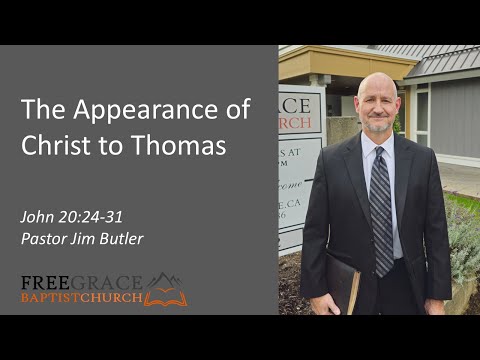
The Appearance of Christ to Thomas
John 20:24–31 presents Thomas not merely as a doubter but as an obstinate man who refuses to believe the resurrection unless his own conditions are met — rejecting the Old Testament prophets, the repeated predictions of Christ, and the apostolic testimony of ten eyewitnesses. Christ responds not with rebuke but with sovereign grace, appearing again on the Lord's Day and inviting Thomas to examine the wounds that sealed a finished atonement. The confession that follows — 'My Lord and my God' — is the theological and experiential crown of the fourth gospel, answering John's own stated purpose in verses 30–31: that through the written word, those who have not seen may nevertheless believe and have life in Christ's name.

The Conversion of Paul, Part 4
Philippians 3:10–11 presents sanctification and glorification as necessary and inseparable consequences of justification by faith alone (v.9). The knowledge of Christ described in verse 10 is experiential, practical, theologically correct, and constitutes the very essence of eternal life — but it includes not only the power of Christ's resurrection (newness of life, union with Christ, definitive breach with sin) but also the fellowship of His sufferings and conformity to His death, which are not redemptive but inevitable for all who side with a crucified Savior in a hostile world. Verse 11 then sets forth glorification — the resurrection of the righteous — as the confident hope that sustains perseverance through the difficulties of sanctification. The sermon draws on 1689 LBCF 11.2 and Westminster Larger Catechism 77 to show that faith which justifies is alone as an instrument, yet never alone in the person justified, being ever accompanied by all other saving graces.
2LCF Chapter 9 - Of Free Will
2LCF Chapter 9 ('Of Free Will') presents the doctrine of human will through four covenantal states: innocency, sin, grace, and glory. Reformed Christianity does not deny free will but insists that the will is conditioned entirely by the state in which man finds himself — created upright yet mutable, fallen into total inability, sovereignly freed by effectual grace, and finally made perfectly and immutably free to good alone in glory. The session traces this framework against the errors of Pelagius, Arminius, the Socinians, and the Jesuits, grounding the Reformed Baptist rejection of paedobaptism in the same biblical anthropology: there are only two states for man, dead in Adam or alive in Christ, leaving no room for an external covenant category for the children of believers.
The Glorious Curse Bearer
Galatians 3:10–14 presents the law's curse as a judicial sentence of divine condemnation from which no sinner can escape by obedience, since perfect and perpetual law-keeping is universally failed. Christ, the covenant champion, redeemed his elect by becoming a curse in their place — bearing the wrath due them, answering on a mountain at a tree the curse that entered the world on a mountain at a tree. The blessing of Abraham — the imputation of Christ's righteousness received through faith alone — comes not through circumcision, ceremony, or ethnic connection to the covenant community, but through union with the crucified and risen Christ. Those outside Christ remain justly under divine condemnation; those in him are freed from the curse and heirs of all the promises of God.