
Cited in sermons
John Newton
106 sermons · All people cited

The Conversion of Rahab the Harlot

Joshua 2 presents the conversion of Rahab the harlot as a sovereign interruption of divine mercy within the context of holy war and Israelite conquest. Before Israel kills a single Canaanite, the narrative compels the reader to stand in awe of a God who justifies a pagan prostitute by grace through faith alone — faith that is demonstrated by treason against Jericho and the sheltering of two spies. Rahab's confession that Yahweh is God in heaven above and on earth beneath places her alongside the great confessions of Scripture, and her inclusion in the Messianic genealogy of Matthew 1 reveals that the conquest was always inseparable from the redemptive purposes of God. The sermon calls hearers to resist self-righteous judgmentalism, to trust in a Christ who saves to the uttermost, and to marvel that the ancestress of Jesus was the shady lady of Jericho.

The Conversion of Matthew
Matthew 9:9–13 records the sovereign call of a tax collector — among the most despised and morally compromised figures in first-century Jewish society — to follow Christ and ultimately to author the first Gospel. The sermon works through three movements: Christ's effectual call of Matthew to discipleship, the feast Matthew hosts to honour Christ and evangelize his associates, and the confrontation with the Pharisees in which Jesus declares the nature of his mission — not to call the self-righteous but sinners to repentance. The account is pressed into seven marks of genuine discipleship, closing with an appeal to the unconverted to look to Christ as the great physician of sin-sick souls.
2LCF Chapter 13 - Of Sanctification
The 1689 London Baptist Confession of Faith, Chapter 13, sets forth sanctification as a real and personal moral transformation wrought by the Holy Spirit through the Word, inseparably joined to justification yet categorically distinct from it. The confession distinguishes the dominion of sin — broken decisively at regeneration — from the remnants of corruption that remain in every part of the believer throughout this life, producing an irreconcilable war between flesh and Spirit. Against both perfectionism and antinomianism, the chapter insists that sanctification is neither a checklist of religious performance nor a license for presumption, but a progressive, Spirit-empowered conformity to Christ that never constitutes the ground of acceptance before God. Hearers are urged to reject the conflation of justification and sanctification — whether in Roman Catholic merit theology, the New Perspective on Paul, or Federal Vision — and to rest acceptance with God solely on the imputed righteousness of Christ.

The Apostle's Prayer for the Ephesians, Part 2
Ephesians 1:19–23 presents the climax of Paul's apostolic prayer: that believers would know the exceeding greatness of God's power. This sermon expounds three demonstrations of that power in Christ — his resurrection from the dead, his current session at the right hand of the Father, and his dominion over all things for the sake of the church. The doctrines of inseparable operations and appropriations ground the Trinitarian account of these events, while the universal and eternal sovereignty of the enthroned Christ is set forth as the foundation for perseverance, praise, and fearlessness in the face of hostile spiritual and civil powers.

The Faithful Christian Mother
Proverbs 31:28–30 presents the faithful Christian mother not merely as a moral exemplar but as a woman whose fear of the Lord is itself the fruit of sovereign grace — a grace Jeremiah 32 promises God will plant in the hearts of his covenant people. The sermon works through four aspects of the Christian mother's calling: her condition before God, her influence over her children, her God-given authority over them (rooted in the fifth commandment), and her fourfold responsibility to instruct, to set an example, to discipline, and to love. Mothers are urged to press law and gospel upon their children tirelessly, to embrace corporal and verbal discipline without apology, and to find their ultimate confidence not in their own faithfulness but in Christ, the stellar Savior, whose life, death, and resurrection is the only ground of acceptance before God.

The Bread of Life Discourse, Part 1
John 6:22–34 records the opening exchange of the bread of life discourse, in which Jesus confronts a crowd whose pursuit of Him is driven entirely by physical appetite rather than spiritual need. The sermon works through three movements: the exposed motive of the people (vv. 22–26), the Savior's exhortation to labor for food that endures to everlasting life (vv. 27–29), and the crowd's demand for a sign to rival Moses (vv. 30–34). Central to the exposition is Jesus' declaration that the 'work of God' is faith in the One the Father has sent — a faith that is itself God's gift — and His identification of Himself as the true bread of God who comes down from heaven to give life to the world, surpassing the manna of the wilderness and extending to every tribe, tongue, people, and nation.
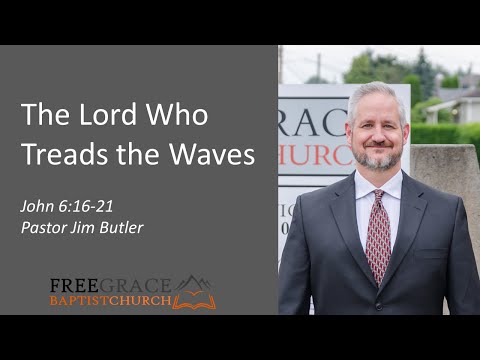
The Lord Who Treads the Waves
John 6:16–21 records the fifth of the seven signs in John's Gospel: Jesus walking on the Sea of Galilee toward his storm-tossed disciples. The sermon works through two movements — the disciples' vulnerability in the storm and the Savior's sovereign approach across the water — to establish that Jesus, by treading the waves, enacts what the Old Testament attributes exclusively to Yahweh (Job 9:8; Psalm 77:19; Isaiah 43:16), thereby demonstrating his consubstantiality with the Father and his lordship over the natural order. The divine self-disclosure 'I am' (ego eimi), voiced both here and at key junctures throughout John's Gospel, is shown to be Jesus' deliberate appropriation of the covenant name revealed to Moses in Exodus 3:14. The sermon closes by pressing the theological remedy for the fear that afflicts God's people: a right knowledge of Christ as the great I AM displaces anxiety about trials, persecutions, and earthly circumstances.

The Consubstantiality of the Son, Part 1
John 5:16–23 records the Jewish charge that Jesus made himself equal with God — and Christ's unequivocal affirmation of that charge. Working through verses 16–23, this sermon demonstrates that Jesus responds not by correcting a misunderstanding but by confirming, through four lines of argument, that he is consubstantial with the Father: sharing the same works, the same love, the same life-giving power, and the same sovereign rule. The stakes are ultimate — to dishonor the Son is to dishonor the Father, and to lack the Son is to lack God entirely.

The Healing at Bethesda
John 5:1–15 presents the healing of a paralyzed man at Bethesda as a display of Christ's sovereign initiative, mercy, and power. The man's 38-year infirmity — physical, helpless, and rooted in personal sin — mirrors the spiritual condition of every sinner apart from grace: unable to save himself and without recourse. Christ seeks the man out from a great multitude, issues a word of command that effects immediate and complete healing, and then addresses the deeper need by calling him to repentance. Against this glory, the opposition of the Jewish leaders — fixating on Sabbath casuistry while ignoring a manifest work of God — warns against a religion so narrowly fastidious that it cannot acknowledge divine mercy.

December 1, 2021 - Wednesday Night Bible Study - Exodus 20:1-3 (1st Commandment)
Exodus 20:3 — 'You shall have no other gods before me' — is expounded through both its prohibitions and its positive demands. The first commandment condemns atheism, polytheism, syncretism, idolatry, sorcery, and heresy, while positively requiring the knowledge, love, fear, obedience, trust, and worship of the one true and living God alone. The sermon draws on Romans 1:18-32 to show that ungodliness — disordered thinking about God — is the root from which all societal unrighteousness springs. The sermon closes with a call to repentance, to flee to Christ as the remedy for every violation of this commandment, and to cultivate the knowledge of God as the chief guard against idolatry in its ancient and modern forms.

The Conduct of a Faithful Minister
What does faithfulness look like in the life and ministry of a gospel minister? Expounding 1 Timothy 4:12–16 as a capstone to a study of elder qualifications in 1 Timothy 3:1–7, this sermon examines four dimensions of ministerial conduct: the minister's example before the congregation, his public ministry of reading, exhortation, and doctrine, his personal growth through sustained meditation on the Word, and his perseverance in both personal piety and sound teaching. The closing application extends these same marks to the congregation, calling the saints to receive the Word with joy, reject heresy with discernment, pursue Christian virtue, and prize the public means of grace.

The Antitype of the Temple
John 2:18–25 presents Jesus as the antitype of the Old Testament temple — the reality to which the type pointed and in which it finds its fulfillment and realization. The Jews' demand for a sign of his authority after the temple cleansing is answered by the one definitive sign: the death and resurrection of Christ, which the apostle John interprets for the reader in verses 21–22. The sermon also treats the omniscience of Christ as evidence of his divinity, demonstrated in his refusal to entrust himself to those whose belief was superficial and temporary. Hearers are called to flee to Christ in genuine faith and repentance, receiving both forgiveness of sin and the imputed righteousness of Christ that avails before the Father.
The New Heaven and New Earth
Revelation 21:1–8 presents the new heaven and new earth not as the annihilation and replacement of creation but as its renovation — the consummation of covenant blessing in which God dwells fully and finally with his redeemed people. Working through four elements of the vision (the new creation, the bride, the announcement of blessing, and the voice from the throne), this exposition situates John's language within the broader biblical storyline of paradise lost in Adam and paradise restored in Christ, and interprets the new Jerusalem as the church — the covenant community that has replaced apostate Israel as the bearer of God's covenant promises. The sermon closes with a meditation on individual eschatology, drawing on Job, the Psalms, and the Apostle Paul to comfort believers with the certainty that those who die in Christ pass immediately into his presence, and that the fullness of covenant blessing awaits them in the age to come.

The First Disciples of Jesus
John 1:35–51 records the calling of the first disciples of Jesus — Andrew, Simon Peter, Philip, and Nathanael — and the passage frames their coming to Christ as the inevitable fruit of John the Baptist's preparatory ministry and the sovereign grace of God. The sermon traces how each disciple is drawn to Christ, how each immediately brings another, and how the accumulating titles given to Jesus in this section — Lamb of God, Rabbi, Messiah, Son of God, King of Israel, Son of Man — build a Christological portrait that mirrors the prologue's declaration that the Word was God. Christ's omniscience in knowing Nathanael and his royal authority in renaming Simon Peter underscore that these disciples are not choosing a teacher but being conquered by a divine Savior. The pattern of Andrew fetching Peter and Philip fetching Nathanael becomes the sermon's model for evangelism: those saved by sovereign grace become, without coercion or manipulation, propagators of that same grace.

The Problem of Sin and the Mercy of God
Proverbs 28:13 sets the problem of sin and its remedy in sharp relief: the one who covers his sin will not prosper, but whoever confesses and forsakes sin will have mercy. The sermon works through the anatomy of sin-covering — denial, minimization, blame-shifting, and self-righteousness — with biblical examples ranging from Adam and Eve to Ananias and Sapphira, demonstrating the futility of every human attempt at self-atonement. Confession is shown to be not merely verbal acknowledgment but a saving act of faith in Christ, inseparably joined to repentance, whereby the sinner lays the hand of faith upon the surety of the new covenant and receives imputed righteousness. The closing application calls both unbeliever and believer to stop covering sin and look in faith to Christ, the only authorized covering for guilt before a holy God.

The Conversion of Rahab the Harlot
Joshua 2 presents the conversion of Rahab the harlot as a sovereign display of divine grace toward an unlikely recipient — a Canaanite prostitute who heard of Yahweh's mighty acts, confessed His majesty, and cast herself upon His mercy. The sermon traces the contact, confession, and contract with Rahab, arguing that her faith — evidenced by works — is a paradigm case of salvation by grace alone through faith alone, consistent with both Paul and James. The closing application calls believers to ground their relationship with God not in their pursuit of holiness but in the righteousness of Christ alone, lest gospel-forgetfulness corrupt their devotion into self-congratulation.
The Only Redeemer of God's Elect
Galatians 3:10–14 sets law and gospel in sharp contrast, demonstrating that justification before God is entirely excluded from the domain of law-keeping. Paul's threefold appeal to Deuteronomy 27, Habakkuk 2:4, and Leviticus 18:5 establishes that the law demands perfect, perpetual, and entire obedience — an impossibility for sinners in Adam. The only hope lies in Christ's substitutionary, curse-bearing work: he bore the imputed sin of his people, exhausted the wrath of God in their place, and secured for them both the blessing of Abraham and the gift of the Holy Spirit. The sermon calls hearers to abandon every form of faith-plus-works supplementation and to rest wholly in the particular redemption accomplished by Christ alone.
The First Commandment, Part 2
The First Commandment — 'You shall have no other gods before me' (Deuteronomy 5:7) — carries not only a prohibition but a cluster of positive obligations that define the redeemed creature's relationship to the Creator. This sermon works through five such positive aspects: the love of God, the fear of God, obedience to God, trust in God, and the proper worship of God, showing how each flows necessarily from the sovereign grace by which God conquers the sinner. The sermon concludes with a call to reject idolatry in all its forms — including mental idolatry constructed by false doctrine — and to cultivate a growing, confessional knowledge of the triune God.

Free Grace Baptist Church - October 2, 2019 Bible Study
Genesis 28 records God's sovereign confirmation of the Abrahamic covenant blessing to Jacob at Bethel — a man fleeing for his life after his own deception, yet met by Yahweh in a dream of angels ascending and descending a ladder between heaven and earth. The passage is expounded under three movements: Jacob's relocation to Padanaram, Esau's futile attempt to secure parental blessing through marriage, and Jacob's vow at Bethel. The dream is interpreted on two complementary levels — as a declaration of divine providence over Jacob's solitary journey, and as a messianic anticipation of Christ as the one mediator between heaven and earth, the interpretation Christ himself provides in John 1:51. The chapter marks a turning point in Jacob's life, from grasping deceiver to worshipping covenant-keeper, and sets a paradigm for all Israel of worship, tithing, and trust in Yahweh's faithfulness.

The Warning Against Apostasy
Hebrews 10:26–31 is one of the most pastorally misread warning passages in the New Testament, and this expository sermon works carefully to distinguish the sin of apostasy from the ordinary, ongoing sin of weak believers. The apostate is not a struggling saint who confesses and seeks mercy; he is one who, having made an outward profession of faith, openly and obstinately repudiates Christ — trampling the Son of God underfoot, counting the blood of the covenant a common thing, and insulting the Spirit of grace. The sermon draws on Owen, Calvin, Gill, and Ursinus to establish that apostasy is a total, willful renunciation of the gospel, not any species of sin for which Christ has made atonement. Believers burdened by remaining corruption are urged to distinguish themselves from apostates by the very instinct that drives them to the throne of grace — and to make full use of the means of grace God has appointed to preserve them from the apostasy the passage warns against.

James 1:2-8
James 1:2–8 addresses the believer's response to trials and the request that should accompany them. The passage distinguishes trials as God-ordained testings of faith from temptations to sin, and calls believers to count such afflictions as joy because God uses them to produce endurance, maturity, and conformity to Christ. When wisdom is lacking in the midst of trial — as it invariably is — the believer is commanded to ask God, who gives liberally and without reproach to all who ask. That asking must be in faith, for the double-minded man who doubts will be unsettled, unanswered, and unstable in all his ways.

The Conversion of Matthew
Jesus calls Matthew — a despised tax collector and notorious sinner — to discipleship with two words: 'Follow me.' This sermon on Matthew 9:9–13 traces three movements: the sovereign, immediate call to Matthew at his tax office; the feast Matthew throws in honor of Christ, filling his table with fellow sinners; and Christ's threefold response to the Pharisees' complaint, in which he identifies himself as physician for the sin-sick, appeals to Hosea's rebuke of mere external religion, and declares his mission to call sinners to repentance. The passage insists that the power demonstrated in forgiving the paralytic avails equally for the greatest of sinners, and calls every hearer to respond as Matthew did — immediately, wholly, and with joy.

The Believer's Gratitude toward God
Colossians 1:12–20 presents the believer's gratitude as an essential component of a walk worthy of the Lord — not a sentimental add-on but a theological necessity rooted in what God has actually done. Paul prays that the Colossians would be fruitful, growing, strengthened, and thankful, with gratitude serving as the lens through which sovereign grace becomes visible. This exposition works through two grounds for thanksgiving — inheritance and deliverance — before tracing the movement of Paul's prayer into the great Christological hymn of verses 15–20, where Christ as Creator, Sustainer, and Redeemer becomes the ultimate reason for the believer's praise. The sermon applies throughout with the exhortation to rehearse these redeemed blessings, particularly in the context of the Lord's Supper.
The Apostles' Defense before the Council
Acts 5:27–32 records the apostles' second arraignment before the Sanhedrin and their bold proclamation of the gospel under direct threat of punishment. Peter's reply — 'we ought to obey God rather than men' — establishes a permanent principle for the church: when civil or religious authority commands disobedience to God, the Christian is bound to God alone. The sermon expounds Peter's gospel proclamation in verses 30–32, treating the incarnation, crucifixion, exaltation, and gift of repentance as a coherent apostolic witness, and closes with exhortations to prepare for persecution, persevere in bold proclamation, and believe the message of forgiveness through Christ.

The Riches and the Poverty of Christ
Second Corinthians 8:9 packs a vast Christology into a single verse: the eternal Son, rich as the second person of the Trinity and agent of creation and providence, became poor through incarnation, a life of rejection, and death on the cross — not by divesting himself of deity (kenosis is rejected), but by addition, taking on humanity while remaining fully God. The hypostatic union — one person, two natures — is shown to be not academic abstraction but the doctrinal foundation that motivates Christian liberality and sustains joy. Believers are called to count their spiritual riches: justification, sanctification, and glorification secured by Christ's poverty, all received by grace through faith.

The Divine Provision of Eternal Life
Isaiah 55 presents God's gracious and urgent invitation to sinners to receive the fullness of salvation — the refreshment, gladness, and nourishment of the gospel — entirely without cost, because the suffering servant of Isaiah 53 has already satisfied the purchase price. The sermon expounds the chapter in two movements: the invitation to come (vv. 1–5), grounded in the new covenant and secured by the Davidic king, and the call to faith and repentance (vv. 6–13), sustained by the sovereign power of God's Word. Believers are urged to treasure the abundance of every spiritual blessing already given in Christ, and unbelievers are warned not to squander their lives on what cannot satisfy while the Lord may yet be found.

The Woman Who Was a Sinner
Luke 7:36–50 presents three parties — a repentant woman, a judgmental Pharisee, and the Lord Jesus Christ — whose interactions disclose the theology of justification by grace alone through faith alone. The woman's extravagant acts of devotion at Christ's feet are not the ground of her forgiveness but its fruit: she loves much because she has been forgiven much. The Pharisee's self-righteousness exposes the danger of confusing surface morality with saving grace, and of imagining any sinner to be beyond the reach of Christ. The sermon calls believers to examine the warmth of their love for Christ as the chief evidence of genuine justifying faith, and invites the unconverted to come to the Savior whose mercy is wider than any sinner's guilt.

The Purpose of the Proverbs
Proverbs 1:2–7 sets out both the purpose and the prerequisite of the entire book of Proverbs. The purpose is comprehensive — to impart wisdom, instruction, and just judgment to the simple, the young, the wise, and every condition of man — while the prerequisite is singular: the fear of the Lord, which is not a natural attainment but a gracious work of God in the soul. The fear of God is shown to be the epistemological foundation of all true knowledge, the animator of righteous conduct, and the preserver of the soul — available only through repentance and faith in the Lord Jesus Christ, the one greater than Solomon in whom all the treasures of wisdom and knowledge are hidden.

The Ascension of Christ
The ascension of Christ in Acts 1:9–11 is no mere epilogue to the resurrection but a theologically freighted event with direct consequences for how believers understand Christ's present reign, the Lord's Supper, intercession, and final glorification. Working through the passage, the sermon establishes that the ascension was visible, local, bodily, and glorious — witnessed by the apostles and interpreted by angelic messengers who announce Christ's return in like manner. The ascension completes Christ's earthly mediatorial work, secures the gift of the Spirit, and grounds the believer's assurance in a high priest who always lives to make intercession — the pledge that those whom He justified He will also glorify.

The Conduct of a Faithful Minister
What does faithful gospel ministry look like in practice? Expounding 1 Timothy 4:12–16 at an ordination service, this sermon works through four apostolic charges Paul lays on Timothy: the minister must be an example to the flock in word, conduct, love, faith, and purity; he must give sustained public attention to Scripture reading, exhortation, and doctrine; he must meditate on these things and give himself entirely to personal growth in godliness; and he must persevere in both personal holiness and sound doctrine, because the stakes of gospel ministry extend to the eternal welfare of those who hear. The sermon closes with a direct charge to the ordinand and to the congregation forming a new church plant, and with an evangelistic appeal grounding the seriousness of the gospel ministry in God's concern to save sinners through it.