
Cited in sermons
John Murray
170 sermons · All people cited

2LCF Chapter 25 - Of Marriage

The 1689 London Baptist Confession of Faith chapter 25 offers a concise yet comprehensive definition of marriage as a lifelong covenant between one man and one woman, established by God in creation for companionship, procreation, and the lawful expression of sexual relations. This study works through each paragraph of the confession's chapter on marriage, examining the monogamous nature of marriage, the major purposes for which it was ordained, and the lawful parties who may enter it. The session also draws on Westminster Confession chapters 24, paragraphs 5 and 6, together with Deuteronomy 24, Matthew 5 and 19, and 1 Corinthians 7, to argue that Scripture authorizes divorce on the grounds of porneia and desertion, and that a lawfully divorced innocent party is free to remarry. The Protestant 'permanence view' of marriage is examined and found to be both exegetically deficient and pastorally harmful to innocent parties whom God's own law was designed to protect.

2LCF Chapter 24 - Of the Civil Magistrate
2 London Baptist Confession Chapter 24 examines the divine origin, proper scope, and Christian obligations relating to civil government. Civil magistrates are ordained by God, under his authority, for his glory and the public good, with their power limited to maintaining justice and peace through the sword — encompassing criminal punishment, capital justice, and defense against foreign invasion. The sermon argues that Christians may lawfully serve as magistrates or soldiers, directly contra the Anabaptist tradition, and that the Confession's three paragraphs provide a sufficient framework for navigating contemporary political crises. Believers are called to submit to lawful commands, resist unlawful ones, and pray persistently for governing authorities so that the church may worship freely.

The Central Demand of the Covenant
Deuteronomy 10 presents the central demand of the Mosaic covenant — that Israel fear, love, and serve the Lord with all their heart and soul — set against the backdrop of the golden calf incident and the covenant's renewal. The sermon traces this demand from its roots in Deuteronomy 10:12–13 through its echoes in Genesis 18, Proverbs 21, Hosea 12, Zechariah 7, Micah 6, and Matthew 23, demonstrating that obedience rooted in heart religion has always been God's requirement of His people. The threefold division of the law is expounded, with the moral law established as perpetually binding while the ceremonial law finds its fulfillment in Christ and the judicial law expires with the Israelite theocracy. The sermon closes by pressing believers to hold fast to God, keeping His law not as a means of justification but as the pattern for sanctification purchased by Christ, the true Israel who alone fulfilled the covenant.

CTF 2026: Q&A Panel Discussion
A panel of Reformed Baptist and Reformed theologians fields audience questions on some of the most demanding loci in Reformed theology: federal headship and the fall, God's effective and permissive will in the hardening of Pharaoh's heart, the mystery of the first sin, free will as acting according to nature, hyper-Calvinism, the infralapsarian and supralapsarian debate, and the legitimacy of the free offer of the gospel under God's exhaustive decree. The discussion is frank about the limits of creaturely knowledge on questions the secret will of God has not resolved, while insisting that doctrinal humility and ordinary means of grace—not cage-stage polemics or churchless social media—are the proper context for growth in these truths.

Ask FGBC Batch 7: Anabaptists, Calvinism, Sincere Offer & More | Reformed Baptist Theology
This panel discussion brings together three Reformed Baptist pastors to address questions submitted to Free Grace Baptist Church on confessional identity, soteriology, covenant theology, and Lord's Day worship. The conversation distinguishes Particular Baptists from Anabaptists on historical-documentary grounds, examines the relationship between Calvinism and confessional Reformed Baptist identity, and evaluates the free and sincere offer of the gospel against what the panelists regard as the theological liabilities of well-meant-offer language. The discussion also treats the threefold division of the law, prosopological exegesis, and the scriptural rationale for two Lord's Day services, consistently grounding each answer in the 1689 Second London Baptist Confession and the exegetical tradition of the Particular Baptists.

The Conclusion of the Decalogue
Deuteronomy 5:22–33 records Moses rehearsing the original giving of the law at Sinai, and this exposition draws out the divine origin, authority, comprehensiveness, finality, and permanence of the Decalogue as the trans-covenantal moral law of God binding on all men in every age. The threefold use of the law — civil, pedagogical, and normative — is traced through the New Covenant, with the imputed righteousness of Christ received by faith as the only ground of justification. The people's terror at the theophany on Sinai is commended as the proper response to God's majesty, and the sermon presses the distinction between slavish fear that flees from God and filial fear that flees to Him, urging the congregation to recover a robust doctrine of divine transcendence in their worship.

2LCF Chapter 11 - Of Justification
Chapter 11 of the Second London Confession of Faith sets forth the biblical doctrine of justification with precision: sinners are accepted before God not by infused or inherent righteousness, nor by the imputation of faith as an act of obedience, but by the imputation of Christ's active obedience to the whole law and His passive obedience in death, received through faith alone as the instrument of justification. The confession navigates the doctrine through careful negative and positive statements, guarding both the sole ground of acceptance in Christ and the inseparable connection between justification and sanctification. Believers are called to rest their assurance entirely on Christ's active and passive obedience — cleansed in His blood and clothed in His righteousness — rather than on any covenantal faithfulness of their own.

The Sixth Commandment, Part 5
The sixth commandment, 'You shall not murder' (Deuteronomy 5:17), is grounded not in mere legal convention but in the theological reality that man bears the image of God — an image that persists from conception through old age, in sickness and health, in the handicapped and the mentally ill. Drawing on Genesis 1, 5, and 9, alongside Jesus' exposition in Matthew 5:21-22 and John's application in 1 John 3, this study traces the commandment's reach inward to unwarranted anger and character assassination, and outward to the present cultural crises of abortion, euthanasia, and the neglect of capital punishment. Because the image of God is the theological rationale for both the prohibition of murder and the mandate of capital punishment, opposition to abortion and support for the death penalty are not contradictory positions but necessary corollaries of the same conviction about the sanctity of human life.
The Sixth Commandment, Part 3
The sixth commandment, 'You shall not murder' (Deuteronomy 5:17), prohibits unlawful killing with premeditation and malice, but the Bible distinguishes murder from lawful taking of life in capital punishment, self-defense, and just war. This study works through the Old Testament legal framework for self-defense, particularly Exodus 22:2–3, alongside several narrative examples, to establish that defensive homicide is not forbidden by Scripture. The teaching of Jesus in Matthew 5:38–42 is examined carefully to show that the Sermon on the Mount addresses personal, interpersonal ethics — not a universal prohibition on self-defense — and that Jesus himself assumes people will protect themselves and others. The study concludes with a call to think with biblical clarity on these matters in an age of muddled Christian ethics.
2LCF Chapter 9 - Of Free Will

2LCF Chapter 9 ('Of Free Will') presents the doctrine of human will through four covenantal states: innocency, sin, grace, and glory. Reformed Christianity does not deny free will but insists that the will is conditioned entirely by the state in which man finds himself — created upright yet mutable, fallen into total inability, sovereignly freed by effectual grace, and finally made perfectly and immutably free to good alone in glory. The session traces this framework against the errors of Pelagius, Arminius, the Socinians, and the Jesuits, grounding the Reformed Baptist rejection of paedobaptism in the same biblical anthropology: there are only two states for man, dead in Adam or alive in Christ, leaving no room for an external covenant category for the children of believers.

The Sixth Commandment, Part 1
The sixth commandment, 'You shall not murder' (Deuteronomy 5:17), forbids not only the external act of unlawful killing but also the internal dispositions of hatred, unwarranted anger, and the assassination of another's character. The sermon establishes that the Hebrew term rendered 'murder' carries the specific sense of premeditated, intentional killing, thereby distinguishing murder from accidental homicide, negligent homicide, and three categories of lawful killing: capital punishment, just war, and self-defense. The bulk of the study undertakes a biblical theology of the death penalty, tracing it from the Noahic covenant in Genesis 9:6 through the Mosaic legislation and into the New Testament witness of Acts 25 and Romans 13:1–4, arguing that capital punishment is a non-abrogated, common-grace ordinance binding on all civil governments. Christians are called to think biblically about civil government, to pray for just magistrates, and to reject the cultural sentimentalism that has displaced God's revealed standard for the punishment of murderers.

The Bronze Serpent
Numbers 21:1–9 records Israel's sin of grumbling in the wilderness, God's judgment through fiery serpents, and the divinely prescribed remedy: look at the bronze serpent lifted on a pole and live. The sermon traces this narrative in two movements — the defeat of the Canaanites in verses 1–3, where Israel prays and trusts God, contrasted with the failure of verses 4–9, where they grumble despite God's provision. The bronze serpent functions as a type of Christ, as Jesus himself declares in John 3:14, and the sermon presses the application that justification is by faith alone — not by prior works, not by self-examination of the wound, but by looking to the one lifted up. Weak faith does not disqualify the sinner; even a feeble look at the appointed remedy brings the sinner into peace with God.

The Importance of Spiritual Exercise
Philippians 2:12–13 is not a self-salvation passage but a call to Spirit-enabled perseverance rooted in the sovereign grace of God. The sermon expounds the believer's responsibility to 'work out' a salvation already given — not to attain it, but to live in conscious, fear-driven obedience to the God who both justifies and sanctifies. Against hyper-Calvinist passivity on one side and Arminian self-effort on the other, the text holds together human duty and divine empowerment: God works in believers both to will and to do according to his good pleasure. The practical summons is to pursue sanctification — the whole of it, fear, trembling, cross-contemplation, and dependence on the Spirit — as those destined for glorification.

The First Commandment
Deuteronomy 5:7 — 'You shall have no other gods before me' — is the foundation of covenant loyalty, defining not only who the one true God is but what response He demands from His people. This study works through the prohibition against other gods (atheism, polytheism, syncretism, sorcery, heresy, and creature-worship) before turning to the positive duties the commandment requires: knowing God, loving Him, fearing Him, obeying Him, trusting Him, and worshipping Him on His own terms. The first commandment is not merely theological orthodoxy but a call to total, exclusive, and practical devotion to Yahweh — a devotion made possible only by the grace that plants His fear in the heart.

The High Priestly Prayer, Part 7
John 17:20 records Christ's intercession extending beyond the apostles to all who would believe through their word — a prayer that excludes the world and encompasses the elect of every age. The verse yields five doctrinal implications: justification is by faith alone; the apostolic word is the ordained instrument of that faith; Christ assumes gospel advance and missions; sovereign election and predestination undergird the certainty that there will be believers; and the world possesses a solidarity in enmity against God that mirrors, and indicts, the disunity too common among God's people. Practically, the sermon calls the church to gospel-centred ministry, qualified and instructional preaching, the earnest pursuit of unity, and calls the unconverted to believe on the Lord Jesus Christ without delay.

2LCF Chapter 1 - Of the Holy Scriptures (Paragraphs 1-3)
The 1689 London Baptist Confession of Faith opens with the doctrine of Holy Scripture because all subsequent confessional theology stands or falls on this foundation. This session works through paragraphs 1–3 of Chapter 1, establishing first the necessity of Scripture — grounded in the insufficiency of general revelation for saving knowledge and the cessation of direct prophetic revelation — and then the identity of Scripture, treating the question of canon (which books belong) and the exclusion of the Apocrypha. Three criteria for canonicity are examined: the providential exposure of books, the divine attributes Scripture bears, and apostolic origin broadly understood.

Galatians 2:17–21 — Justification by Faith Alone
Galatians 2:17–21 closes Paul's autobiographical defense of justification by faith alone, and these five verses press three weighty questions: Is Christ a minister of sin when believers forsake the Mosaic ceremonies? Who is the true transgressor? And what does Judaizing heresy actually do to the cross of Christ? The sermon argues that to impose any measure of works upon the economy of salvation — whether old-covenant ceremony or its modern legalistic counterpart — is to render the incarnation, the perfect obedience, and the atoning death of the Son of God as vanity. The single ground of the believer's justification, assurance, and perseverance is the Son of God who loved us and gave himself for us, in whom alone everlasting righteousness is found.

The Sixth Commandment
The Sixth Commandment — 'You shall not murder' (Exodus 20:13) — addresses far more than the physical act of killing; it presupposes the dignity of every human being as an image-bearer of God and condemns unrighteous hatred of the heart. This sermon expounds the Hebrew word for murder, distinguishing it from lawful killing in capital punishment, just war, and self-defense, before pressing the command's indictment of abortion and euthanasia as violations of the sanctity of life. Jesus's teaching in Matthew 5 extends the commandment's reach to unwarranted anger and character assassination, and the three uses of the law — civil, pedagogical, and normative — frame both the church's public witness and the believer's ongoing sanctification. The sermon closes by insisting that the most faithful response to a death culture is to preach both the law and the cross of Christ.
The Riches of God's Grace
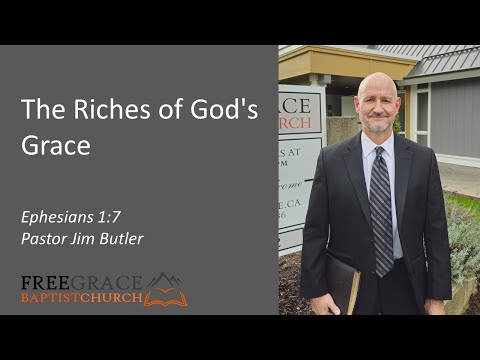
Ephesians 1:7 declares that believers possess redemption through Christ's blood and the forgiveness of sins according to the riches of God's grace. This sermon works through the triune shape of salvation in Ephesians 1:3–14, arguing that the redeemed are not a class of morally capable people who needed modest assistance, but guilty sinners who required blood atonement, divine election, and the sealing of the Holy Spirit. The cross is shown to satisfy divine justice as well as display divine love — God is both just and the justifier of the one who has faith in Jesus, as Paul argues in Romans 3:21–26. The sermon closes with a direct application to baptism, presenting the ordinance as an outward declaration of the inward forgiveness and righteousness received through union with Christ.

2LCF Chapter 29 - Of Baptism, Part 3 - Paedobaptist Arguments
Believers' baptism rests on the covenant distinction between Israel after the flesh and the spiritual seed of Abraham, and no paedobaptist argument survives the scrutiny of those covenantal boundaries. This third study in the confession's chapter on baptism works through six major paedobaptist arguments — from the Abrahamic covenant, household baptisms, federal holiness, and more — and answers each from Scripture, the 1689 confession, and Nehemiah Cox's seventeenth-century Baptist covenant theology. A question-and-answer period then addresses practical matters: rebaptism after sprinkling or infant immersion, communicating credo-baptist convictions to paedobaptist family and elders, prerequisites for baptism, minimum age, and the necessity of immersion as the sign that answers the thing signified.

2LCF Chapter 29 - Of Baptism, Part 2
Credobaptism rests on five mutually reinforcing theological arguments: covenant theology, federal headship, the doctrine of salvation, the clarity of New Testament revelation, and the regulative principle of worship. This session (Part 2 of a study on 2LCF Chapter 29) works through the final three arguments, demonstrating from Romans 6, Acts 2, Acts 8–9, Galatians 3, and 1 Corinthians 10 that baptism signifies union with Christ in his death, burial, and resurrection, and therefore belongs only to those who actually possess that union. The session closes by showing that infant sprinkling not only lacks any express divine command but positively contradicts the explicit command to baptize believers only — an inconsistency that even notable paedo-baptist writers (Owen, Calvin, Matthew Henry) expose in their own defenses of the regulative principle of worship.

The Requirements for Priesthood and Sacrifice
Leviticus 21–22 sets out strict requirements for both the priests who offer sacrifice and the animals brought to the altar: wholeness, purity, and freedom from defect. These ceremonial regulations are not arbitrary exclusions but typological anticipations of the one perfect High Priest and the one perfect sacrifice that God himself would provide in the person and work of the Lord Jesus Christ. The sermon works through the four sections of the passage — practical restrictions on priests, physical requirements for priests, regulations concerning priestly food, and physical requirements for sacrificial animals — before turning to Hebrews 7–10 to show how Christ fulfills and surpasses everything the Levitical system could only shadow. The conclusion calls the congregation to the Lord's Supper with eyes fixed not on themselves but on the one who offered himself once for all and sat down.

Ask FGBC #14: How do we connect modern day Israel to Old & New Covenant Promises?
How should Christians understand the modern state of Israel, the Abrahamic and Davidic covenants, and the land promises in light of the New Testament? This Q&A exchange argues that the church is not a replacement for Israel but is the eschatological Israel of Old Testament prophecy — one people of God, Jew and Gentile together, united in Christ. Dispensationalism's two-peoples-of-God framework is evaluated and rejected on hermeneutical grounds, with Romans 11, the Davidic covenant, and the land promise examined in turn. The conversation broadens into the necessity of reading Scripture canonically and horizontally, the value of confessionalism, and the danger of allowing political rhetoric to distort biblical interpretation.

Ask FGBC #10: Why should only believers be baptized?
This Q&A episode addresses the Reformed Baptist argument that only professing believers are proper subjects of baptism. Drawing on the distinction between moral law and positive law, and grounding baptism firmly in the New Covenant rather than the Abrahamic covenant, the speaker argues that circumcision was an ordinance tied to a specific historical covenant now abrogated, and that its recipient-list cannot be transferred to baptism. The episode also traces the historical development of paedobaptism from pre-Reformation sacerdotalism to the covenantal argument codified in the Westminster Confession.

The Righteousness of David
David's declaration in 2 Samuel 22:21 — 'The Lord rewarded me according to my righteousness' — presents an apparent contradiction for anyone who knows his history of adultery, murder, and failure of justice in his own household. This sermon works through that tension by examining the theology underlying David's claim: his righteousness is not a personal moral achievement but the imputed righteousness of Christ received by faith alone, the same doctrine Paul draws from David's own Psalm 32 when arguing for justification in Romans 4. The sermon concludes with a call to imitate David not merely in doctrine but in appetite — in his fierce love for public worship, the means of grace, and the presence of God.

Ask FGBC - Podcast with Jim Butler, Dr James Renihan, Dr Richard Barcellos
This roundtable conversation between three pastors and theologians addresses a wide range of questions submitted by church members, covering biblical theology, covenant theology, baptism, eschatology, and Christian living. The discussion moves from how Christ fulfills Old Testament Israel, through the covenantal basis for believers' baptism, to the nature of the eternal state, the hermeneutics of applying Old Testament promises, the place of ethnic Israel in relation to the church, and the means of grace for raising covenant children. Throughout, the speakers return to a consistent Reformed hermeneutic: Christ is the true and greater fulfillment of all Old Testament promise, the church is the eschatological Israel of prophetic expectation, and the ordinary means of grace — Word, prayer, and faithful worship — remain God's appointed instruments for the conversion and nurture of his people.

The Pharisee and the Publican
Luke 18:9–14 sets before the reader two men whose manner of prayer exposes the only two grounds on which a person can seek acceptance with God: self-righteousness or the imputed righteousness of Christ. The Pharisee's boastful rehearsal of his own religious merits and his contempt for the publican show that pride and the despising of others are inextricably joined. The publican, who can do nothing but beat his breast and cry for propitiation, goes home justified — declared righteous not by what he was or did, but by the alien righteousness of another received through faith alone. The sermon calls hearers to examine whether they stand before God as the Pharisee or the publican, and to come to the Lord's Supper not as a reward for good behavior but as those who rest entirely on Christ's doing and dying.

The Sanctity of Life
The sixth commandment's prohibition of murder rests on the foundation that man is made in the image of God — a dignity that attaches to every human being at every stage of life, including the preborn child in the womb. Exodus 21:22–25 addresses the case of a pregnant woman injured during a fight, and the Hebrew text's use of normal birth language rather than miscarriage terminology establishes that the child in the womb is covered by the same lex talionis as any other person. The sermon works through the biblical witness to the imago Dei across the whole of human life — pre-fall, post-fall, in infancy, disability, sickness, old age, and the womb — before turning to the passage in Exodus as concrete civil legislation protecting that dignity. The law condemns the sin of abortion without reservation, yet the sermon closes by directing the guilty to the gospel: the blood of Christ cleanses from all sin, including this one.
The Unsurpassed Value of the Gospel
The gospel of Jesus Christ is worth suffering and dying for — not because of its abstract beauty, but because of its origin, its author, and its achievement. Expounding 2 Timothy 1:8–10, this sermon traces Paul's exhortation to Timothy through three movements: the pattern for gospel ministry (refusing shame and embracing suffering in God's power), the origin of God's plan of salvation (purposed before time began, not according to works but according to divine grace), and the execution of that plan in the appearing of Christ, who has abolished death and brought life and immortality to light. The Lord's Supper frames the entire meditation, giving the congregation cause to rejoice that the one who purposed their salvation in eternity has accomplished it decisively in history.

Death Penalty, Part 3
Romans 13:1–7 furnishes the New Testament's clearest warrant for civil government bearing the sword, including capital punishment — yet common objections, both biblical and pragmatic, continue to challenge this teaching. This third installment of a study arising from Leviticus 20 addresses the two most significant biblical objections: the pacifist misreading of Matthew 5:38–42 and the attempt to leverage John 8:1–11 against lawful execution. The sermon argues that Jesus in the Sermon on the Mount is correcting the misapplication of the lex talionis to personal relationships, not dismantling civil jurisprudence, and that his handling of the woman caught in adultery actually upholds Mosaic evidentiary law rather than nullifying capital punishment. Five pragmatic objections — that the death penalty is incompatible with Christian forgiveness, lacks mercy, risks executing the innocent, fails to deter, and forecloses salvation — are each answered from Scripture and reason.