
Cited in sermons
John Gill
1,025 sermons · All people cited

2LCF Chapter 1 - Of the Holy Scriptures, Part 1

The necessity of Holy Scripture, as confessed in 2LCF Chapter 1, paragraph 1, arises from the insufficiency of general revelation to communicate saving knowledge. While creation and providence manifestly display God's goodness, wisdom, and power — leaving all men without excuse — they do not and cannot reveal blood atonement, the incarnation, or justification by faith alone. It therefore pleased God to commit His will to writing, producing a Scripture that is the only sufficient, certain, and infallible rule of all saving knowledge, faith, and obedience. The session closes with extended discussion of cessationism, the distinction between inerrancy and infallibility, and the hermeneutical principle that Scripture interprets Scripture.

The Necessity of Christ's Passion
Matthew 16:21–23 presents the first formal announcement of what Christ himself calls a divine necessity: he must go to Jerusalem, suffer at the hands of the elders and chief priests, be killed, and be raised on the third day. The sermon traces this necessity through the covenant of redemption, the Old Testament prophetic witness — Psalms 22, 69, and 110, Isaiah 52–53, Daniel 9, Zechariah 9–14 — and a series of informal anticipations across Matthew's Gospel. Peter's sharp rebuke is examined as a representative failure to grasp the messianic agenda of a suffering Servant, and Christ's equally sharp response — 'Get behind me, Satan' — is shown to be the definitive affirmation that substitutionary curse-bearing is non-negotiable: error here is not a skin disease but a disease at the heart. The congregation is urged to hold fast to the doctrine of Christ crucified and risen as the only stable ground of perseverance in the Christian life.

The Royal Wedding
Psalm 45 presents a royal wedding between the divine King and his bride, the church, composed centuries before the incarnation as a song of love pointing directly to the Lord Jesus Christ. The sermon moves through four sections: the psalmist's overflowing intention, the perfections and divine-human person of the King, the instruction to the bride concerning faith and repentance, and the declaration of the King's eternal glory. Christ is shown to be fairer than all the sons of men, advancing his kingdom through truth, humility, and righteousness rather than deception, while his priestly office — not only his kingly conquest — is pressed upon the hearer as the only ground of hope for sinners. The bride is clothed not in her own righteousness but in the imputed righteousness of Christ, received by faith alone, to be brought with gladness into the King's palace.

The Conduct of the New Man, Part 2
Ephesians 4:29–32 calls believers to put off corrupt speech and bitter dispositions and to put on edifying words and a forgiving heart — not as conditions for salvation, but as conduct that flows necessarily from it. The sermon exposits the structure of Paul's exhortations: a prohibition, a positive exhortation, and a motivation in each subsection. Corrupt speech grieves the Holy Spirit, who has sealed believers for the day of redemption; and bitterness, wrath, clamor, and evil speaking are symptoms of the old man that must be mortified. The sermon closes with the ground of all Christian forgiveness: God in Christ has already forgiven us, and that forgiveness is the cause, not the goal, of our forgiveness toward others.

The Attempted Murder of the Good Shepherd
John 10:31–42 presents the religious leadership of Jerusalem responding to Christ's declaration 'I and my Father are one' not with worship but with stones. This exposition traces three movements: the revelation of Christ's divine glory in verse 30, the attempted murder by the Jewish leaders in verses 31–39, and the fruitful reception of Christ in the Transjordan in verses 40–42. Central to the passage is Christ's appeal to Psalm 82 and the argument from lesser to greater — if God calls earthly magistrates 'Elohim,' on what grounds do they stone the One whom the Father sanctified and sent? The sermon closes with an encouragement to the people of God: where Jerusalem rejects, the Transjordan receives, and the Good Shepherd will gather His sheep from every tribe and nation.

The Conduct of the New Man, Part 1
Ephesians 4:25–28 grounds the Christian's ethical conduct not in legal compulsion but in the indicative of redemption: the old man has been put off, the mind is being renewed, and the new man has been put on. This sermon works through three prohibited actions — lying, sinful anger, and theft — each examined under its corresponding commandment from the Decalogue (the Ninth, Sixth, and Eighth), with a prohibition, an exhortation, and a motivation for each. The ethical demands of the New Covenant are not a new law but the restoration of the creational law now internalized by the Spirit according to Jeremiah 31:31–34. The hearer is called to put off deceit, guard against nursed anger that gives opportunity to the devil, and replace theft with diligent labor aimed at charitable surplus.

The Identity of the Good Shepherd
John 10:22–30 records the climactic confrontation in Solomon's Porch during the Feast of Dedication, where Jesus answers the persistent demand to declare his identity plainly. He does so not with new information but by pressing what he has already said — through his works, his doctrine, and his relation to the Father — culminating in the declaration 'I and my Father are one,' a statement the unbelieving Jews rightly understood as a claim to full divine essence. The sermon traces five movements in verses 25–30: the declaration, confirmation, rejection, recognition, and affirmation that Jesus is the Christ, with extended treatment of the sovereignty of God in salvation, the security of the sheep grounded in both the Son and the Father, and the ontological unity of Father and Son against both Arian and Sabellian error. Believers are called to rest in the particular, efficacious, and irrevocable redemption accomplished by the Good Shepherd, and those outside Christ are called to hear his voice and believe.

The Characteristics of the New Man
Ephesians 4:17–24 sets before believers a stark contrast between the darkened, alienated mind of the spiritual Gentile and the renewed mind of the new man in Christ. The sermon argues that verses 22–24 are not imperatives commanding believers to transform themselves, but indicatives declaring what God has already accomplished in regeneration: the old man has been put off, the mind is being renewed, and the new man has been put on. These realities — rooted in the second Adam reversing what the first Adam forfeited — form the doctrinal foundation upon which the ethical commands of Ephesians 4:25–6:24 rest. Believers are therefore called to walk in a manner consistent with what they already are in Christ, using the ordained means of gospel preaching, Scripture, and prayer to pursue sanctification.
The Tabernacle Erected, and the Glory of God
Exodus 35–40 records the construction, assembly, and divine consecration of the Israelite tabernacle, culminating in the glory cloud filling the completed dwelling place. This session surveys those chapters as the climax of the book of Exodus, tracing the biblical-theological theme of God's dwelling with his people from Eden through the tabernacle, the Solomonic temple, and forward to the incarnate Word who tabernacled among us. A sustained exegetical focus falls on the tension in Exodus 40:35 — Moses unable to enter the glory-filled tabernacle — and its resolution in Leviticus 9, where blood atonement transforms God's dwelling place into a meeting place. The session closes by drawing out the regulative principle of worship, the typological significance of the tabernacle as a shadow of Christ, and the necessity of blood atonement for sinful creatures to approach a holy God.
The Warning Against Apostasy
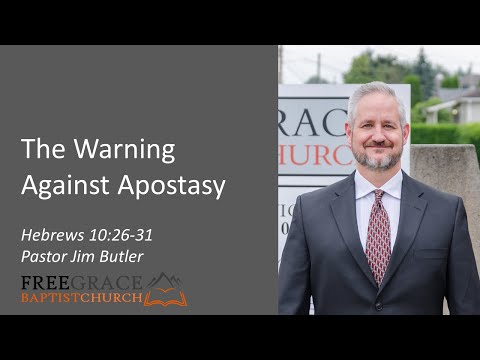
Hebrews 10:26–31 contains one of the New Testament's starkest warnings, and the question it raises is precise: who has committed the sin of willful apostasy, and can it be the believer who struggles with remaining corruption? This sermon works through the nature and judgment of apostasy, distinguishing between the sensitive saint who sorrows over indwelling sin and the apostate who openly tramples the Son of God underfoot, counts the blood of the covenant a common thing, and insults the Spirit of grace. Drawing on Calvin, Owen, Gill, and Ursinus, the sermon argues that the persons in view are not struggling believers but outright rejecters of the gospel — in the original context, Hebrew Christians who publicly renounced Christ to return to the Levitical system. The chief comfort the passage affords is precisely this: the believer who fears he has committed the unpardonable sin almost certainly has not, and is called to draw near, hold fast, and consider one another in the confidence of a once-for-all sacrifice that saves to the uttermost.

2LCF Chapter 31 - Of the State of Man After Death, and of the Resurrection of the Dead
The doctrine of the intermediate state — the condition of the soul between death and the final resurrection — is examined through 2LCF Chapter 31 and the key Scripture passages that ground it. The confession teaches a sharp dichotomy: at death, the body returns to dust while the immortal soul either goes immediately to be with Christ in paradise or is cast into hell, with no third option such as purgatory or soul sleep. The resurrection of both the just and the unjust on the last day is treated in paragraphs 2 and 3, with 1 Corinthians 15 providing the clearest statement that Christ's coming is followed immediately by the end — a structure that complicates dispensational premillennialism. The lesson closes with a call to find comfort and ethical urgency in the simplicity of biblical eschatology rather than in elaborate prophetic systems.

The Good Shepherd, Part 3
John 10:11–21 presents Jesus as the Good Shepherd — a title laden with Old Testament expectation from Psalm 23, Jeremiah 23, and Ezekiel 34 — set in sharp contrast to the hireling religious leaders who fled from every threat to the sheep. The sermon works through three movements: the declaration of Christ's role (v. 11), the condemnation of his opponents as hirelings (vv. 12–13), and the explanation of his mission (vv. 14–18), showing how the abundant life of verse 10b flows specifically from Christ's voluntary, authoritative, and efficacious death and resurrection. Particular attention is given to the intimacy between the shepherd and his sheep — a knowledge analogous to the Father's knowledge of the Son — and to the definite scope of Christ's saving work, which brings not only Jewish but Gentile sheep into one flock under one shepherd. The closing exhortation calls those still outside this fold to look to Christ in faith, since the shepherd's love is secure and nothing shall separate his own from it.

Renewal of the Covenant, Part II
Exodus 34:10–35 records God's renewal of the Mosaic covenant with Israel following the golden calf apostasy of chapter 32. The passage demonstrates that the divine attributes proclaimed in verses 6–7 — mercy, grace, long-suffering, and abounding goodness — are not merely stated but actively exhibited in God's willingness to restore a covenant his people had shattered. The sermon works through three sections: the covenant renewed (vv. 10–28), with its prohibitions against religious, social, and political alliances with Canaanite nations; and the reflection of God's glory on Moses' face (vv. 29–35), which Paul's argument in 2 Corinthians 3 sets within the larger framework of old covenant and new covenant glory. The central application is that the same perfections God displayed toward covenant-breaking Israel are the perfections believers now experience in the gospel of the Lord Jesus Christ, whose new covenant ministry of righteousness far exceeds the fading glory of Moses.

The Gifts Given by the Ascended Christ, Part 4
Ephesians 4:15–16 concludes Paul's treatment of the gifts given by the ascended Christ by setting out the positive influence those gifts are designed to produce in the church: spiritual maturity through truth spoken in love, and corporate edification flowing from union with Christ the head. The sermon argues that the Christian ministry is not a free-for-all of entertainment or emotional stimulation but is governed by Christ himself, who gave pastor-teachers to equip the body for growth into the fullness of Christ. Against the twin dangers of internal spiritual complacency and external false teachers, the church is called to the use, consistent use, and persevering use of the ordinary means of grace — preaching, prayer, and the gathered assembly — as the God-ordained path to maturity.

The Renewal of God's Covenant, Part 1
Exodus 34:1–9 records the renewal of the Mosaic covenant following Israel's catastrophic idolatry with the golden calf, and the chapter's theological heart is God's self-proclamation of His own glory to Moses on Sinai. The sermon works through three movements in verses 1–9: the command to cut new tablets as a covenant-renewal symbol, the descent of God in the cloud, and God's proclamation of His own name — a compendium of divine perfections stretching from mercy and grace through long-suffering, goodness, truth, and covenant faithfulness to justice and righteousness. These attributes are traced across the canon from the Psalms and the prophets to their fulfillment in the high-priestly work of Christ, who makes definite propitiation for the sins of His people. Moses' response — immediate worship followed by intercessory prayer grounded in the very perfections God had just declared — is held out as the model for the believer's own approach to God.

2LCF Chapter 30 - Of the Lord's Supper
The Lord's Supper is a divinely instituted ordinance of the New Covenant, not a repeated sacrifice but a perpetual memorial of Christ's once-for-all offering upon the cross. This confession study works through 2LCF Chapter 30 paragraph by paragraph, exposing the errors of Roman Catholic transubstantiation and Lutheran consubstantiation on Christological grounds — to predicate ubiquity of Christ's humanity is to deny true humanity — while recovering the Calvinian understanding of Christ's real spiritual presence by the Holy Spirit. The chapter is shown to be comprehensive: institution, nature, celebration, elements, and recipients of the supper are each addressed. Worthy receivers feed spiritually upon Christ crucified and all the benefits of his death; the supper functions as a means of grace confirming faith, nourishing the soul, and promoting obedience.

The Good Shepherd, Part 1
John 10:1–10 stands in direct continuity with John 9: having healed and saved the man born blind, Jesus turns to indict the Pharisees as thieves and robbers who exercised illegitimate authority over the sheepfold of God. The sermon works through Jesus' parabolic illustration in verses 1–6, showing that the true shepherd enters by the door (granted access by God the Father), calls his own sheep by name with a specific and effectual summons, and leads them out — while the sheep, made alive by the Spirit in regeneration, hear and follow his voice and flee the stranger's. The application is double: believers are called to seek the shepherd's voice in Scripture, family worship, and the preaching of the Word, and the unconverted are called to ask with the blind man, 'Who is he, Lord, that I may believe in him?'
The Promise of God's Presence
Exodus 33 confronts Israel with the consequences of the golden calf: God threatens to withhold His special presence, lest He consume a stiff-necked people in the wilderness. Moses responds not with passive acceptance but with escalating, bold intercession — arguing from grace received, from Israel's covenant identity, and finally from a desire to see God's glory itself. The sermon traces God's anthropomorphic self-disclosure, His accommodation of Moses' three petitions, and His self-proclamation as the God of sovereign grace and compassion. The controlling application is that it is the Giver, not the gift, that the people of God must desire above all things — and that access to His presence now comes through the mediation of Christ alone.

The Healing of a Blind Man, Part 3
John 9:35–41 records the climax of the healing of the man born blind: not the restoration of his physical sight, but his salvation through faith in the Son of God. This sermon argues that providence and miracles do not save — only grace through faith in Christ does — and that Christ's coming pronounces both salvation on the spiritually blind who see their need and judgment on the self-righteous who claim to see but remain in their sin. The exposition closes with a direct appeal: the self-righteous require both the law, to expose the bankruptcy of their works-confidence, and the gospel, to offer the righteousness of Christ received by faith alone.
The Idolatry of Israel, Part III
Exodus 32:30–35 presents Moses interceding for Israel after the golden calf debacle, confessing their great sin and offering himself to be blotted out of God's book on their behalf. The sermon works through Moses's rebuke, his request, and God's response, giving particular attention to the theological question of whether God blots names from the Book of Life — resolving the tension by distinguishing the conditional Old Covenant (a covenant of works securing physical blessings) from the unconditional New Covenant, in which the elect are eternally secure in Christ. The Mosaic intercession is read typologically as pointing to Christ, who was, in effect, blotted out on behalf of his people. The sermon closes with application to the gravity of idolatry drawn from Romans 1 and a quote from John Stott.

The Wondrous Love of God
God is love — not merely that love is one attribute among many, but that love is what God is, a statement grounded in the doctrine of divine simplicity: all that is in God is God. John's argument in 1 John 4:7–11 moves from declaration ('God is love', v.8) to demonstration: the sending of the only begotten Son into the world (v.9) and, supremely, the propitiation Christ accomplished on the cross (v.10), by which the wrath of God due to sinners was not deflected but fully absorbed and satisfied. The Son did not come to procure the Father's love; He came as the supreme manifestation of a love that was antecedent to any love or knowledge we have of God. Those who have been born of God and savingly know Him will therefore love the brethren — and the Lord's Supper proclaimed at this service is the corporate, horizontal expression of that same love.

2LCF Chapter 27 - Of the Communion of Saints

The 1689 London Baptist Confession chapter 27 grounds the communion of saints in the prior doctrine of union with Christ and union with one another in love, then draws out the obligations that follow for both local church life and the wider household of faith. The chapter carefully rules out any ontological or hypostatic union between Christ and his saints while affirming that believers genuinely share in his graces, sufferings, death, resurrection, and glory through the indwelling Spirit and the gift of faith. Three constituent elements of that communion are identified — complementary profiting through gifts and graces, spiritual encouragement in gathered worship, and physical provision for those in need — before a closing qualification defends personal property rights against any collectivist or communistic reading of the text.

The Healing of a Blind Man, Part 2
John 9:13–34 records the formal interrogation of a man born blind by the Pharisees following his healing by Jesus. The passage exposes the willful unbelief of Israel's religious leadership — men who suppress plain evidence, commit perjury, and wield coercion against a helpless witness — while simultaneously tracing the healed man's growing confession of Christ, from 'he is a prophet' to 'if this man were not from God, he could do nothing.' The sermon argues that opposition to the Son of God is always opposition to the Father who sent him, and that the courage to confess Christ in the face of exclusion and shame is the mark of genuine discipleship.

The Idolatry of Israel, Part 2
Exodus 32:15–35 records the descent of Moses from Sinai and the immediate consequences of Israel's golden calf idolatry. This study covers four movements in the text: Moses' symbolic breaking of the covenant tablets, Aaron's evasive self-defense, the Levites' execution of three thousand offenders, and Moses' intercessory return to the Lord. The gravity of idolatry — as a direct assault on the being and honor of God — is traced from Sinai through Numbers 25 and Psalm 106, and pressed home with Calvin's warning that the human heart is a perpetual idol factory, turning even good gifts and the self into objects of ultimate devotion.

The Gifts Given by the Ascended Christ, Part 1
Ephesians 4:7–11 presents Christ the ascended Lord as the giver of gifts to His church. This sermon expounds the provision of God's grace in verse 7, the Christological argument drawn from Psalm 68 in verses 8–10, and the specific gifted men named in verse 11 — apostles, prophets, evangelists, and pastor-teachers. The preacher argues that Paul's appeal to Psalm 68 is typological: as Yahweh conquered Israel's enemies, received tribute, and distributed it to his people, so Christ conquered sin and death, ascended to the right hand of the Father, and now distributes gifts to His church through the Spirit. The practical weight of the sermon falls on killing pride, praying for elders and deacons, and recognising that the teaching ministry — not celebrity — is the bond that produces the love and unity Paul commands in verses 2–3.

Livestream - The Basis for Love and Unity
Ephesians 4:4–6 presents seven 'ones' — one body, one Spirit, one hope, one Lord, one faith, one baptism, and one God and Father — as the objective, Spirit-wrought basis for the love and unity to which Paul exhorts believers in verses 1–3. The sermon argues that these seven unities are not aspirational ideals but present realities constituted by the Holy Spirit in the production of the church, and that believers are therefore called to steward, not generate, the unity already given. The practical weight falls on bearing with one another in love, contending for the faith once delivered to the saints, and recognising that the Triune God — not social trinitarianism — is the foundation of all communion and the basis for genuine ecumenism among confessional Christians.

The Healing of the Blind Man
John 9:1–12 presents the healing of a man born blind as a sign that Jesus is the light of the world — not merely a title (John 8:12) but a function he enacts in restoring both physical and spiritual sight. The sermon addresses the disciples' question about the cause of the man's blindness by distinguishing between suffering that is a direct consequence of particular sin and suffering that is ordained by God's sovereign providence to display his works. God's absolute sovereignty over all creatures and all their actions — including congenital affliction — is defended from Scripture and the 1689 LBCF chapter on providence, with Job, Paul, and the man born blind as converging witnesses that God's people walk by faith in Romans 8:28 when affliction comes. The sermon closes with an evangelistic appeal drawn from John's stated purpose: that readers believe Jesus is the Christ, the Son of God, and have everlasting life.

The Idolatry of Israel, Part 1
Exodus 32:1–14 records the catastrophic breach of Israel's covenant oath, sworn only weeks earlier in Exodus 24, as the people demand a visible god and Aaron fashions the golden calf. The passage exposes the persistent human tendency toward idolatry — rooted in total depravity and inflamed by impatience, carnality, and the craving for a manageable deity — and demonstrates that their sin was not a denial of Yahweh but a second-commandment violation: representing the true God by a forbidden image. The sermon then turns to Moses' masterful intercession, grounded in appeals to God's power, his glory before the nations, and his covenant oath to the patriarchs, and concludes with extended treatment of divine immutability and anthropopathism to explain why Exodus 32:14 ('the Lord relented') cannot be made to teach flux or change in God.

The Cross of Christ in the Book of Acts
The cross of Christ is not a threshold event left behind at conversion but the perpetual heartbeat of Christian life and worship. Working through the theme of the cross as it appears across the Book of Acts, this sermon traces six dimensions of the cross under six headings — divine purpose, divine promise, divine providence, divine power, divine proclamation, and divine proficiency — demonstrating that the crucifixion was planned in eternity, foretold throughout redemptive history, carried out through providential means, accomplished by the God-man himself, heralded by apostolic messengers, and effectually applied to all whom the Father gave the Son. The central application is a call to restore the art of marveling in the cross daily, not only on the Lord's Day, as the only fitting response to the reality that the God of heaven and earth took human flesh to bring many sons to glory.

The Joy of Abraham in the Day of Christ
John 8:54–59 presents the most concentrated claim to divine identity in this chapter: Jesus asserts unity with the Father, declares that Abraham rejoiced to see His messianic day, and finally identifies Himself as the eternal 'I Am' of Exodus 3:14. The sermon traces Abraham's anticipatory faith through the protoevangelium of Genesis 3:15, the Abrahamic covenant promises, and their fulfilment in Christ alone, demonstrating that old covenant saints were justified by grace alone through faith alone in Christ alone. The response of the religious leaders — picking up stones for blasphemy — confirms what they rightly understood Jesus to be claiming: equality with the Father. The sermon closes with a direct call to faith, contrasting the animosity of unbelieving Jerusalem with the joy of Abraham, and urging hearers not to harden themselves against the one who promises that whoever keeps His word shall never see death.