
Cited in sermons
John Foxe
10 sermons · All people cited
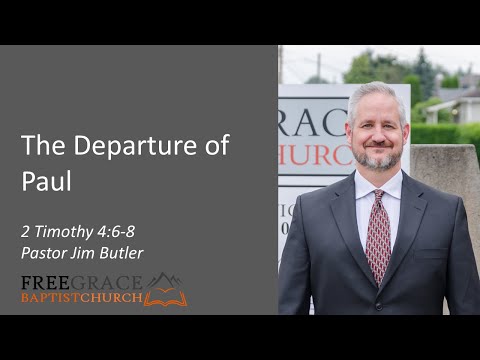
The Departure of Paul

Paul's final written words in 2 Timothy 4:6–8 disclose the mind of a man at the eleventh hour of his life: conscious of imminent martyrdom, yet unshaken in confidence. The sermon works through three movements — the apostle's present situation as a drink offering poured out (v. 6), his past perseverance in fight, race, and faith (v. 7), and his future hope in the crown of righteousness (v. 8). Central to the exposition is the insistence that the crown of righteousness is not a reward for performance but a confirmation of justification by faith alone, the imputed righteousness of Christ conveyed freely by the righteous judge. The application presses every believer to live now in such a way that the eleventh hour may be faced with the same God-graced confidence Paul displays here.

The Refuge for God's People
Psalm 46 sets the people of God in the midst of cosmic and political chaos and calls them to find their sole refuge in the Lord of hosts. This exposition works through four movements in the psalm — the assurance of God's presence, the demonstration of his power over creation and the nations, the invitation to rehearse his past works in redemptive history, and the command to be still and know that he is God. The sermon argues that Reformed Christians who rightly confess God's sovereignty in salvation must equally rest in that sovereignty under tyranny, pandemic, and war. The chief application is that the church must know God — his perfections, his names, his covenant fidelity — because it is the knowledge of God, not practical principles, that steadies the soul and fuels missionary confidence in the darkest of times.

The Christian's Duty toward Non-Christians
Titus 3:1–3 sets out the Christian's duty toward both civil government and all people outside the church. The sermon traces the divine origin of civil government from Genesis 9 through Romans 13 and 1 Peter 2, arguing from Francis Turretin's two-kingdom framework that Christ rules both the civil and spiritual spheres, and that the civil state therefore has no authority to command the church as church. Verse 3's catalogue of pre-conversion vices — foolishness, disobedience, malice, hatred — is read as a theological reason for patient, peaceable, and humble conduct toward non-Christians: believers were once exactly what they now struggle to bear in others, and those others may yet become objects of the same sovereign grace.
The Sovereignty of God
Proverbs 3:19–20 grounds God's sovereignty not merely in creation but in every sphere of existence — the world was founded by divine wisdom, and that same sovereign wisdom governs all of history and secures the redemption of His people. Drawing widely from Proverbs alongside Genesis, the Psalms, Daniel, and Romans, this sermon traces three distinct expressions of God's sovereignty: His free, unconstrained creation of all things; His comprehensive providence over human affairs including civil government; and His eternal purpose in redemption, centred in the pre-existent Christ of Proverbs 8. The practical force of the message is that divine sovereignty — rightly understood — produces neither fatalism nor hyper-Calvinist passivity, but rather deep comfort, stable faith, and the use of appointed means, all to the glory of God.
The Imprisonment and Release of the Apostles
Acts 5:17–26 records the arrest, miraculous release, and re-arrest of the apostles at the hands of a Sanhedrin dominated by Sadducees — the very men who denied the existence of angels. The angel who opens the prison doors and the apostles who immediately return to temple preaching together demonstrate that no earthly authority can silence the gospel of Jesus Christ. This passage is treated as a paradigm for the church's experience throughout history: faithful proclamation will always draw persecution, yet Christ is building His church and the gates of hell shall not prevail against it. The sermon calls hearers to remember the globally persecuted church, to pursue the boldness of the apostles, and to believe the words of this life — the gospel of forgiveness and imputed righteousness in Christ.
The Hope of the Resurrection
Paul's closing words in 2 Timothy 4:6–8 set before the church three interlocking realities: his present situation as a condemned man being poured out as a drink offering, his past perseverance across the full course of Christian warfare, and his future hope — the crown of righteousness awarded by the righteous Judge on the day of resurrection. The sermon argues that the resurrection hope is not a passive consolation but the very engine of faithful Christian living: Paul fought, ran, and kept not as an ascetic but because of the surpassing worth of Christ and the certainty of what awaits. Believers are exhorted to examine whether they are presently fighting, running, and keeping — for what is said in the eleventh hour can only be said because of what was done faithfully in hours one through ten.
2LCF Chapter 24 - Of the Civil Magistrate
Civil government is not a social convention or mere human compact but a divinely instituted ordinance answerable to God Most High — and that divine origin is simultaneously the source of its authority and the boundary of its competence. This study of 2LCF Chapter 24 works through three paragraphs: the nature, purpose, and power of the magistrate (including the sword and capital punishment); the lawfulness of Christian participation in government against Anabaptist objections; and the Christian's duties of submission and intercession toward civil rulers. The abiding application is that Christians must neither deify the state nor abandon it, but submit to it in all lawful things, resist it when it commands sin, and pray for the conversion and restraint of those who govern.

The Minister's Duty to Endure Hardship
Paul's command in 2 Timothy 2:3–7 that Timothy endure hardship is not a gentle suggestion but an apostolic imperative addressed to every minister of the gospel in every age. Working through three interlocking metaphors — the soldier, the athlete, and the farmer — this exposition shows that faithful gospel ministry requires the devoted single-mindedness of a soldier who lives to please his commander, the disciplined self-denial of an athlete training for an imperishable crown, and the diligent hard work of a farmer who knows that cause and effect govern his harvest. A fourth element, drawn from verse 7, calls the minister to be a dedicated disciple who meditates on apostolic doctrine and trusts the Lord to give understanding through that Word alone. The whole passage is set within the larger purpose of the ministry: the glory of God, the edification of the saints, and the salvation of sinners by sovereign grace.

The Death Penalty
Romans 13:1–4 grounds the civil magistrate's authority to execute criminal offenders not in political theory but in the creational ordinance of Genesis 9:6 and the delegated wrath of God. The sermon traces a biblical theology of capital punishment from the Noahic covenant through the Mosaic economy into the New Testament, demonstrating that the sword Paul assigns to the magistrate in Romans 13 is no metaphor but a mandate. Common objections — drawn from Exodus 20:13, Matthew 5:38–42, and John 8 — are answered exegetically, and pragmatic objections (racial disparity, deterrence, forgiveness) are answered from Scripture and reason. The hearer is called to submit to governing authorities as God's ordained ministers of justice, to renounce private vengeance, and — if an unbeliever — to flee to Christ before facing the ultimate Judge whose assessment of the heart no magistrate can anticipate.
Paul's Departure
What does it look like to face death with settled confidence and undimmed gospel zeal? This exposition of 2 Timothy 4:6–8 examines Paul's final written words — his description of his impending martyrdom as a drink offering poured out, his retrospective claim to have fought, finished, and kept, and his forward-looking anticipation of the crown of righteousness. The sermon presses the point that the composure Paul displays in his prison cell is inseparable from the Christ-centered, gospel-saturated life he lived in every preceding hour, summoning hearers to the same persevering faith and eschatological hope.