
Cited in sermons
John Flavel
42 sermons · All people cited
The Fear of God

Proverbs 1:7 declares that the fear of the Lord is the beginning of knowledge, yet this disposition is widely misunderstood and neglected among professing Christians. This topical survey distinguishes slavish fear from filial fear, demonstrates from Romans 3, Jeremiah 32, and the book of Proverbs that true fear of God is a gracious implantation sovereignly worked in the regenerate soul, and traces its necessary effects on the mind, the conduct, and the perseverance of believers. The sermon closes by calling both individual believers and the corporate assembly to cultivate this fear — in personal holiness, in theological engagement, and in God-directed, regulative-principle worship.

The Covenantal Context of the Incarnation
The Incarnation of the Son of God was not an afterthought but the execution of an eternal, intra-Trinitarian covenant — the covenant of redemption — in which the Father gave the Son a definite number of elect people, and the Son willingly undertook to be their covenant surety and mediator. Drawing on Hebrews 10:5–10, John's Gospel, Isaiah 53, Romans 5, and Ephesians 1, this study presents three lines of biblical evidence: the relationship between the Father and the Son, the covenantal language applied to that relationship, and the pre-temporal foundation of the Son's redemptive work. The practical force is doxological and pastoral: believers are eternally secure because their salvation rests not on their own resolve but on a covenant sworn before creation, in which Christ bore a covenant of works on their behalf, obeying perfectly so that his righteousness might be imputed to them by faith alone.

The Third Announcement of Jesus' Death
Matthew 20:17–19 records Jesus' third and most detailed formal announcement of his coming death, functioning as a table of contents for the remainder of Matthew's Gospel. The passage identifies four prophetic elements: the betrayal of the Son of Man to the Sanhedrin, the Jewish council's condemnation, the delivery to the Gentiles for mocking and scourging, and the triumph of resurrection on the third day. This announcement is grounded in the Covenant of Redemption — the pretemporal compact between Father, Son, and Holy Spirit — the fulfillment of Old Testament Scripture, and the necessity of saving God's elect from their sins. The sermon calls the church to receive, embrace, and worship in response to the gospel, and calls the unbeliever to flee the wrath of God by faith in Christ crucified and risen.
2LCF Chapter 7 - Of God's Covenant, Part 3

The Covenant of Redemption (pactum salutis) is the pre-temporal, intra-Trinitarian agreement between the Father and the Son in which the Father gives a particular people to the Son and the Son willingly undertakes to be their mediator and surety. This teaching examines the definition, parties, stipulations, and promises of the pactum, traces its exegetical foundations across both Testaments, and shows how it grounds the Covenant of Grace and underwrites definite atonement. Understanding the Covenant of Redemption provides believers with firm assurance, because the immutable and impassible God has covenanted in eternity to save the elect in Christ, and that plan cannot fail.

The Pursuit of Christian Unity
Ephesians 4:1–3 commands believers to walk worthy of their calling by cultivating four virtues — lowliness, gentleness, long-suffering, and forbearing love — as the means by which the church maintains the Spirit-wrought unity already given to it. The sermon distinguishes this genuine, truth-grounded unity from any ecumenicism that achieves togetherness by dissolving doctrinal conviction. Because the Holy Spirit is the author of church unity and the triune God is its ultimate foundation, to abandon the pursuit of it is to dishonor God himself. Hearers are pressed to give diligent, active effort to preserve what the Spirit has produced, and those outside of Christ are reminded that Christian ethics, including the pursuit of unity, can only flow from salvation by grace alone through faith alone in Christ alone.
The Superstructure of Grace
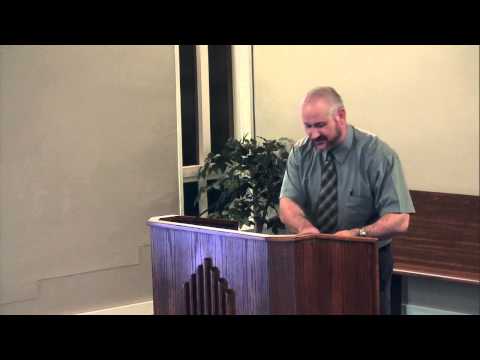
Romans 8:32 sets forth what Thomas Manton called 'the superstructure of grace': because the Father did not spare his own Son but delivered him up as substitutionary, propitiatory, sin-bearing, and curse-bearing sacrifice for all the elect, it necessarily follows that he will freely give them all things besides. The argument moves from the greater to the lesser — if God has done the immeasurably costly thing, he will certainly not withhold the lesser mercies of guidance, strength, and ultimate glory. The sermon closes by calling believers to rest the full weight of their security, sanctification, and glorification on this one redemptive foundation, and to come to the Lord's Table in that confidence.
The Fear of God
The fear of God is the necessary prerequisite for wisdom, right thinking, and right conduct before a holy God — yet fallen man possesses none of it apart from sovereign grace. Drawing primarily from the book of Proverbs, this sermon traces four observations: the fear of God is wrought by divine grace (not moral effort), it governs the mind, it shapes behavior, and it preserves the soul in perseverance. The sermon closes with practical applications to personal cultivation of the fear of God, corporate worship governed by reverence, and a call to unbelievers to come to Christ — the one through whom God plants his fear in the heart.
The Covenant of Redemption
The Covenant of Redemption (pactum salutis) is the eternal, intra-trinitarian pact in which the Father gave a definite people to the Son, the Son covenanted to serve as their surety and mediator, and the Spirit proceeds to apply the accomplished redemption — forming the unchanging foundation upon which the Covenant of Grace rests in history. Working through key texts in John, Hebrews, Ephesians, Philippians, and Acts, the sermon demonstrates that Christ's obedience, death, and exaltation were not afterthoughts but the execution of a pre-temporal divine agreement. Because salvation rests on the Father's eternal purpose and the Son's perfect obedience rather than on the believer's performance, the doctrine of the Covenant of Redemption is presented as the primary ground of lasting Christian comfort, peace, and perseverance.
The High Priest of the New Covenant
Hebrews 7:20–28 presents Jesus Christ as the high priest of the new covenant who surpasses the entire Levitical order in three decisive respects: his appointment by divine oath rather than tribal descent, his permanent and unchangeable priesthood grounded in an endless life, and his sinless character and once-for-all self-offering. The sermon expounds why Christ's eternal intercession and definitive sacrifice leave nothing undone for the salvation of his people, pressing these doctrines as the ground of perseverance against every temptation to seek completeness elsewhere.
The High Priest of the New Covenant
Hebrews 7:20–8:6 presents Christ as the High Priest of the New Covenant, whose priestly office rests on four pillars: a divine oath, a permanent and unchangeable priesthood, a sinless character, and a heavenly ministry in the true tabernacle. Because Christ is the surety of the better covenant — bearing the full debt of sinners in the place of finite Levitical priests who died without completing what they began — He saves completely and finally all who come to God through Him. The sermon calls both unbelievers to abandon self-reliance and bow to this all-sufficient Savior, and believers to rest their assurance not on their own performance but on the unchangeable priesthood of Christ.
The Purpose of Proverbs
Proverbs 1:1–7 sets out both the purposes of the book and the indispensable prerequisite for benefiting from it. The sermon traces five interlocking purposes — general, judicial, formative for the young, moral, and intellectual — showing that the Proverbs are not a self-help manual but a comprehensive word-and-life guide for those already justified by grace and now pressing on in sanctification. The ruling principle that unlocks the entire book is the fear of the Lord, which is not a slavish terror but a covenant grace implanted in the regenerate heart — 'twas grace that taught my heart to fear. The sermon closes with an urgent call to believe the gospel first, and then to take up Proverbs daily, chapter by chapter, as the God-given instrument for growing in practical wisdom.
Christ's Circumcision
Colossians 2:11–12 is frequently marshalled by paedobaptists to argue that baptism has replaced circumcision as the covenant sign and therefore ought to be administered to infants, but the passage cannot bear that weight. This sermon works through three preliminary observations — the structure of covenant theology, the relationship between circumcision and baptism, and the actual point of the passage — before exegeting verses 11–12 directly. The circumcision Paul describes is spiritual regeneration performed by Christ without hands, and baptism is its retrospective public sign, not a parallel to the prospective sign of physical circumcision given to Abraham's infant sons. The sermon closes with a sharp warning against any gospel that supplements Christ's finished work, insisting that justification is an alien, forensic righteousness imputed to the believer by grace alone through faith alone in Christ alone.