
Cited in sermons
John Calvin
990 sermons · All people cited

The Qualifications for Elders

What qualifications does Scripture require of a man before he may serve as an elder in a local church? Expounding 1 Timothy 3:1–7, this sermon establishes that the elder, overseer, and pastor are three terms for one office, and that the qualifications Paul lists are not recommendations but binding mandates. The sermon works through the first qualification — a genuine, rightly-motivated desire for the office — and frames it within four criteria for evaluating a call to ministry: right motives, graces indicating genuine Christian experience, gifts indicating divine provision (especially aptness to teach), and providential opportunity. The congregation is exhorted to apply these standards carefully and not to install any man, however virtuous or personable, who lacks the God-given ability to preach and teach the word.

The Meeting with Nicodemus
John 3:1–10 presents Jesus confronting Nicodemus — a ruler of the Sanhedrin sent by the Jerusalem religious leadership — with the doctrine of regeneration: that a man must be born again, born from above, before he can see or enter the kingdom of God. The sermon argues that the new birth is entirely a sovereign act of God Most High, not a command for the sinner to obey by his own power, and that regeneration logically precedes and produces saving faith rather than following it. Those born of God will evidence that new life through faith in Christ, a practice of righteousness, love for the brethren, and an overcoming of the world.

Exodus 12, Part 2
Exodus 12:29–51 records the execution of the tenth plague, the departure of Israel from Egypt, and the regulations governing who may participate in the Passover. The death of every firstborn in Egypt—from Pharaoh's throne to the dungeon—is presented not as arbitrary cruelty but as the righteous retribution of a holy God against a nation that had enslaved and slaughtered His people, fulfilling the promise made to Abraham in Genesis 15. The Passover ordinance, with its requirements of circumcision for participation and the prohibition against breaking the lamb's bones, functions typologically to point forward to Christ, who is our Passover sacrificed for us, whose bones were not broken at the crucifixion.

The Cleansing of the Temple
Jesus' cleansing of the temple in John 2:13–17 is not an aberration from his character but a direct expression of his identity as the Son of God and the antitype of the temple itself. The passage reveals two inseparable realities: the apostasy of first-century Israel's worship and the messianic zeal prophesied in Psalm 69, Malachi 3, and the post-exilic prophets. Christ's authority to purge the temple rests on his sonship by nature, not adoption, and his action announces that the entire Old Covenant sacrificial system finds its fulfillment in him. The sermon calls the church to recover zeal for the purity of God's worship, to identify and resist the defections of contemporary Christendom, and to look in faith to the Lamb who has displaced every animal sacrifice.

Exodus 11
Exodus 11 announces and describes the tenth plague — the death of the firstborn throughout Egypt — which God executes directly and immediately, without mediation through natural means. The chapter is structured around three movements: the promise of liberty and prosperity to Israel, the announcement of sweeping judgment upon every household in Egypt, and Pharaoh's continued, God-ordained rebellion. The hardening of Pharaoh's heart is treated not as mere divine permission but as a just act of sovereignty, displaying God's power, holiness, and mercy simultaneously — mercy to Israel being inseparable from judgment upon her oppressors.

The Wedding at Cana of Galilee
John 2:1–12 recounts the wedding at Cana, where Jesus turns water into wine as the first of his public signs. The sermon traces three movements in the passage — the setting, the sign, and the summary — and argues that the miracle is not merely a display of power over nature but a prophetically charged inauguration of new covenant abundance, anticipated by Isaiah, Jeremiah, Joel, Amos, and Zechariah. The water pots of Jewish purification give way to wine that surpasses what came before, signifying that the grace and truth that came through Jesus Christ exceeds the law given through Moses. The closing application presses hearers to heed the one command Mary gives in all of Scripture: whatever Jesus says, do it.

The Crucifixion of Jesus, Part 2
Matthew 27:39–44 records the threefold mockery of Christ on the cross — by passing bystanders, by the chief priests and scribes, and by the robbers crucified alongside him. Each taunt — that he could not save himself, that his kingship was fraudulent, that his claim to divine sonship was false — is shown to be an ironic confirmation of the very things the mockers deny: Christ's identity as temple builder, King of Israel, and Son of God. His refusal to descend from the cross is not weakness but the perfect obedience of the covenant of redemption, the very means by which he saves his people from their sins. The sermon closes with the conversion of the penitent thief as a trophy of sovereign grace and an argument for faith in a willing Savior.

2nd London Baptist Confession of Faith (1689) - Sunday School Study - August 29, 2021
What does it mean that God is 'without body, parts, or passions'? This study works through Chapter 2, Paragraph 1 of the Second London Baptist Confession of 1689, examining the perfections of God under three classical categories: divine incorporeality (God has no body), divine simplicity (God is not composed of parts), and divine impassability (God does not undergo emotional change). By grounding each doctrine in Scripture and the church's historic theological grammar — including the distinction between proper and improper predication, accommodation, and anthropomorphism — the exposition argues that God's transcendence over every creaturely category is not a cold abstraction but the very foundation of confident worship and unshakeable assurance for his people.

The Pharisee and the Publican
This exposition of Luke 18:9–14 examines the parable of the Pharisee and the publican as a penetrating diagnosis of self-righteousness and a declaration of justification by faith alone. The sermon works through the occasion of the parable, the contrasted characters of the two men, and Christ's concluding verdict that the tax collector — not the Pharisee — went home justified. The central contention is that acceptance before God rests entirely on the imputed righteousness of Christ received through faith, not on any moral performance or religious accomplishment, and that those who understand this will be marked by humility rather than contempt toward others.

The Enthronement of the Priest-King
Psalm 110, the most frequently cited Old Testament passage in the New Testament, presents the Messiah as the divinely enthroned Priest-King whose universal dominion is secured by the oath of God. This exposition traces three movements in the psalm: the enthronement and government of Christ the King (vv. 1–3), his eternal priesthood after the order of Melchizedek (v. 4), and the triumphant conquest of his enemies (vv. 5–7). The sermon draws on Peter's argument in Acts 2, Paul's application in 1 Corinthians 15 and Ephesians 1, and the author of Hebrews to show that Christ's present session at the right hand of the Father is not passive but active — he reigns, subdues, and intercedes. Christians living in tumultuous times are urged to resist despair by fixing their confidence in the sovereign rule of the enthroned Priest-King rather than in the shifting circumstances of earthly politics.

1 Peter 1:6-9

The paradox of simultaneously rejoicing and grieving marks the Christian life as Peter describes it in 1 Peter 1:6–9. Trials are not accidents of providence but a necessary divine instrument: God uses suffering to prove and purify a faith that is more precious to Him than refined gold is to men, and that tested faith will issue in praise, honor, and glory at the revelation of Jesus Christ. The principle for maintaining joy amid suffering is not mere willpower but a growing, knowledge-grounded faith fixed on Christ — His cross, His resurrection, and the inheritance He has secured — so that joy becomes the constant fruit of right focus rather than a fluctuating response to circumstances.

1 Peter 1:3-5
The believer's hope of glory, grounded in 1 Peter 1:3–5, is not a vague aspiration but a certain inheritance secured by God's sovereign mercy and the resurrection of Christ. Peter's doxology unfolds the doctrine of salvation under three headings: God the Father as its author, the nature of that salvation as a living hope pointing to a new creation, and the certainty of preservation by divine power. Because both the inheritance and the heirs are kept — the one reserved in heaven, the other shielded by omnipotence through faith — believers facing trial are called to reorient every earthly sorrow toward the glory that is to come.

The First Disciples of Jesus
John 1:35–51 records the calling of the first disciples of Jesus — Andrew, Simon Peter, Philip, and Nathanael — and the passage frames their coming to Christ as the inevitable fruit of John the Baptist's preparatory ministry and the sovereign grace of God. The sermon traces how each disciple is drawn to Christ, how each immediately brings another, and how the accumulating titles given to Jesus in this section — Lamb of God, Rabbi, Messiah, Son of God, King of Israel, Son of Man — build a Christological portrait that mirrors the prologue's declaration that the Word was God. Christ's omniscience in knowing Nathanael and his royal authority in renaming Simon Peter underscore that these disciples are not choosing a teacher but being conquered by a divine Savior. The pattern of Andrew fetching Peter and Philip fetching Nathanael becomes the sermon's model for evangelism: those saved by sovereign grace become, without coercion or manipulation, propagators of that same grace.

The Crucifixion of Jesus, Part 1
Matthew 27:32–38 records the crucifixion of the Lord Jesus Christ with studied brevity, and this expository sermon works through each verse to show that every detail — from the place called Golgotha to the division of garments and the charge above his head — is the deliberate fulfillment of Old Testament Scripture, not an accident or afterthought in the plan of God. The sermon traces the thread from the proto-gospel of Genesis 3:15 through the typological head-wounds of Israel's enemies to Christ's death blow against the devil at the place of the skull. Three concluding applications draw out the pastoral weight: the unwitting testimony of Pilate, the triumph of the skull-crushing seed of the woman, and the immeasurable love of the Savior who was stripped naked, numbered with transgressors, and crucified so that his people might be clothed with his righteousness, received in glory, and given everlasting life.

The Testimony of John the Baptist, Part 2
John 1:29 records the Baptist's singular declaration — 'Behold the Lamb of God who takes away the sin of the world' — a phrase saturated with the weight of Old Testament redemptive history. This sermon works through the theological freight of that title, tracing the Lamb through Genesis 22, Leviticus 16, and Isaiah 53 to show that Christ's mission is substitutionary blood atonement: he takes up the sin of his people in order to take it away entirely. The 'world' from which sin is removed is not every individual without exception but men and women without ethnic or national distinction, saved by grace alone through faith in Christ alone.

The Neglect of Weighty Matters
Jesus condemns the scribes and Pharisees in Matthew 23:23–24 not for tithing mint, anise, and cumin, but for doing so while neglecting the weightier matters of the law: justice, mercy, and faith. The Pharisaic imbalance is neither ancient nor extinct — the same tendency to obsess over religious minutiae while bypassing the moral and covenantal substance of God's law persists in the church today. Drawing on Micah 6:8, Hosea 6:6, and the broader prophetic tradition, this exposition argues that genuine obedience to God is universal and balanced, not selective and performative.

The Defense of the Faith
Jude 3 commands every believer — not merely pastors or theologians — to contend earnestly for the faith once for all delivered to the saints. This sermon examines the exhortation itself, the internal threat posed by sneaky, ungodly apostates who pervert grace and deny Christ, and the practical preparedness Jude prescribes: remembering apostolic warning, building up on the most holy faith through Scripture and prayer, and resting in the assurance that God himself preserves his people. The defense of the faith is not pessimistic trench-holding but confident advance grounded in Christ's promise to build his church against which the gates of Hades shall not prevail.

Live Stream - July 11, 2021
John 1:18 presents two inseparable doctrines: the invisibility and incomprehensibility of God, and the revelation of that invisible God through the incarnate Word. The sermon works through the prologue of John's Gospel to show that while no creature has ever perceived the essential glory of God — not Abraham, not Moses, not Isaiah — the only begotten Son, who exists eternally in the bosom of the Father as a distinct yet consubstantial person of the Trinity, has exegeted the Father to us. The practical burden is that saving knowledge of God is not merely knowledge about the economy of redemption but knowledge of the Redeemer himself — Father, Son, and Holy Spirit — and that the chief end of man is to glorify and enjoy this triune God forever.

The Ministry of the Word
What is the basis and method of God's ordained means for saving sinners? This sermon on 2 Timothy 4:2 argues that the preaching of the Word stands as the primary instrument through which God saves the lost and builds his church, grounding that claim in the logical chain of Romans 10, the divine pleasure announced in 1 Corinthians 1, and the final apostolic charge of Paul to Timothy. The sermon challenges the contemporary drift toward audience-driven church strategies, calling both preachers and hearers to fidelity to the proclaimed Word as the irreplaceable means of grace.

The Soldiers Mock Jesus
The mockery of Jesus by the Roman soldiers in Matthew 27:27–31 is examined as a Lord's Supper meditation, tracing the psychological and physical brutality inflicted on the Son of God after Pilate's verdict. The scene is read through the lens of fulfilled prophecy — Isaiah 50:6 and Isaiah 53 — and the covenant of redemption, in which Christ willingly undertook every indignity as the surety and substitute for his people. The sermon closes by turning to the book of Revelation to show that what the soldiers performed in jest — robing, crowning, and hailing a king — Christ possesses in eternal reality, and calls believers to respond with the genuine homage these soldiers withheld.

The Hope of the Nations
Psalm 67 frames both the church's need for God's mercy and the church's missionary calling to the nations as inseparable realities. The psalmist's threefold petition — mercy, blessing, and communion with God for the church — is the ground from which prayer for the salvation, worship, and righteous governance of the nations flows. Drawing on the Aaronic blessing, the Abrahamic covenant, and the New Testament's Great Commission, the sermon argues that the church's received grace creates an inescapable obligation to proclaim that grace to the ends of the earth. The closing application calls the congregation to corporate prayer, support of the missionary enterprise, and fidelity to the gospel message as the only means God has ordained for the hope of the nations to be realized.
Wednesday Night Bible Study (Exodus 11:1-10) - June 23, 2021
Exodus 11 presents the announcement of the tenth and decisive plague upon Egypt, the death of the firstborn, through which God simultaneously crushes Egyptian tyranny and liberates his covenant people Israel. The chapter is examined in three movements: the announcement of the plague with its accompanying promises of liberty and prosperity (vv. 1–3), the description of the plague emphasising God's immediate and sovereign action (vv. 4–8), and the rebellion of Pharaoh as the occasion for the multiplication of God's wonders (vv. 9–10). The sermon presses beyond the historical narrative to show how the destruction of God's enemies is inseparable from the blessing of God's people — a pattern running from Exodus through Joshua to Revelation — and grounds both divine sovereignty and human responsibility in the theological framework of the 1689 Second London Confession chapters 3 and 5.

2nd London Baptist Confession (Chapter 1) - June 20th
What makes Christian faith in the Bible something more than a blind leap? Working through the first five paragraphs of Chapter 1 of the 1689 London Baptist Confession of Faith, this exposition unpacks Sola Scriptura under three headings drawn from the Confession's opening line: the certainty, sufficiency, and infallibility of Holy Scripture as 'the only sufficient, certain, and infallible rule of all saving knowledge, faith, and obedience.' The sermon establishes that the Bible's authority rests on God himself as its author — not on church tradition, human reason, or self-referential claim — and that full persuasion of its divine origin comes through the inward testimony of the Holy Spirit (2LCF 1.5). Rational evidences — manuscript attestation, historical reliability, eyewitness testimony to the resurrection, and the fulfillment of prophecy — are presented not as the ground of faith but as means to bolster the believer's confidence and equip him to give a reasoned defense of the hope within him.

Psalm 24
Psalm 24 asks who may ascend into the hill of the Lord and stand in his holy place — a question that exposes the impossibility of any sinner approaching a holy God on the basis of personal merit. The psalm is expounded in three movements: the sovereign lordship of Yahweh the Creator over all the earth, the covenant conditions of holy hands and a pure heart that no creature can meet in himself, and the triumphal ascension of the King of Glory who alone meets those conditions and leads his redeemed captives into the presence of God. The righteousness required to enter God's presence is not achieved but received by faith, given freely by the God of salvation through the obedient life, atoning death, and victorious resurrection of the Lord Jesus Christ.

The Incarnation of the Word, Part 1
John 1:14 — 'the Word became flesh and dwelt among us' — is the hinge on which all Christian theology turns. This exposition works through the identification, the incarnation proper, and the indwelling presence of the Word, establishing that the eternal Son assumed a true human nature (body and soul) without ceasing to be the second person of the Trinity — the doctrine the church confesses as the hypostatic union. The sermon draws on the active and passive obedience of Christ to show that the incarnation was not primarily exemplary but redemptive: the Word took flesh to render the perfect obedience sinners owe and to shed the blood that purchases their forgiveness. Hearers are pressed to see Christ not only as Redeemer but as reigning King, and the unbeliever is called to receive, by faith alone, that righteousness which comes from God.

The Lord Jesus and the Demoniacs
Matthew 8:28–34 presents Christ's authority over demonic powers as a ground for confident trust in him as the Son of God. The demons' own confession — 'You Son of God' — exposes what the disciples have not yet grasped: that Jesus holds sovereign dominion over every spiritual power, including the devil himself. The exorcism at Gerasa is set within Matthew's sustained demonstration, across chapters 8–9, that the one who teaches with authority also acts with authority. If Christ has conquered death and the devil, every lesser affliction that threatens the people of God lies well within his sovereign reach.

Exodus 10
Exodus 10 records the eighth plague of locusts and the ninth plague of darkness, both of which expose Pharaoh's hardened pride and vindicate the sovereignty of God over Egypt, its rulers, and its gods. The hardening of Pharaoh's heart is examined not as a capricious act but as a judicial act of divine justice against a man and a dynasty already guilty of enslaving and murdering God's people. The passage carries forward two covenantal purposes: the public declaration of God's supremacy and the transmission of that knowledge to successive generations within the covenant community. Believers are called to pray for God's glory above all earthly concerns, to refuse embarrassment over God's justice, and to trust his sovereignty even in prolonged seasons of affliction.

The Call to Faithfulness in Perilous Times
Paul's warning in 2 Timothy 3:1–9 concerns not pagan opposition but a more dangerous internal threat: professing Christians within the local church who bear the outward form of godliness while denying its power. The sermon works through the passage in four movements — recognising the danger of 'the last days,' identifying the vice list under categories of pride, lovelessness, disobedience, slander, and treachery, heeding the exhortation to withdraw from such persons, and receiving encouragement that their folly will be publicly exposed. The congregation is called to maintain vigilant, doctrinally grounded churchmanship, to agonise over the church's internal corruptions as Ezekiel's faithful remnant did, and to resist both despair and naivety, trusting Christ's promise that the gates of Hades shall not prevail against his church.
Introduction to the 1689 Second London Baptist Confession of Faith
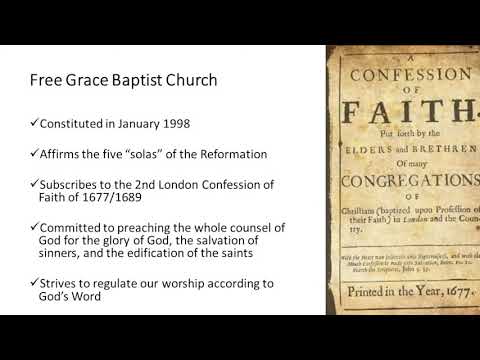
Why should a church bind itself to a confession of faith? This introductory lesson on the Second London Baptist Confession of 1677/1689 grounds the answer exegetically in Ephesians 4 — where Christ gives gifted men to the church so that the body attains doctrinal unity and is no longer tossed about by every wind of teaching — and then traces the historical origins of the 1689 among the Particular Baptists, distinguishing them from Anabaptists, Presbyterians, and Congregationalists. Four functions of a confession are developed: defining, defending, discriminating, and disciplining with reference to the doctrine of the church. The lesson closes by distinguishing Reformed theology (Calvinism plus covenant theology plus the regulative principle) from mere five-point Calvinism, and by defending the confession's silence on matters of Christian liberty as a feature, not a defect.

The Trial Before Pilate, Part 3
Matthew 27:24–26 records the sentencing of Jesus by Pontius Pilate — the culmination of a trial in which the governor thrice declared the accused innocent yet delivered him to crucifixion anyway. The sermon examines Pilate's hypocritical self-absolution by the washing of hands, the crowd's willing acceptance of blood-guilt and its ominous extension to their children, and the formal scourging and condemnation of Christ. Throughout, the exposition presses the double benefit of the gospel: the forgiveness of sins and the imputation of Christ's righteousness received by faith alone, both grounded in the penal substitutionary atonement symbolised by Barabbas going free while the just one goes to the cross.