
Cited in sermons
John Calvin
990 sermons · All people cited

2LCF Chapter 19 - Of the Law of God

2 London Baptist Confession of Faith Chapter 19 sets forth a comprehensive doctrine of the law of God, tracing its origin in the covenant of works given to Adam, its threefold division into moral, ceremonial, and judicial law under the Mosaic economy, and its continuing role in the life of the New Covenant church. The moral law, rooted in creation and specially revealed at Sinai in the Ten Commandments, retains its binding force for all persons, while the ceremonial law finds its divinely designed terminus in the person and work of Christ, and the judicial law expired with the dissolution of the Israelite state. The sermon closes with a christological summary: Christ alone actively obeyed the whole law in the room and stead of the elect, bore the law's curse in his passive obedience, and now governs the hearts of his people by his Spirit according to that same law.

The Commission Given to Joshua

Joshua 1:1–9 records the divine commission given to Joshua upon the death of Moses — a commission built on four pillars: the reminder of God's covenant promise, the blessing of God's presence, the charge to courageous obedience, and the centrality of God's Word. God's appointment of Joshua as Moses' successor demonstrates that sovereign providence works through human instruments, yet is never bound to them; the faithfulness of God outlasts every leader. The sermon draws a direct line from the conquest commission to the Great Commission of Matthew 28, arguing that Christ's promised presence with His church is the only sufficient ground for courage and faithfulness in gospel ministry.

Paul in Athens
Paul's encounter with the philosophers and council of Athens in Acts 17:16–34 exposes the persistent and universal nature of idolatry, the sufficiency of general revelation to render all men without excuse, and the necessity of special revelation for salvation. The sermon traces Paul's Mars Hill address to show how the apostle grounds his proclamation in the doctrines of creation, providence, and divine aseity before pressing the call to repentance and warning of coming judgment. Where idolatry blurs the Creator-creature distinction, the gospel restores it — and the varied responses of the Athenians (mockery, curiosity, and saving faith) remind the church that conversion belongs to the Spirit of God, not to the eloquence of the preacher.

Ask FGBC - Podcast with Jim Butler, Dr James Renihan, Dr Richard Barcellos
This roundtable conversation between three pastors and theologians addresses a wide range of questions submitted by church members, covering biblical theology, covenant theology, baptism, eschatology, and Christian living. The discussion moves from how Christ fulfills Old Testament Israel, through the covenantal basis for believers' baptism, to the nature of the eternal state, the hermeneutics of applying Old Testament promises, the place of ethnic Israel in relation to the church, and the means of grace for raising covenant children. Throughout, the speakers return to a consistent Reformed hermeneutic: Christ is the true and greater fulfillment of all Old Testament promise, the church is the eschatological Israel of prophetic expectation, and the ordinary means of grace — Word, prayer, and faithful worship — remain God's appointed instruments for the conversion and nurture of his people.

CTF 2024 Session 1: An Engaging Overview of the Second London Confession of Faith

The Second London Confession of Faith (1689) did not arise in a vacuum but was forged in response to specific doctrinal crises and pastoral needs within the 17th-century particular Baptist churches. This address traces the historical circumstances behind the Confession's 1677 publication — including the Christological heresies of Thomas Collier and Matthew Caffin, the threat of Quaker mysticism, fear of Roman Catholic resurgence, and the pastoral concern for family catechesis. The speaker then surveys the Confession's 32 chapters as a coherent theological architecture, showing how its structure reflects the covenant of grace viewed from both divine and human perspectives. Listeners are urged to recover the Confession as a living instrument of orthodoxy, protection, instruction, and proclamation for the church today.

Ask FGBC #6 - Why is historical confessional Christianity important?
The question of why historical confessional Christianity matters is addressed by examining what Scripture itself says about the gifts Christ gives to his church. Drawing on Ephesians 4 and Matthew 28, the argument is made that creeds and confessions are the accumulated fruit of those gifts — the best doctrinal articulation the church has produced across centuries of theological controversy, from Nicaea and Chalcedon through the Second London Confession. To reject them in favor of a 'no creed but the Bible' posture is not humility but a subtle repudiation of the very ecclesiology the Bible commands, and it leaves individuals without the guardrails that preserve orthodox Christianity.

The Regulation of the Church's Worship
What gives the church the right to dictate the forms of its own worship — and what happens when it does? Expounding 1 Timothy 3:14–16, this sermon grounds the regulative principle of worship in the nature of the church itself: because the church is the house of the living God, the pillar and ground of the truth, God alone determines what is done within it. The sermon surveys the pastoral epistles to show that Scripture consistently prioritizes sound doctrine over therapeutic or culturally-tailored substitutes. The practical call is to use the means God has ordained — corporate prayer, preaching, psalm-singing — trusting that Christ is genuinely present in the midst of his gathered people.

The Empty Tomb and the Risen Lord
The empty tomb of Matthew 28:1–10 is not a symbol or a felt experience but a historical event on which the entire Christian gospel stands or falls. Working through the arrival of the women, the descent of the angel, and the appearance of the risen Lord, this exposition shows that the resurrection was predicted by Christ, attested by angels, and confirmed by the physical presence of the one who holds his disciples as brethren even after their desertion. The sermon closes by grounding the believer's freedom from fear, confidence in advocacy, and obligation to proclamation in the fact that Jesus was raised for our justification.

The Lord's Supper
Paul's rehearsal of the Lord's Supper institution in 1 Corinthians 11:23–26 exposes the Corinthians' wretched conduct precisely because the ordinance comes by divine apostolic command and carries the full weight of Christ's atoning death. The sermon traces four aspects of the Supper: its character as a divine command, as a remembrance generally, as a remembrance of Christ specifically, and as a proclamation of His death until He comes. Christians who absent themselves from this ordinance rob themselves of the Spirit-wrought strengthening that God has annexed to this living symbol of the gospel.

The Whole Armor of God, Part 2
The sword of the Spirit and the necessity of prayer form the offensive weapons of the whole armor of God in Ephesians 6:17–24. This exposition argues that the church is constituted as the pillar and ground of the truth and must wield the Word of God against spiritual enemies rather than substituting entertainment, therapeutic programming, or institutional management for gospel proclamation. Prayer is examined through its manner — constant, Spirit-dependent, watchful, and persevering — and its objects: intercession for all the saints and for gospel boldness in the ministry of the Word. The close of the epistle is read as a benediction grounding grace and peace in the Trinitarian life of God.

The Pharisee and the Publican
Luke 18:9–14 sets before the reader two men whose manner of prayer exposes the only two grounds on which a person can seek acceptance with God: self-righteousness or the imputed righteousness of Christ. The Pharisee's boastful rehearsal of his own religious merits and his contempt for the publican show that pride and the despising of others are inextricably joined. The publican, who can do nothing but beat his breast and cry for propitiation, goes home justified — declared righteous not by what he was or did, but by the alien righteousness of another received through faith alone. The sermon calls hearers to examine whether they stand before God as the Pharisee or the publican, and to come to the Lord's Supper not as a reward for good behavior but as those who rest entirely on Christ's doing and dying.

2LCF Chapter 11 - Of Justification
How is a guilty sinner declared righteous before a holy God? This study of 1689 London Baptist Confession chapter 11 works through the six paragraphs on justification, giving careful attention to the three pairs of denials and affirmations in paragraph one. The confession is set against the Roman Catholic conflation of justification and sanctification, Socinian and Arminian errors regarding faith and evangelical obedience as the ground of justification, and the doctrine of eternal personal justification. The sole ground of the sinner's acceptance before God is the imputed active and passive obedience of Christ, received through faith alone — itself a gift of God — so that God is glorified as both perfectly just and richly gracious in the justification of sinners.
2LCF Chapter 21 - Of Christian Liberty and Liberty of Conscience
Christian liberty, properly understood, is not primarily about matters of lifestyle preference but about the freedom Christ has purchased for believers: freedom from the guilt, power, and punishment of sin, and freedom for joyful, childlike access to and obedience toward God. The 1689 London Baptist Confession chapter 21 unfolds this in three movements — the definition of Christian liberty (paragraph 1), the protection of liberty of conscience (paragraph 2), and the qualification that Christian liberty is never a license to sin (paragraph 3). Central to paragraph 2 is the confession's axiomatic claim that God alone is Lord of the conscience, which means neither civil authority nor ecclesiastical authority may bind the conscience beyond or against the Word of God. The practical application presses believers to distinguish between God's explicit commands and their own preferences, and to resist the near-universal temptation to elevate personal opinion to the status of thus saith the Lord.

The Whole Armor of God, Part 1
Ephesians 6:10–17 calls the believer to armed, active resistance against a spiritual enemy whose power and cunning exceed any merely human opposition. The sermon works through three movements in the passage: the necessity of the armor (vv. 10–11a), the reason for it in the reality of demonic spiritual warfare (vv. 11b–12), and the meaning of each defensive piece — truth, righteousness, the gospel of peace, faith, and salvation — drawn from both Old Testament background and Paul's wider corpus. Against the tendency toward either passive Christianity or an obsessive preoccupation with demonic activity, the text calls every believer to stand, hold ground, and advance, doing so entirely in dependence on the power of the risen and ascended Christ who reigns over all principalities and powers.

The Servant and Master Relationship
Ephesians 6:5–9 concludes Paul's household code by addressing the obligations of both bondservants and masters in first-century Greco-Roman society. The passage insists that redemption in Christ does not dissolve temporal social obligations: the slave must obey with a heartfelt, Christ-centered, and eschatologically grounded sincerity, while the master must forsake threatening and govern with the knowledge that he too stands under an impartial heavenly Master. The sermon applies this to the modern employer-employee relationship through four principles drawn from Proverbs and the parallel passage in Colossians 3: the condemnation of laziness, the commendation of diligence, the consideration of Christ in all things, and the cultivation of self-control as the Spirit-wrought fruit that undergirds every godly social relation.
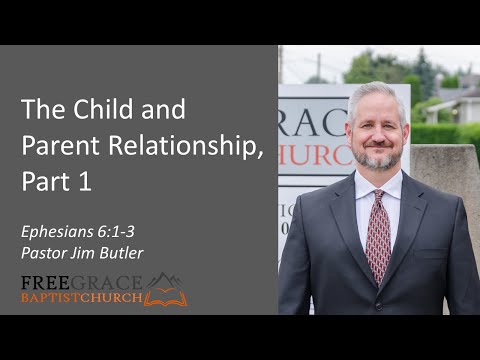
The Child and Parent Relationship, Part 1
Ephesians 6:1–3 addresses children directly within the gathered congregation, a detail that itself carries ecclesiological weight: Paul assumes children are present under the preaching of the Word, not segregated from it. The sermon works through two movements — the rightness of obedience grounded in the light of nature and created order, and the requirement of God's law grounded in the fifth commandment (Exodus 20:12; Deuteronomy 5:16), which Paul universalizes from Old Covenant Israel to Gentile children in Ephesus and, by extension, to every generation. The three uses of the law are carefully distinguished: the law cannot justify, but it restrains, reveals sin and the need for Christ, and then normatively patterns the sanctified life of the believer. Children are urged to search their hearts, see their failure to honor and obey, and flee to Christ for the righteousness they lack.

The Sanctity of Life
The sixth commandment's prohibition of murder rests on the foundation that man is made in the image of God — a dignity that attaches to every human being at every stage of life, including the preborn child in the womb. Exodus 21:22–25 addresses the case of a pregnant woman injured during a fight, and the Hebrew text's use of normal birth language rather than miscarriage terminology establishes that the child in the womb is covered by the same lex talionis as any other person. The sermon works through the biblical witness to the imago Dei across the whole of human life — pre-fall, post-fall, in infancy, disability, sickness, old age, and the womb — before turning to the passage in Exodus as concrete civil legislation protecting that dignity. The law condemns the sin of abortion without reservation, yet the sermon closes by directing the guilty to the gospel: the blood of Christ cleanses from all sin, including this one.

The Defense of the Faith
Jude 3 commands every believer — not merely clergy or scholars — to contend earnestly for the faith once for all delivered to the saints. This sermon expounds the exhortation, its rationale in the infiltration of ungodly men who pervert grace and deny Christ, and the practical readiness required: remembering apostolic warnings, building on Scripture, praying in the Spirit, and looking for the mercy of Christ at His return. The defence of the faith is not optional, not confined to specialists, and not finally dependent on human faithfulness — it is God's fight, and He keeps those who contend.

2LCF Chapter 8 - Of Christ the Mediator, Part 3
The incarnation of the Son of God — that the eternal, divine Son took to himself a true and complete human nature without ceasing to be God — stands at the centre of the Christian religion and is inseparable from the doctrine of salvation. This confession study works through 2LCF Chapter 8, paragraphs 2 and 7, first clearing away eight historical errors about what the incarnation is not (mutation, docetism, a heavenly body, a bodyless appearance, an animal soul without a human soul, a mixing of natures, a divestiture of divine attributes, and a Nestorian conjunction of persons), then positively establishing the language of assumption, union, and incarnation as the church's consistent witness from the apostolic era forward. The Son did not subtract from nor add to himself; he took to himself that which he was not while remaining fully what he eternally is, and the Trinity — Father, Son, and Spirit — acts undividedly in this work, though it terminates on the Son alone.

The Husband and Wife Relationship
Ephesians 5:28–33 presents what Paul calls the 'one-flesh argument' — the creation-rooted logic that a husband who fails to love his wife acts against both Scripture and nature, since the wife is, in the deepest sense, his own flesh. The sermon works through four movements: the explanation, implication, affirmation, and application of that argument, grounding each in the harmony between general and special revelation. The affirmation from Genesis 2 is shown to be authoritative, accurate, and paradigmatic — the same text to which Christ and His apostles return whenever they address role distinction in marriage. Husbands are called to lead with love, nourish and cherish their wives as Christ does the church, and to repent of every form of negligence, coldness, or abuse that contradicts both the natural order and the gospel.

The Husband and Wife Relationship, Part 2
What does it mean for a husband to love his wife as Christ loved the church? Expounding Ephesians 5:25–27, this sermon argues that the husband's headship is never a license for domestic tyranny but is always to be exercised as a reign of love, patterned after Christ's self-sacrificing, sanctifying love for his bride. The sermon works through the nature and explanation of the command to love, the characteristics of that love (faithful monogamy, consistent self-sacrifice, joyful commitment to the wife's well-being), and its threefold expression: praying for her, providing for her, and protecting her. The passage then opens into the broader Christological vision of Ephesians 5:26–27 — Christ's definite atonement, his sanctifying and cleansing of the church, and his purpose to present her to himself without spot, wrinkle, or blemish — held up as both the ground and the standard of the husband's love.

Death Penalty, Part 3
Romans 13:1–7 furnishes the New Testament's clearest warrant for civil government bearing the sword, including capital punishment — yet common objections, both biblical and pragmatic, continue to challenge this teaching. This third installment of a study arising from Leviticus 20 addresses the two most significant biblical objections: the pacifist misreading of Matthew 5:38–42 and the attempt to leverage John 8:1–11 against lawful execution. The sermon argues that Jesus in the Sermon on the Mount is correcting the misapplication of the lex talionis to personal relationships, not dismantling civil jurisprudence, and that his handling of the woman caught in adultery actually upholds Mosaic evidentiary law rather than nullifying capital punishment. Five pragmatic objections — that the death penalty is incompatible with Christian forgiveness, lacks mercy, risks executing the innocent, fails to deter, and forecloses salvation — are each answered from Scripture and reason.

Wednesday Night Bible Study - November 8, 2023
Leviticus 20 prescribes specific penal sanctions for covenant violations, and this study surveys those sanctions before turning to the broader biblical teaching on capital punishment. The Noahic Covenant (Genesis 9:6), understood as a universal common grace covenant never abrogated, grounds the death penalty for murder in the imago Dei and assigns its execution to the civil magistrate. Old Covenant Israel adds further distinctions — between accidental homicide and murder, between first-table and second-table offenses — and Numbers 35 establishes that no monetary ransom may substitute for the execution of a murderer. The study closes by noting that blood guilt defiles the land and can only be expiated by the blood of the one who shed it, setting up a subsequent session on the New Testament's treatment of capital punishment.

The Good Fight of Faith
The Christian life is not ease but warfare, and 1 Timothy 6:11–12 summons every believer to flee wickedness, pursue righteousness, fight the good fight of faith, and maintain steadfast perseverance. The sermon is careful to frame these imperatives not as conditions for acceptance with God but as the necessary marks of one already conquered by sovereign grace and effectually called. Paul's martial language is grounded in the objective content of the faith once delivered to the saints and in the subjective grip the believer must not release. The passage receives its sharpest application at a baptism service, where the public confession of Tabea and Benjamin illustrates that the effectual call comes by the same sovereign grace whether a person is seized dramatically on a road to Damascus or nurtured quietly in the home of a Eunice and a Lois.

The Infallible Rule of All Saving Knowledge
Second Timothy 3:16–17 grounds the authority and sufficiency of Scripture in its divine origin: God breathed out these words, making them infallible, inerrant, and profitable for every purpose of the Christian life and ministry. The sermon works through the identity of Scripture (the whole Old and New Testament canon), its authority as the God-breathed word that admits no human arbitration, and its fourfold utility — doctrine, reproof, correction, and instruction in righteousness. The specific profitability of verse 17 is shown to fit the man of God for every good work, with the primary work being the preaching of the word commanded in 2 Timothy 4:2. The practical summons is to receive Scripture's reproof and correction without shrinking, and to value sound doctrine as the very means by which God shepherds, sanctifies, and equips his people.

The Cessation of Revelatory Gifts
First Corinthians 13:8–13 declares that tongues, prophecy, and words of knowledge have a designed and determined end, giving way to the completed New Testament canon. This sermon argues from Acts 2, 1 Corinthians 13–14, Hebrews 1–2, Ephesians 2, and Daniel 9 that the revelatory gifts were temporary, apostolic, and tied to the first advent of Christ and the foundational era of the church. The 'perfect' of 1 Corinthians 13:10 refers not to the eschatological consummation but to the inscripturated fullness of divine revelation in the New Testament scriptures. Christians today are called to glory in the completed Word of God and in the abiding work of the Holy Spirit in regeneration and illumination, rather than seeking gifts that have ceased.

The Blessings of the Ascended Christ
The ascended and glorified Christ actively dispenses blessings to his church from the right hand of the Father. Expounding Acts 2:22–47, this sermon traces three categories of those benefactions: his proclamational gifts (the gift of preachers, the preaching of the Word, and the Spirit's empowering of that preaching), his salvific gifts (effectual calling and the forgiveness of sins), and his ecclesiastical gifts (the creed of the church, the building and unity of the church, the gathering around apostolic doctrine, and the new covenant ordinances of baptism and the Lord's Supper). Believers are exhorted to pray for Spirit-empowered preaching, to attend diligently upon all the appointed means of grace, and to find their unity in the objective content of Christian confession rather than in secondary things.

The Triumph of the Church
Matthew 16:13–18 presents three interlocking realities about Christ and his church: the identity of Christ confessed by Simon Peter, the divine source of that confession, and the indestructible promise Christ appends to his church. The rock upon which the church is built is not Peter's person but the Christ Peter confessed — the second person of the triune God who assumed humanity, died, and rose for his people. Christ himself is the builder, foundation, and protector of the church, which means the gates of Hades assault the church not as a conquering force but as a defensive one being overrun by the church's gospel advance. The practical summons is for the church to fulfil her three marks — the preaching of the word, the administration of the sacraments, and the exercise of discipline — with the confidence that Christ's triumphant headship guarantees the church's survival into the eschaton.

2LCF Chapter 4 - Of Creation
Creation is not a brute fact but a deliberate act of the undivided Trinity — Father, Son, and Holy Spirit — for the manifestation of His eternal power, wisdom, and goodness. This study of 2LCF Chapter 4 traces what creation is (all things not God, made ex nihilo and from previously created matter), who created (the triune God whose immutability and eternality mean creation produced no change in Him), and what man is within creation (a being made male and female, bearing reasonable and immortal souls, the image of God in knowledge, righteousness, and true holiness). The chapter culminates in the covenant of works: man was not created in covenant but was brought into covenant by God's voluntary condescension, establishing the pre-fall communion whose loss in Adam and recovery in the second Adam frames the entire remainder of the confession.

The Contest at Carmel
Elijah's confrontation with the prophets of Baal on Mount Carmel exposes the absolute futility of idolatry and the exclusive sovereignty of Yahweh. Set against the backdrop of Ahab's state-sponsored Baalism and a three-year drought, the passage drives a direct challenge: total allegiance belongs to the living God alone, with no syncretistic middle ground. The sermon traces the contest from Elijah's gauntlet through the false prophets' frenzied failure to God's decisive, fire-bearing answer, arguing that the same God who consumed the sacrifice at Carmel receives sinners today through the atoning blood of Christ. The application is direct: those who still halt between two opinions are called to repent and look to Christ in faith, while believers are charged to hold fast to God Most High without divided allegiance.