
Cited in sermons
John Calvin
990 sermons · All people cited
The Bible and Capital Punishment

Capital punishment is examined as a biblical mandate rooted in the sanctity of human life as image-bearers of God, tracing the consistent teaching of Scripture from Genesis 9:6 through Romans 13:1–4. The sermon argues that the Noahic covenant establishes civil government's God-given authority to execute murderers, an authority confirmed rather than overturned in the New Testament. Common objections — from the sixth commandment, the Sermon on the Mount, the woman caught in adultery, and concerns about deterrence and salvation — are answered exegetically. Believers are called to submit to governing authorities as God's ministers of wrath, to pray the imprecatory psalms, and to reject both personal vengeance and the sentimental rejection of God's revealed standard of justice.

The Prohibition Against Judgmentalism
Matthew 7:1–5 contains not a universal ban on discernment but a precise prohibition against the censorious, fault-finding spirit that delights in the shortcomings of others. Working through three movements — the prohibition itself, Christ's explanation of its consequence, and the plank-and-speck illustration — the sermon establishes that judgmentalism is a serious sin condemned by Christ on the Mount, one attended by self-righteousness, a lack of charity, and a practical denial of remaining corruption in oneself. The application calls believers to seek the Spirit's influence, apply biblical law evenhandedly, pursue humility, and let the cross be the death knell of self-righteousness.

Free Grace Baptist Church - December 4, 2016 AM
Philippians 2:8–11 presents the obedience of Christ as the crux of the gospel: the Son of God, fully God and fully man, humbled himself unto the cross death in substitutionary obedience to the law of God in the place of all who believe. This sermon works through three movements — the reality, the crux, and the result of Christ's obedience — grounding each in the theology of the two Adams: as Adam's disobedience plunged mankind into sin and condemnation, so Christ's perfect obedience as the second Adam restores and surpasses all that was lost. The obedience of Christ is not merely a doctrinal category but a free gift of righteousness received by faith alone, the very lifeblood of the gospel, received with joy and answered in humble service to others after the pattern of the Lord.

The Hymn to Christ as to God, Part 3

What does it mean that Christ 'emptied himself' in Philippians 2:7? This sermon works through the first clause of Christ's condescension, arguing that the self-emptying was not a divestiture of deity but an addition of humanity — Christ took on what he was not without ceasing to be what he eternally was. The incarnation is treated under two headings: his self-emptying by assuming man's nature, and his self-humiliation in engaging that nature as a bondservant. The sermon closes by drawing out the practical weight of Christ's true humanity for worship, perseverance under suffering, and help in temptation.

The Importance of Preaching
Paul's declaration in 1 Corinthians 1:18–25 that God saves sinners 'through the foolishness of the message preached' establishes preaching not as one option among many but as the divinely ordained and irreplaceable means of grace. The sermon traces four interlocking claims: preaching is the means by which dead sinners are brought to saving faith, the means by which Christ builds his church, a proclamation that has Christ himself as its sum and substance, and a proclamation that has the cross as the apex of its content. Hearers are pressed to pray and give financial support for gospel ministers, to deepen their knowledge of Christ crucified, and — if as yet unconverted — to seek salvation through that cross alone.

Free Grace Baptist Church - November 20, 2016 AM
Philippians 2:6–11 contains one of the richest Christological confessions in all of Scripture, composed within two decades of the resurrection and already rehearsing Christ's pre-incarnate divine majesty, his voluntary humiliation, and his subsequent exaltation. This sermon opens the 'anatomy' of Paul's hymn to Christ as to God, establishing two foundational realities: the structural movement of the text from loftiness to lowliness to supreme exaltation, and the full, unqualified deity and equality of the Son with the Father. The church is called to hide these truths in their hearts against every heresy that diminishes Christ, and to find in his condescension the very ground and pattern of Christian humility and unity.

The Reformation of the Church
What does it mean for the church to be 'the pillar and ground of the truth'? Expounding 1 Timothy 3:14–16, this sermon examines the identity and confession of the church through three descriptions Paul gives in verse 15 — the house of God, the church of the living God, and the pillar and ground of the truth — before applying the doctrinal legacy of the sixteenth-century Reformation to the contemporary church. The great Christological confession of verse 16 is shown to be the theological center around which all church conduct, worship, and proclamation must orbit. The sermon calls the church to guard sola scriptura, justification by faith alone, the regulative principle of worship, and a proper Christology against the perpetual drift toward pragmatism, experientialism, and Romanizing errors.

The Olivet Discourse, Part 9
Matthew 24:30–31 presents what many regard as the decisive difficulty for a preterist reading of the Olivet Discourse: the Son of Man coming on clouds and the gathering of the elect. This sermon argues that both verses are best understood through the grammar of Old Testament prophetic and apocalyptic language, in which cloud-coming consistently signifies God's judicial intervention against nations rather than a physical, bodily descent. The primary interpretive key is Daniel 7:13–14, read as an ascension text in which the Son of Man comes *to* the Ancient of Days, receives universal dominion, and then sends forth messengers to gather his elect — a movement that corresponds to Christ's post-resurrection enthronement and the subsequent worldwide proclamation of the gospel. Hearers are urged to rest their souls in the present, active reign of Christ at the Father's right hand, and to guard against both false teaching and carnal anxiety by understanding what Scripture actually teaches about the session and kingdom of the ascended Lord.
Of the Holy Scriptures (2LCF 1.5-10)
The 1689 London Baptist Confession of Faith, paragraphs 5–10, sets out a comprehensive doctrine of Holy Scripture, and this study draws out the hermeneutical principles embedded in each paragraph. The scope of Scripture is theocentric and Christocentric — all of it tends toward the glory of God through the mission of Christ — and every other interpretive concern flows from that governing conviction. The sufficiency of Scripture encompasses both explicit texts and implicit doctrine derived by good and necessary consequence, while the perspicuity of Scripture assures even the unlearned that the things necessary for salvation are clearly propounded. The analogy of Scripture and the analogy of faith together form the infallible rule by which obscure passages are interpreted through clearer ones and through the theological sense of the whole.

The Olivet Discourse, Part 7
Matthew 24:22–28 addresses the days of the great tribulation surrounding the destruction of Jerusalem in A.D. 70, and Jesus' warnings against false Christs who would arise during the siege. Taking a preterist hermeneutic, this exposition argues that the shortening of those days (v. 22) reflects God's sovereign limitation of covenant judgment for the elect's sake, and that the lightning metaphor of verse 27 describes not Christ's final physical return but a judgment-coming executed from His enthroned position at the Father's right hand. The carcass-and-eagles image of verse 28 is read against Deuteronomy 28 and Habakkuk 1 as a covenant-curse idiom for the Roman armies as instruments of divine vengeance. Throughout, the passage is applied evangelically: the only refuge from any coming judgment is flight to Christ alone, by grace alone, through faith alone.
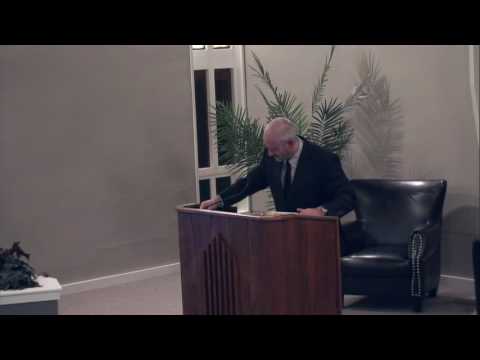
The Works of the Flesh
Galatians 5:19–21 presents a vice list Paul calls 'the works of the flesh,' catalogued here under four headings: sins of the flesh (adultery, fornication, uncleanness, lewdness), sins of religious apostasy (idolatry, sorcery, heresy), sins against personal relationships (hatred, contentions, jealousy, outbursts of wrath, selfish ambitions, dissensions, envy, murder), and sins of intemperance (drunkenness, revelries). The sermon distinguishes between remaining corruption — the ongoing struggle common to every justified believer — and reigning corruption, the habitual, unrepentant practice that characterises the unregenerate and excludes from the kingdom of God. Drawing on the Westminster Larger Catechism, Calvin, and Perkins, the preacher grounds each vice in the moral law and closes with a double summons: believers who have fallen into these sins are to repent and seek forgiveness through the blood of Christ; unbelievers are to see in the law their need for the Saviour.

Free Grace Baptist Church - October 2, 2016 PM
Genesis 15 records God's covenant with Abram, and this sermon expounds that passage under two headings: the promise to Abram (vv. 1–6) and his request for a sign (vv. 7–17). The central argument is that when God alone passes between the divided animals — taking the covenant's self-maledictory oath entirely upon himself — he typifies what Christ accomplished on the cross: bearing the curse that covenant-breaking sinners deserved. Justification is by faith alone, as Genesis 15:6 declares and as Paul confirms in Romans 4 and Galatians 3; Abram's faith was not in a nebulous future hope but in the promised seed, the Lord Jesus Christ. The sermon closes by leading the congregation into the Lord's Supper, calling believers to eat and drink in grateful remembrance of the substitute who passed through judgment in their place.
Genesis 3:15
Genesis 3:15, the protevangelium, announces a Redeemer who would be born of a woman, accomplish victory through suffering and death, and crush the serpent's head — not a vague, undefined figure but a precisely identified Messiah. This Bible study traces the progressive covenantal narrowing of that promise from the seed of the woman (Genesis 3) through the Abrahamic, Mosaic, and Davidic covenants, the Psalms, and the prophets, demonstrating that Old Testament believers possessed substantial, detailed knowledge of the coming Christ. The study draws on Paul, John Owen, and the 1689 London Baptist Confession to show that salvation has always been by grace alone, through faith alone, in Christ alone, with no separate Old Testament economy of law-keeping. The closing application presses hearers toward Simeon-like doxology in response to the Christ who fulfills every promise of the Old Testament.

The Olivet Discourse, Part 3
Matthew 24:9–14 presents the church with two realities that precede the fall of Jerusalem in A.D. 70: the persecution of the church (vv. 9–12) and the proclamation of the gospel (v. 14, deferred to the following week). Working from a preterist interpretation, the sermon argues that external threats from unbelieving Israel and the Roman Empire, internal threats of apostasy, betrayal, false prophecy, and antinomianism, all demonstrably occurred in the first century and are documented throughout the New Testament. The practical weight falls on every generation equally: because Christ reigns at the right hand of the Father, his people are called to endure, to hold the law of God as the concrete expression of love, and to resist the cold that lawlessness produces in the heart.

The Olivet Discourse, Part 2
Jesus' Olivet Discourse opens not with a timetable for the end of all things but with two commanding exhortations: 'Take heed that no one deceives you' and 'See that you are not troubled.' Expounding Matthew 24:4–8 within a preterist framework, this sermon argues that Christ's description of false messiahs, wars, famines, pestilences, and earthquakes depicts the conditions preceding the Roman destruction of Jerusalem in A.D. 70 — the covenant curses of Leviticus 26 and Deuteronomy 28 falling at last upon an apostate people who rejected their Messiah. The practical burden is twofold: guard theological sanity by submitting to the Word rather than to prophecy speculators, and guard emotional stability by resting in God's sovereign governance of history rather than panicking at world events.
2 Samuel 23:1-7
David's final official words in 2 Samuel 23:1–7 are not a backward glance at his own reign but a forward-looking messianic prophecy concerning the Lord Jesus Christ, identified as 'the anointed of the God of Jacob' and 'the favorite of the songs of Israel.' The passage discloses the Trinitarian agency behind the words, the comprehensive and just nature of Messiah's reign, the everlasting Davidic covenant that grounds the hope of a perfect king despite David's own failures, and the exclusion of the unrepentant from that kingdom. Believers are called to take comfort in Christ's just and universal rule, to proclaim the terror of divine judgment honestly, and to worship the one to whom all the Psalms point.

The Pharisee and the Publican
Luke 18:9–14 presents two men at prayer whose contrasting postures before God expose the heart of the doctrine of justification. The Pharisee's self-congratulatory prayer — cataloguing what he is not and what he does — illustrates the fatal error of self-righteousness: banking one's standing with God upon personal merit, which inevitably produces contempt for others. The tax collector's wordless self-renunciation — 'God be propitious to me, the sinner' — is the only posture that receives the verdict 'justified,' because justification is an act of God's free grace wherein the righteousness of Christ alone, received by faith, is the ground of the sinner's acceptance. The parable calls every hearer to kill pride, renounce all self-congratulatory religion, and cast himself entirely upon the mercy of God in Christ.

The Astonishment of Paul
Paul's opening salvo in Galatians 1:6–9 is a study in holy alarm: the apostle marvels not with wonder but with grief that the Galatian churches are so quickly defecting from the gospel of grace to a Judaizing corruption that mingles law-keeping with faith. The Judaizing heresy — like Roman Catholicism, the New Perspective on Paul, and the Federal Vision after it — does not abolish Christ but supplements him, which Paul declares is no gospel at all, because justification is either entirely by grace alone through faith alone in Christ alone, or it is not justification at all. The sermon traces three movements in the passage: Paul's astonishment at the defection, the nature of the false gospel as something that is 'not another,' and the double anathema pronounced on all who pervert the gospel regardless of their authority. The application calls hearers to a 'blessed intolerance' toward gospel corruption, to precision in doctrine, and to the personal embrace of Christ's doing and dying as the sole ground of acceptance with God.

The Confidence of the Believer
Micah 7 presents one of the most concentrated confessions of faith under duress in all of Scripture: a prophet who surveys moral collapse, political corruption, and the breakdown of domestic trust, yet steadfastly declares, 'I will look to the Lord.' This sermon works consecutively through Micah 7 in three movements — the prophet's lamentation over the state of the covenant community, his counsel to the godly remnant, and his closing doxology — to show what it means in practice for the just to live by faith. The doxology of verses 18–20 grounds that faith not in optimism or circumstance but in the revealed character of God: his pardoning of iniquity, his delight in mercy, his subduing of remaining sin, and his unbreakable covenant faithfulness. The sermon closes with a direct exhortation to feed faith on Scripture and sound theology, because faith cannot lay hold of what it does not know.
2LCF Chapter 31 - Of the State of Man After Death, and of the Resurrection of the Dead
2 London Baptist Confession chapter 31 surveys the state of the soul between death and the final resurrection, and the resurrection of both the just and the unjust. The chapter distinguishes the intermediate state — in which the souls of the righteous are immediately with Christ in paradise while the souls of the wicked are cast into hell — from the final resurrection, when body and soul will be reunited and raised to honor or dishonor. The sermon refutes soul sleep, limbus patrum, limbus infantum, and purgatory as departures from Scripture, arguing that purgatory is an affront to the finished atonement of Christ. Hearers are called to find comfort in the bodily resurrection, to resist Gnostic tendencies that denigrate the body, and to embrace the simplicity of biblical eschatology rather than elevating millennial schemes to tests of orthodoxy.

A Psalm of Habakkuk
Habakkuk 3 is a psalm composed by the prophet on the brink of the Babylonian devastation of Judah, and it shows what it looks like when a man lives out the principle of Habakkuk 2:4 — 'the just shall live by his faith.' Working through the psalm's three movements — petition, remembrance, and refuge — the sermon traces four gifts that faith provides in tumultuous times: rest in the day of trouble, joy in God amid devastation, stability grounded in God's strength, and material for the corporate worship of the church. The evangel is pressed home at the close: no human righteousness commends a sinner to God, and the sole instrument by which a sinful soul enters saving union with Christ is faith receiving and resting on Christ and His imputed righteousness.
The Past as a Present Reminder
Hebrews 10:32–39 calls the people of God to recall their early days of faith — the illumination received, the sufferings endured, the goods joyfully surrendered — not as a memorial to past zeal but as a present summons to perseverance. The passage moves from a reminder of former faithfulness (vv. 32–34) to a direct exhortation not to cast away confidence (vv. 35–39), grounding both in the confession that the just shall live by faith. Trials are not accidental but divinely ordered, and endurance is not a matter of moral bootstrapping but of faith in the Son of God who loved us and gave himself for us. The sermon calls hearers to shake off spiritual lethargy by drawing near to God, holding fast the confession of their hope, and actively considering one another in the assembly.

The Salvation of Zacchaeus
Luke 19:1–10 presents Zacchaeus — a wealthy, corrupt chief tax collector — as a demonstration of the divine power described just verses earlier in Luke 18, where Christ declared it easier for a camel to pass through the eye of a needle than for a rich man to enter the kingdom of God. The salvation of Zacchaeus is therefore not merely a warm story of hospitality but a proof of omnipotent, sovereign grace: the effectual call goes forth, the dead sinner descends from the tree, confesses Christ as Lord, and manifests genuine repentance in the only currency that could prove a rich man's heart-change. The sermon closes with the mission statement of Luke 19:10 — 'the Son of Man came to seek and to save that which was lost' — as the ground for evangelical confidence, joyful worship, and hope for any who have not yet come down from their own sycamore tree.

The Warning Against Apostasy
Hebrews 10:26–31 has long troubled sensitive believers who fear they have committed the unpardonable sin described there. This exposition argues that the willful sin in view is not the ongoing struggles and failures of the regenerate, but apostasy — a total, obstinate repudiation of the once-for-all sacrifice of Christ, the renunciation of the gospel itself. Drawing on the parallel warning in Hebrews 6, the covenantal comparison with Deuteronomy 17, and the testimony of Owen, Calvin, and Gill, the sermon demonstrates that those most troubled by this passage are precisely those whom it does not address. The comfort the text affords is real: the priestly intercession of Christ sustains weak and failing saints, and the just shall live by faith — not by the perfection of their obedience.
2LCF Chapter 30 - Of the Lord's Supper
The Lord's Supper, as confessed in chapter 30 of the 1689 London Baptist Confession of Faith, is examined across all eight paragraphs under four headings: its nature, administration, elements, and reception. The session expounds the Confession's positive affirmations — that the Supper is a divine ordinance of perpetual remembrance, proclamation of Christ's finished sacrifice, and a means of grace by which the risen Christ spiritually nourishes His people by the Holy Spirit — alongside its sharp rejection of Roman Catholic transubstantiation, the Mass as a propitiatory sacrifice, and Lutheran consubstantiation. The 17th-century polemical context is traced, showing that the particular Baptists aligned with Presbyterian and Congregationalist confessionalism against both Roman Catholic sacerdotalism and the anti-Trinitarian Socinian memorial-only reduction. The session closes with an urgent call to faithful, frequent participation in the Lord's Supper as an act of communion with Christ and with one another, refusing both careless neglect and the errors of Rome.

Free Grace Baptist Church - July 31, 2016 PM
Psalm 67 is a missionary psalm framing the church's reception of divine mercy, blessing, and communion not as ends in themselves but as the grounds and means of global gospel proclamation. Working through the psalm's two movements — the petitions of verses 1–5 and the promises of verses 6–7 — the sermon argues that the church's prayer for herself is inseparable from her obligation to make the way of God known among all nations. The application is pointed: the church's mission is the proclamation of salvation by grace alone through faith alone in Christ alone, and she must pray the psalms boldly, believing that God can turn idolaters — whether ancient Canaanites or modern Islam — to the living God through the foolishness of preaching.

Free Grace Baptist Church - July 31, 2016 AM
Hebrews 10:19–25 presents the doctrinal foundation and practical exhortations that flow from Christ's high priestly office. The passage opens with two grand encouragements — the believer's boldness to enter the holiest of holies by the blood of Jesus, and the possession of a great high priest over the house of God — before issuing three corresponding imperatives: draw near, hold fast the confession of hope, and consider one another. The sermon insists that the access to God secured by Christ's atoning death and the tearing of the veil is a present possession to be actively used, not a theoretical privilege to be admired from a distance. Believers are urged to attend the public assembly, maintain private and family worship, and pray for one another with the urgency appropriate to those who see the day approaching.
2LCF Chapter 29 - Of Baptism
The 1689 London Baptist Confession chapter 29 on baptism is expounded under two headings: the lawful recipients of the ordinance and its proper mode. The confession's definition of baptism as a sign of union with Christ in his death and resurrection is shown to require that only those who have actually professed repentance and faith are its proper subjects — a conclusion argued from covenant theology, positive law, and the consistent narrative of the New Testament. The proper mode is established as full immersion in water in the name of the triune God, grounded in the example of Christ at the Jordan, the Greek term baptizo, and the burial-and-resurrection imagery of Romans 6.

The Need for Wisdom
James 1:5–8 calls the believer in the midst of trial not to seek deliverance but to seek wisdom — the divinely granted skill to bear affliction rightly. God is the inexhaustible and non-reproaching source of that wisdom, and He gives it liberally to all who ask in faith. The sermon works through four aspects of the pursuit of wisdom in verse 5, then three features of the necessity of faith in verses 6–8, showing that doubt produces instability, unanswered prayer, and a double-minded life. The governing application is that the afflicted saint must ask God for wisdom and do so in genuine faith, trusting the Scripture's testimony that trials work patience and conform us to Christ.

The Conversion of the Ethiopian Eunuch
Acts 8:26–40 records the Spirit-orchestrated conversion of an Ethiopian eunuch through Philip's proclamation of Christ from Isaiah 53. The passage is set within the fulfillment of Isaiah 56's promise that eunuchs and Gentiles would be brought near to God in the messianic age — a promise Luke deliberately highlights as the risen and exalted Christ builds his kingdom to the uttermost parts of the earth. The sermon expounds the substitutionary suffering of the servant of Yahweh as the content of Philip's evangelism, the great exchange of 2 Corinthians 5:21 as the ground of justification, and the proper order of faith then baptism as the pattern of apostolic practice. Hearers are pressed to ask whether they understand the gospel, to believe it without delay, and — if already believing — to submit to baptism as an act of obedience and a means of grace.