
Cited in sermons
Gordon Fee
6 sermons · All people cited

The Conduct of Women in Corporate Worship (Authority)

First Timothy 2:11–15 contains one of the New Testament's clearest directives on the role of women in corporate worship, and this exposition works through the passage in three movements: the duty of women to receive the Word in silence and submission (v. 11), the apostolic prohibition against women teaching or exercising authority over men (vv. 12–14), and the blessing held out to women in the childbearing (v. 15). The prohibition is grounded not in the culture of first-century Ephesus but in creation order and the fall, the same foundations the apostles consistently invoke across Ephesians 5, Colossians 3, 1 Corinthians 11 and 14, and 1 Peter 3. The messianic reading of verse 15 is defended: 'she will be saved in the childbearing' points to the incarnation of Christ as the hope for Eve and every believing woman, not to physical childbirth as a condition of salvation. Women are called to embrace their creationally ordered role — silent, submissive reception of the Word and the full range of ministry open to them — as the sphere in which they work out their salvation in faith, love, holiness, and self-control.
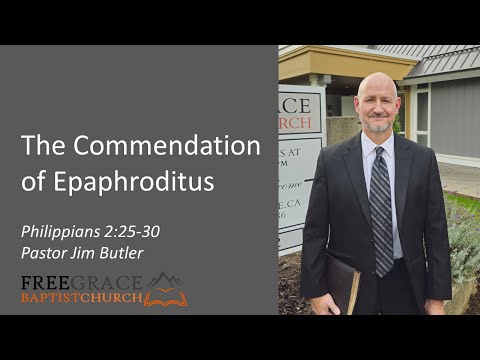
The Commendation of Epaphroditus
Philippians 2:25–30 presents Epaphroditus as a model of Christian ministry and other-mindedness, embodying the very exhortation Paul gave in Philippians 2:3–4 to esteem others above oneself. The sermon examines the three titles Paul assigns Epaphroditus in relation to himself — brother, fellow worker, fellow soldier — and his two roles in relation to the Philippian church — messenger and minister. The Christian life, and pastoral ministry in particular, is shown to be genuine warfare requiring devotion, discipline, and diligence. The church is called to receive and esteem men who hazard their lives for the work of Christ, recognising that to neglect such men is to demean the ascended Christ who gives them as gifts to his church.

Rejoicing in Christ's Righteousness

Philippians 3:1–11 presents Paul's charge to rejoice in Christ's righteousness rather than in any credential of the flesh. The sermon exposes the Judaizing error of mixing works with justification, demonstrates that every fleshly advantage Paul possessed was counted as rubbish compared to the surpassing excellence of knowing Christ, and traces the spiritual wealth found in Christ through justification, sanctification, and the hope of glorification. Hearers are called to rejoice in an alien righteousness received by faith alone, to beware of any teaching that smuggles works into salvation, and to walk as kingdom citizens whose passport is Christ's righteousness imputed to them.

The Pattern for Gospel Ministry
Second Timothy 1:8 calls Timothy — and by extension all ministers and believers — to an unashamed allegiance to the gospel of the Lord Jesus Christ and a readiness to suffer for it. The sermon traces two movements in the verse: a prohibition against shame and a positive exhortation to share in the sufferings of the gospel according to the power of God. Four temptations toward shame are examined — the person of Christ, the work of Christ, the doctrine of Christ, and the cause of Christ — before the message closes with the assurance that the Spirit supplies power, not fear, to those who must persevere under opposition and trial.
Women, the Word, and the Ministry
First Timothy 2:11–15 sets out Paul's prohibition against women teaching or exercising authority over men in the gathered church, grounding the rule not in first-century Ephesian culture but in the creation order of Genesis 2 and the fall of Genesis 3. The sermon works through three movements: Paul's exhortation that women receive the Word in submission, his double prohibition against women teaching men or holding authority over them, and his appeal to Adam's prior formation and Eve's deception as the theological rationale. Complementarian church governance is shown to be neither novel nor culturally conditioned but the normative, historically consistent pattern binding on every local church in every age. The closing treatment of verse 15 presents both the 'preservation in domestic faithfulness' reading and the 'messianic childbearing' interpretation, with the preacher siding with the latter.
Paul's Conflict and Concern for the Colossians
Colossians 2:1–5 exposes both the nature of Paul's apostolic struggle and the objectives that drove it: he agonized in prayer for churches he had never visited because the stakes of false teaching are eternal. The sermon traces four objectives of Paul's conflict — that believers be encouraged in heart, united in love, assured in understanding, and consumed with Christ as the sole treasury of wisdom and knowledge — before turning to Paul's concern in verses 4–5, where persuasive words are shown to be the perennial weapon of heresy. The antidote is not rhetorical sophistication but deep, corporate rootedness in the person and sufficiency of Christ, which alone guards the church against the humanistic philosophy, legalism, mysticism, asceticism, and antinomianism Paul will address throughout the epistle.