
Cited in sermons
George Whitefield
35 sermons · All people cited

The Exhortation to Wage the Good Warfare

The closing verses of 1 Timothy 1 resume Paul's charge to Timothy to wage the good warfare against false teaching in Ephesus. This exposition works through two movements: the charge itself (vv. 18–19a), grounded in Timothy's apostolic authority and prophetic calling, and the conflict that necessitates it (vv. 19b–20), illustrated in the defection and discipline of Hymenaeus and Alexander. The sermon argues that gospel ministry in every age requires holding the objective content of the Christian faith, maintaining a good conscience, and exercising church discipline against those who blaspheme by contradicting the truth of Christ.

The Third Appearance by Christ to the Disciples
John 21:1–14 operates on two levels simultaneously: the ordinary scene of a fishing trip and breakfast, and the symbolic portrait of the church's mission under the risen Christ. The passage is read as a paradigm for gospel ministry — the disciples' commitment, challenge, and conviction in fishing corresponds to the church's calling to preach the gospel to all nations, while Jesus directing the catch, preparing breakfast, and eating with His disciples illustrates His abiding authority and presence with His church. The sermon applies this to a recovery of ordinary, patient faithfulness in church life against the pressure of 'radical Christianity' performance culture, insisting that Christ is sovereign over the results of gospel proclamation and that the church's task is obedient casting of the net.

Spurgeon & Open Air Preaching

Drawing on Hebrews 13:7's command to remember and follow faithful ministers, this lecture examines the life, preaching, and open-air ministry of Charles Haddon Spurgeon as a model for gospel proclamation. The speaker presents material from his published doctoral dissertation on Spurgeon's open-air preaching, working through three open-air sermons and Spurgeon's own pedagogy for street evangelism. A recurring application presses the listener — whatever their theological sophistication — to proclaim the excellencies of Christ to all people, including the lowest and most despised.

Live Stream - October 15, 2023
Ephesians 5:15–17 calls believers to walk circumspectly — not as fools but as wise — by redeeming the time in days that are evil. The sermon distinguishes biblical wisdom from mere intellectual knowledge, defining it as the skillful application of God's word to the whole of life. The twin remedy against folly is the regular study of Scripture (with particular attention to the Book of Proverbs as a manual of wisdom) and persistent, faith-filled prayer for wisdom as commended in James 1. The new man in Christ is not left to himself but is given the pattern and the means to navigate a present evil age in a manner consistent with his calling.
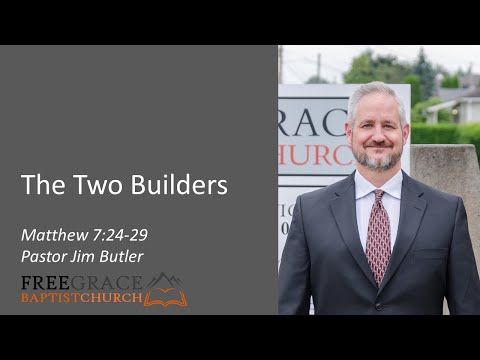
The Two Builders
Matthew 7:24–29 concludes the Sermon on the Mount with a parable of two builders whose contrasting foundations — rock and sand — expose the decisive difference between saving faith and mere hearing. The sermon argues that true faith, sovereignly granted and resting on Christ alone, produces a life of obedience to his word, while the mere hearer — however impressed by the teaching — builds on shifting ground and faces a great and final ruin. The devil, the world, and remaining indwelling corruption all beat against both houses, but only the house founded on Christ stands. Hearers are urged to close with Christ now, trusting not in works or false religion but in his righteousness alone.

The Lord's Prayer
True prayer is distinguished from hypocrisy and paganism not merely by form but by motivation, manner, and theological grounding. Matthew 6:5–13 exposes the Pharisee who prays to be seen by men and the heathen who employs vain repetition to coerce a god, and sets against both the secret, faith-driven communion of the genuine child of God with his Father. The Lord's Prayer is not a liturgical formula to be recited but a structured outline — ordering petition rightly, with God's name, kingdom, and will before any human need — rooted in the sovereignty of a Father who knows what his children require before they ask. The sermon calls believers to examine their own prayer lives: whether prayer functions as worship and dependence upon the triune God, or as a merely transactional exercise.

2LCF Chapter 3 - Of God's Decree
God's decree — his eternal, comprehensive, and unchangeable purpose over all things — is the subject of 1689 London Baptist Confession Chapter 3. The confession affirms that God has foreordained whatsoever comes to pass, including the free and sinful actions of men, without becoming the author of sin or violating the will of the creature. Paragraph 2 refutes the Molinist and Arminian claim that God's decree is grounded in his foreknowledge of human choices, insisting instead that election puts sinners in Christ rather than finding them there. The doctrine is shown to be practically consoling, doxologically oriented, and inseparable from the character of God as defined in Chapter 2.

The Practice of the Church
Acts 2:41–47 describes the first-century church's response to apostolic preaching and, when read in light of the whole New Testament, is prescriptive for churches today. The sermon traces two main movements: the power of the gospel that produces faith, repentance, and baptism, and the fourfold practice of the church — steadfast continuation in the apostles' doctrine, fellowship, the breaking of bread, and prayer. Cessationism is applied to the signs and wonders of the apostolic era, while the ongoing marks of the church are drawn from the Belgic Confession's articles on the true church and the obligations of her members. The practical burden is that believers must resist both the reduction of church life to entertainment and the temptation to substitute online participation for embodied, corporate worship.

The Ministry in Rome
Acts 28:11–31 records the Apostle Paul's arrival in Rome under house arrest and his sustained ministry to the Jewish leaders there, demonstrating that divine providence — not Roman law or Jewish opposition — governs the advance of the gospel. The sermon traces Paul's two meetings with the Roman Jews: his defence of his innocence and his grounding of the gospel in the hope of Israel, and then his full-day exposition of Christ from Moses and the prophets, which divides his hearers between belief and hardened unbelief. The open-endedness of Acts is shown to be deliberate fulfilment of Acts 1:8 — Christ's commission to witness from Jerusalem to the uttermost parts of the earth has been accomplished. Hearers are called to resist fear, to proclaim Christ from the Scriptures with confidence, and to rest in sovereign grace as the sole explanation for why any sinner believes.

The Third Missionary Journey, Part 4
Acts 20:1–16 narrates Paul's closing movements on his third missionary journey — through Macedonia and Greece, into Troas where Eutychus falls to his death and is raised, and then south toward Jerusalem. The passage is used to argue that the early church's pattern of worship is not merely descriptive but carries prescriptive force: the Lord's Day (the first day of the week), corporate assembly, the Lord's Supper, and the preaching of God's Word are the God-ordained elements of Christian worship, regulated by Scripture alone. Cessationist and confessional commitments frame the reading throughout, and the sermon closes with a direct call to sinners to trust in Christ's imputed righteousness and atoning blood as the only ground of salvation.

The Ministry of Philip in Samaria
Acts 8:5–8 records Philip's preaching ministry in Samaria — a region despised by Israel as racially and religiously impure — and presents it as the deliberate fulfillment of Christ's commission in Acts 1:8 to carry the gospel to Jerusalem, Judea, Samaria, and the uttermost parts of the earth. The sermon traces the historical background of Samaritan alienation from Israel, the fourfold summary of Philip's ministry (his preaching, the response of the crowds, the authenticating miracles, and the resulting joy), and the theological significance of the Spirit's confirmation through Peter and John. Against contemporary debates over racial justice, the sermon argues that the cross of Christ — preached faithfully in his offices as prophet, priest, and king — is the only power that reconciles divided peoples and extends the kingdom of God across ethnic boundaries.

Genesis 9:1-17
The Noahic covenant establishes not only capital punishment but a comprehensive framework for criminal justice that the civil magistrate is bound to apply. Drawing from Genesis 9, Ecclesiastes 8, and the Mosaic civil law, this sermon traces three lesser forms of punishment — restitution, indentured servitude, and corporal punishment — demonstrating that each is governed by due process, proportionality, and a concern for the dignity of the offender as an image-bearer of God. The modern prison system is evaluated against these biblical categories and found to undermine restitution, rehabilitation, and human dignity alike. Hearers are called to think carefully about what Scripture actually teaches concerning crime and punishment rather than dismissing it as barbaric.

The Diligence of the Ant
Proverbs 6:6–11 and 26:13–16 present the ant as a model of self-directed industry and the sluggard as a figure of moral and practical ruin. The sermon traces four marks of the lazy man — excuse-making, love of sleep, inability to complete tasks, and self-congratulating conceit — before turning to the genuine blessings diligence brings: material provision, the dignity of honest labor, and the honor of excellent work. The exposition closes by applying the same categories spiritually: the sinner who makes excuses before Christ and the drowsy saint grown cold in the means of grace are both called to a diligence that flees to the Savior and feeds on the Word.

The Response to Peter's Sermon
Acts 2:41–47 records the immediate fruit of Peter's Pentecost sermon: three thousand souls baptized and a church marked by steadfast doctrine, fellowship, the Lord's Supper, and prayer. This exposition argues that the passage is both descriptive and prescriptive — what the early church did defines what the church in every age must be. Along the way, believers' baptism is defended against paedo-baptist readings of verse 39, and the growth of the church is traced not to programs or techniques but to the sovereign calling of God through the faithful preaching of Christ crucified.
2 Kings 1:1-18
2 Kings 1 records the idolatry, judgment, and death of Ahaziah, king of Israel — a man who, when facing death, turned not to Yahweh but to Baal-Zebub, the god of Ekron. The chapter exposes the nature of idolatry as a practical confession that the living God is incompetent to meet one's needs, and it establishes the certainty of God's word against any king or army that would silence it. God's protection of Elijah through consuming fire is neither divine caprice nor Old Testament barbarism, but the settled, holy justice of a God who will brook no rival and whose jealousy for his own glory is inseparable from his mercy toward sinners. The passage calls hearers to examine what their instinctive cry in trial reveals about the true object of their allegiance.

The Salvation of Zacchaeus
Luke 19:1–10 presents Zacchaeus — a wealthy, corrupt chief tax collector — as a demonstration of the divine power described just verses earlier in Luke 18, where Christ declared it easier for a camel to pass through the eye of a needle than for a rich man to enter the kingdom of God. The salvation of Zacchaeus is therefore not merely a warm story of hospitality but a proof of omnipotent, sovereign grace: the effectual call goes forth, the dead sinner descends from the tree, confesses Christ as Lord, and manifests genuine repentance in the only currency that could prove a rich man's heart-change. The sermon closes with the mission statement of Luke 19:10 — 'the Son of Man came to seek and to save that which was lost' — as the ground for evangelical confidence, joyful worship, and hope for any who have not yet come down from their own sycamore tree.

The Need for Wisdom
James 1:5–8 calls the believer in the midst of trial not to seek deliverance but to seek wisdom — the divinely granted skill to bear affliction rightly. God is the inexhaustible and non-reproaching source of that wisdom, and He gives it liberally to all who ask in faith. The sermon works through four aspects of the pursuit of wisdom in verse 5, then three features of the necessity of faith in verses 6–8, showing that doubt produces instability, unanswered prayer, and a double-minded life. The governing application is that the afflicted saint must ask God for wisdom and do so in genuine faith, trusting the Scripture's testimony that trials work patience and conform us to Christ.

The Final Charge to Timothy, Part 1
Paul's final formal charge to the church, delivered through Timothy in 2 Timothy 4:1–2, consists of a solemn charge and a specific command: preach the Word. The solemnity of the charge is grounded in the presence of the triune God as divine audience and in the coming judgment of Christ over the living and the dead, which simultaneously weighs on the minister who handles the Word and on the people who will one day stand before God. The command itself, rooted in the image of the herald (Greek kēryx), demands faithful proclamation of the Word — not creative substitutes, not life-coaching, not entertainment — through conviction, rebuke, exhortation, longsuffering, and teaching. The sermon closes with a call for biblical preachers, biblical preaching, and biblical hearers, arguing that the church's abandonment of the pulpit is the root of her contemporary crisis.

Past, Present, and Future at the Lord's Supper
The Lord's Supper operates across three tenses simultaneously: it is a memorial ordinance calling believers to remember Christ's humiliation, substitutionary suffering, and death as prophesied in Isaiah 53; it is a present means of grace conferring real spiritual communion with the exalted Christ by the Spirit, not merely a conscious recollection; and it is an eschatological anticipation, pointing the church toward the consummation when the ordinance itself will give way to the marriage supper of the Lamb. Against both Roman Catholic transubstantiation and a bare memorialist view, the sermon argues from 1 Corinthians 10–11 that the bread and wine remain unchanged in substance while serving as conduits by which the risen Lord nourishes and confirms the faith of His gathered people.
Gideon's Victory Over the Midianites
Judges 7 records God's reduction of Gideon's army from 32,000 to 300 men before routing the Midianites — not because Israel marshalled superior strength, but precisely so that no Israelite could claim the glory of victory. This sermon traces four movements in the narrative: the assembling of enemies and the Spirit's coming upon Gideon, the divinely-ordered troop reduction, God's patient encouragement of a fearful Gideon through a pagan soldier's dream, and the midnight rout of Midian. The controlling thesis is that God perfects His strength through human weakness so that glory belongs to Him alone, a principle the sermon applies to the church's ongoing mission and to the gospel call addressed directly to unbelievers in the congregation.

The Nature of the Gospel
Galatians 1:1–5 is not merely a greeting but a compressed summary of gospel truth that Paul will defend throughout the entire epistle against the Judaizing error of faith plus works. Working through five observations drawn from verse 4, this exposition establishes that Christ's death was voluntary, substitutionary, liberating, decreed by the Father, and designed to terminate in the glory of God alone. The sermon argues that sovereign grace — not human decision, will, or merit — is the only ground of salvation, and that right understanding of this gospel inevitably produces doxology rather than self-congratulation.
Judges 7
Judges 7 recounts God's reduction of Gideon's army from 32,000 to 300 men before Israel's victory over 120,000 Midianites — a disparity that is not incidental but theologically deliberate. The controlling principle of the entire chapter is verse 2: God whittled down Israel's forces so that the nation would not claim glory for itself, demonstrating that divine strength is perfected through human weakness. The lappers and kneelers are not to be distinguished by vigilance or virtue; the selection is simply a sovereign means to reduce the army to a number that makes self-congratulation impossible. God's patient encouragement of the fearful Gideon along the way reveals not only His sovereignty but His kindness, and the judges as a whole point typologically to the Lord Jesus Christ, the final deliverer who saves His people from sin rather than merely from earthly oppressors.
The Servant Song of Matthew
Matthew 12:15–21 records Jesus withdrawing from the murderous rage of the Pharisees while multitudes — including Gentiles — follow Him for healing, and Matthew interprets this through the first Servant Song of Isaiah 42:1–7. The sermon works through six characteristics of the Servant of Yahweh as Matthew presents them: His excellence as the Father's chosen and beloved, His empowerment by the Holy Spirit, His message of justice to the Gentiles, His character and commitment as one who does not quarrel or cry out, His mercy toward bruised reeds and smoking flax, and His worldwide mission culminating in the Great Commission. Throughout, the preacher presses the comfort that weak faith — however small — is true faith, and that Christ as the great Savior of great sinners is the hermeneutical center of all Scripture.
A Ruler's Daughter and an Afflicted Woman
Matthew 9:18–26 presents two intertwined miracles — the raising of Jairus's daughter and the healing of a chronically afflicted woman — as Matthew's climactic demonstration of Christ's authority over death and disease. The passage exposes the nature of saving faith: not its strength or emotional intensity, but its object, the Lord Jesus Christ, who is both willing and omnipotent to save. Whether the petitioner is a prominent synagogue ruler or a marginalized, impoverished woman, Christ receives all who come to him in faith, regardless of social station. The sermon closes with a call to venture on Christ in faith, and a pastoral plea for parents to pray that their children would be brought to saving knowledge of him in their youth.
The Plan of Salvation
Two verses in 2 Timothy 1 contain a concentrated summary of the entire plan of salvation, and this sermon unpacks five observations from that text: God alone saves, the effectual call is the means employed, the basis is divine purpose and grace rather than human works, the plan originates before time began in the counsel of the triune God, and it is executed in history through the doing, dying, and rising of Jesus Christ. The sermon sets monergism against every form of synergism, argues that Athanasius's soteriological defense of Christ's deity depends on the incapacity of man to save himself, and traces the pactum salutis through John 17, Romans 16, and Ephesians 1. The hearer is pressed to rest all assurance on the finished work of Christ alone and to give God all praise for a salvation that is his from first to last.
The Arrival of the Messianic Kingdom
Matthew 4:18–25 records the arrival of the Messianic Kingdom through two decisive acts: Christ's sovereign call of four Galilean fishermen to discipleship, and his healing of multitudes throughout Syria, Galilee, and beyond the Jordan. The passage resists the expectation that kingdom advancement demands spectacular instruments — four local fishermen casting nets are the nucleus of a world-overturning apostolic ministry. The theological weight of Christ's healing ministry is not mere spectacle but the attestation of kingdom power; teaching, preaching, and healing together define the Messiah's work. Hearers are pressed to respond to the gospel call with the same immediacy as Peter, Andrew, James, and John, and to pursue faithful, determined, and patient witness in whatever station God has appointed.
A Fourfold Promise to Zion
Isaiah 54 follows directly from the fourth servant song of Isaiah 53, and on the basis of Christ's substitutionary atonement the Lord God makes four distinct promises to his church: increase, stability, blessing, and security against enemies. The chapter addresses the church as Zion — barren, forsaken, and tossed with tempest — and calls her to sing because the servant's atoning work secures a covenant of peace that cannot be removed. These promises require faith, since the visible condition of the church often contradicts them, yet God's everlasting kindness toward his people is grounded not in their faithfulness but in the finished work of the servant of the Lord. The sermon closes with a call to bold evangelism drawn from Isaiah 55, the gospel invitation that flows naturally from the church's promised prosperity in chapter 54.
Hearing the Word of God
Nehemiah 8 records the post-exilic assembly of Judah gathered before Ezra at the Water Gate to hear the public reading and exposition of the Law — an occasion that produced expectancy, attentiveness, reverence, and responsive obedience in the people. This sermon draws four corporate lessons from that assembly and applies them to the gathered church's posture toward the preached Word. The congregation is called to come to the Lord's Day service as Cornelius came to Peter: not to be entertained, but to hear all that God has commanded. Biblical preaching, the sermon argues, necessarily produces conviction for sin, thanksgiving, rejoicing, and a desire for more of the Word.
The King of Zion
Micah 5:2–5 announces the birth and reign of Israel's coming king from the seemingly insignificant village of Bethlehem Ephrathah — a ruler whose goings forth are from everlasting, identifying him as nothing less than the eternal Son of God. The sermon traces two main subjects: the birthplace, Godward focus, and divine nature of the Messiah's coming; and the character of his reign as the sole king who feeds his flock, exercises universal empire, and is himself the peace of his people. Drawing on the Davidic covenant, the apostolic witness, and the New Testament birth narratives, the exposition calls hearers to worship the incarnate deity, rest under the shepherding of Christ, and pray boldly for the advance of his kingdom to the ends of the earth.
The Apostle's Paternal Appeal to the Galatians
Galatians 4:12–20 presents the Apostle Paul's most personal and emotionally charged appeal in the letter — not a doctrinal argument but a pastoral one, grounded in shared history and genuine affection. The sermon expounds two movements in the passage: a reminder of the filial relationship Paul shared with the Galatians on his first visit among them, and a warning against the Judaizers whose zealous courtship of the Galatians serves not the glory of Christ but the aggrandisement of themselves. Throughout, the preacher presses the point that sound doctrine and warm pastoral affection are inseparable — contending for justification by faith alone must be done with the heart of a nursing mother and a grieving father, not merely the pen of a polemicist.