
Cited in sermons
Cyril of Jerusalem
11 sermons · All people cited

The Insurrectionist and the King

Luke 23:32–43 sets two criminals beside the crucified Christ — one blaspheming, one confessing — and leaves no neutral ground between them. This exposition works through the passage under three headings: the setting at Calvary (its geography, its Old Testament typology, and the fulfillment of prophecy in the crowd's mockery), the scoundrels (the total depravity of the blaspheming robber, and the remarkable faith of the converted one), and the Savior's response (certainty, immediacy, and felicity in the words 'today you will be with me in paradise'). The sermon closes with an urgent call to believe on Christ now, finding in the dying thief a picture of salvation by grace alone through faith alone in Christ alone.
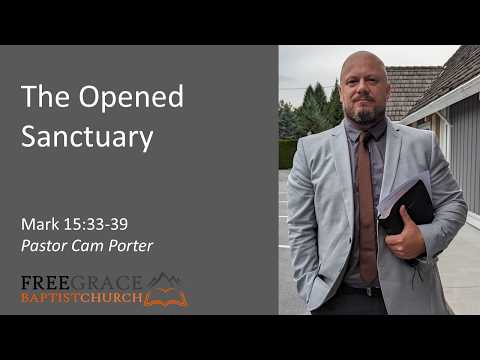
The Opened Sanctuary
Mark 15:33–39 presents three interlocking realities at the crucifixion: the forsaken Son bearing divine wrath, the torn veil opening the sanctuary to God's presence, and a Roman centurion's confession inaugurating the gospel's reach to the nations. The noontide darkness fulfills Old Testament types — the Egyptian plague of darkness and Amos 8:9 — while Christ's cry of dereliction, drawn from Psalm 22, expresses not a severing of the Trinity but the full weight of divine justice borne substitutionarily by the Son as mediator. The tearing of the veil declares that the shadowy Old Covenant order is fulfilled, the true high priest has acted, and access to the holy presence of God is secured through the veil of Christ's flesh. Those who gather at the Lord's Supper are exhorted to glory in the Savior who bore the wrath His people deserved so that they need never cry out in God-forsakenness themselves.

The Gospel's Indispensable Glory
What is the gospel? Paul's answer in 1 Corinthians 15:1–4 is not what we do or feel, but the objective, once-for-all work of the Lord Jesus Christ: his death for sins, his burial, and his bodily resurrection on the third day according to the Scriptures. This sermon works through two categories — the necessity of the gospel and its essential content — showing that the gospel is both the lifeblood of Christian existence and the only ground of justification and resurrection hope. The sermon closes with a direct summons: for the Christian, the risen Christ is blessed Savior and interceding High Priest; for the unbeliever, he is the coming Judge.

The Apostle Paul, Part 4: His Doctrinal Legacy
The doctrinal legacy of the Apostle Paul is surveyed across seven theological themes: the comprehensive nature of sin and depravity, the incarnation of the divine Son of God, the sovereignty of the triune God in salvation, amazing grace, justification by faith alone, sanctification in union with Christ, and a simple and glorious eschatology. Paul's writings are shown to move consistently from the gravity of man's ruin to the glory of God's redeeming grace in Christ. The sermon closes with a direct call to believers to be built up in the knowledge of the gospel, and to those outside of Christ to believe on the Lord Jesus Christ and be saved.

2LCF Chapter 8 - Of Christ the Mediator, Part 3
The incarnation of the Son of God — that the eternal, divine Son took to himself a true and complete human nature without ceasing to be God — stands at the centre of the Christian religion and is inseparable from the doctrine of salvation. This confession study works through 2LCF Chapter 8, paragraphs 2 and 7, first clearing away eight historical errors about what the incarnation is not (mutation, docetism, a heavenly body, a bodyless appearance, an animal soul without a human soul, a mixing of natures, a divestiture of divine attributes, and a Nestorian conjunction of persons), then positively establishing the language of assumption, union, and incarnation as the church's consistent witness from the apostolic era forward. The Son did not subtract from nor add to himself; he took to himself that which he was not while remaining fully what he eternally is, and the Trinity — Father, Son, and Spirit — acts undividedly in this work, though it terminates on the Son alone.

The Incarnation of the Word, Part 1

John 1:14 — 'the Word became flesh and dwelt among us' — is the hinge on which all Christian theology turns. This exposition works through the identification, the incarnation proper, and the indwelling presence of the Word, establishing that the eternal Son assumed a true human nature (body and soul) without ceasing to be the second person of the Trinity — the doctrine the church confesses as the hypostatic union. The sermon draws on the active and passive obedience of Christ to show that the incarnation was not primarily exemplary but redemptive: the Word took flesh to render the perfect obedience sinners owe and to shed the blood that purchases their forgiveness. Hearers are pressed to see Christ not only as Redeemer but as reigning King, and the unbeliever is called to receive, by faith alone, that righteousness which comes from God.

The Incarnation of the Word
John 1:14 declares that the eternal Word — the second person of the Trinity, who was in the beginning with God and was God — became flesh and dwelt among men. This sermon expounds the incarnation under two heads: first, the identity and reality of the Word taking on true humanity (the hypostatic union of two complete natures in one person), and second, the glory of that Word as the only begotten of the Father, full of grace and truth. The incarnation is shown to be the indispensable ground of redemption — whatever is not assumed is not redeemed — and sinners are urged to flee to a mediator who is full, not miserly, in grace and truth.

The Thief on the Cross
The salvation of the dying thief in Luke 23 is examined as one of the most concentrated demonstrations of vital theology in all the gospel narratives, showing that salvation is by grace alone through faith alone in Christ alone and that the sufficiency of Christ's atoning work requires no supplementary priesthood or sacrifice. The sermon moves through the sobering inscription over Christ's cross, the unrepentant blasphemy of the cursed robber as a window into total depravity, and the remarkable conversion of the penitent thief — a reviler turned praiser — as evidence of sovereign, effectual grace. The thief's confession is shown to be theologically substantive: he acknowledges the fear of God, owns the justice of his condemnation, confesses Christ's innocence, and calls upon Christ as Lord and King. Hearers are called to remember their former state of spiritual bondage, to glory in the amazing grace that has brought them from reviling to worshiping, and to rest in Christ's word to the thief — 'today you will be with me in paradise' — as a word addressed to all who trust in Him.

The Dying Thief and the Prince of Life
The crucifixion scene of Luke 23:38–43 presents three voices: the cursed robber who reviles Christ to his last breath, the dying thief who exercises remarkable faith in a bloodied and apparently defeated king, and the Prince of Life who responds with sovereign assurance. This sermon exposition focuses on Christ's words to the thief — 'Assuredly, I say to you, today you will be with me in paradise' — unpacking the divine promise, immutable love, and perfection of Christ's blood and righteousness that undergird that assurance. The confession of faith's teaching on the perseverance and assurance of the saints illuminates why the thief's salvation is certain, and the same certainty belongs to all who believe on the Lord Jesus Christ.

The Prince of Life and the Penitent Thief
The conversion of the penitent thief on the cross presents what one 19th-century commentator called the finest demonstration of vital theology in all the gospel narratives. Working through Luke 23:38–43, this sermon examines four elements of that occasion: the ironic truth embedded in the inscription 'This is the King of the Jews,' the unrepentant blasphemy of the cursed robber as a mirror of unregenerate depravity, the dying thief's Spirit-wrought confession of God's holiness, Christ's innocence, and Christ's lordship, and the sovereign comfort of Christ's assurance that salvation rests on divine promise rather than human merit. The sermon is delivered in the context of a Lord's Supper service, and each point is drawn toward the ordinance as a call to remember the King, to recall one's former state of enmity, and to rest on the blood and righteousness of Christ alone.
Don't Be Antichrist
Philippians 2:6–11, the Carmen Christi, presents in six verses the whole point of the Bible: the person and work of Christ unto the glory of God the Father. This sermon works through that hymn under three heads — the deity and humanity of Christ in his person, the voluntary and obedient character of his work (distinguishing his preceptive and penal obedience), and the exaltation that issues in universal worship. The congregation is pressed to hold a full, undiluted Christology, warned that a defective view of either Christ's deity or his humanity places one outside saving faith, and called to bow the knee now in genuine confession rather than await the compelled confession of judgment.