
Cited in sermons
Cyril of Alexandria
90 sermons · All people cited
2LCF Chapter 32 - Of the Last Judgment

The biblical doctrine of the Last Judgment—its nature, purpose, and practical relevance—is examined through 1689 LBCF Chapter 32. God has appointed a day on which He will judge the world in righteousness through Jesus Christ as covenant mediator, to manifest both His mercy in the eternal salvation of the elect and His justice in the eternal damnation of the reprobate. Romans 9 grounds the theocentric purpose of judgment in God's sovereign disposition of mercy and wrath, while 2 Thessalonians 1 supplies the apostolic warrant for the believer's rejoicing in divine justice. The session concludes with an overview of the major millennial positions and their hermeneutical foundations, urging the church to let eschatology produce holiness, consolation, and gospel urgency rather than pride or speculation.

The Glorious Proverb

The Gospel can be stated with stunning brevity: Christ Jesus came into the world to save sinners. Expounding the 'faithful saying' of 1 Timothy 1:15, this sermon examines why the apostolic proverb is trustworthy and deserving of universal acceptance — rooting its reliability in the character of the God who speaks it and the Christ who performs it. The condescension of the eternal Son is explored with care, guarding against any notion that the omnipresent God vacated heaven to visit earth, while insisting that he genuinely assumed human nature for the redemption of sinners. The sermon closes with three applications: the sinner may rest on this saying because its foundation is the faithfulness of the triune God, the Incarnation should produce deep humility, and no degree of personal sin places a soul beyond the reach of Christ's saving power.

The Prayer of the Man of Sorrows
Psalm 6 is read christologically as the prayer of the man of sorrows — not merely a record of David's personal penitence, but a prophetic foreshadowing of Christ's redemptive anguish as the representative of his people. The doctrine of imputation grounds this reading: what Christ bears is not his own sin but the sin of those the Father gave him, laid upon him by divine appointment. The sermon works through two major sections of the psalm — the sorrow of the psalmist in verses 1–7 and the confidence of the psalmist in verses 8–10 — calling hearers to see their sin as atoned for by the Son of God and to live in light of that imputed righteousness, pursuing holiness and resting their prayers upon the same mercies Christ secured.

The Appearance of Christ to the Disciples
John 20:19–23 presents two interlocking realities: the presence of the risen Christ among His fearful disciples on the first day of the week, and the commission He gives them to carry His gospel into the world. The peace Christ pronounces is not a generic greeting but the fruit of His atoning wounds — the satisfaction of divine justice that reconciles guilty sinners to God. From this the sermon argues that the church's entire mission is delimited by Christ's own sending: not entertainment, social uplift, or political activism, but the proclamation of the forgiveness of sins through the crucified and risen Lord, empowered by the promised Holy Spirit.

The Confirmation of His Death
John 19:31–37 records the confirmation of Christ's death by Roman soldiers and the apostle John, providing decisive historical and theological testimony against any swoon theory or denial of His true humanity. The soldiers' breaking of the legs of the other condemned men — but not of Jesus, who was already dead — and the piercing of His side with a spear fulfills two strands of Old Testament prophecy: the unbroken bones of the Passover lamb (Exodus 12:46; Numbers 9:12) and the piercing of Israel's Messiah (Zechariah 12:10). John's eyewitness testimony is given with a stated evangelistic purpose — 'that you may believe' — grounding the gospel call in verified historical fact. The sermon closes with an exhortation to confident, prayer-filled gospel proclamation on the basis of Christ's finished, sovereign work of redemption.

2LCF Chapter 8 - Of Christ the Mediator, Part 3
The sinlessness of Christ, the efficient and instrumental causes of the incarnation, and the hypostatic union are examined through a clause-by-clause exposition of 2LCF Chapter 8, paragraph 2, with supporting analysis of paragraphs 3 and 7. The confession's language — 'yet without sin,' 'conceived by the Holy Spirit,' 'of the seed of Abraham and David,' 'without conversion, composition, or confusion' — is unpacked against the background of patristic Christology, Chalcedonian definition, and Reformed theological precision. The ministry of the Holy Spirit throughout the entire mediatorial life of Christ is recovered as an often-neglected dimension of Christology. Incarnational and interpretive rules drawn from paragraph 7 equip hearers to handle Scripture passages that appear to diminish Christ's deity, by distinguishing what is predicated of a nature from what is predicated of the one person according to a nature.

2LCF Chapter 8 - Of Christ the Mediator, Part 2
The incarnation of the Son of God — his taking to himself a true and complete human nature — is the greatest of all gospel mysteries and the life and soul of the church. Working through paragraphs one, two, three, seven, and nine of the Second London Confession chapter eight, this study examines the timing, manner, and extent of the Son's assumption of humanity, arguing that the incarnation was neither a subtraction from deity nor an addition to it, but a terminative assumption by which the eternal Son united human nature to his own divine person in the hypostatic union. The full extent of that assumption — body, reasonable soul, human will, human affections, and the common sinless infirmities of our nature — is not a speculative nicety but a soteriological necessity: what is not assumed is not healed.
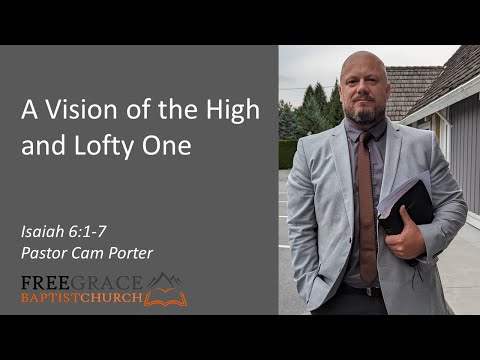
A Vision of the High and Lofty One
Isaiah 6:1–7 presents the prophet's visionary encounter with the enthroned Lord — holy, holy, holy — and his subsequent cleansing by a coal from the altar. This sermon works through five movements in the passage: the introductory contrast between dying earthly kings and the eternal High King of Heaven; the exemplary posture of the seraphim before the divine majesty; the superlative holiness, glorious titles, and unbounded presence of the Lord of hosts; Isaiah's fitting confession of his own uncleanness; and the gracious divine initiative in purification, which anticipates the definite atoning work of Christ. The congregation is called to approach the living God with the humility of Isaiah and the seraphim, confident that the same sovereign who commissioned his prophet will fill the whole earth with his glory through the proclamation of the gospel.

The Scourging and Mockery of Jesus
What was Pilate attempting when he ordered Jesus scourged and permitted the soldiers' mock enthronement? This exposition of John 19:1–4 argues that Pilate's scourging of Jesus was a failed act of crowd appeasement by a governor who knew he was condemning an innocent man, while the soldiers' mockery staged a deliberate parody of royal investiture against one they took for a pretender to Jewish kingship. The sermon draws Isaiah 50 and 53 and Psalm 109 into the foreground to show that these sufferings were neither accidental nor outside the decree of God — the Father delivered up the Son, the Servant of Yahweh gave his back to those who struck him, and the imprecatory prayer of Psalm 109 illuminates the inner life of Christ before his accusers. The application presses the congregation to feel the weight of substitutionary suffering, to resist a superficial Christianity untouched by the cost of redemption, and to confess Christ's lordship now rather than in the judgment.

The Arrest of Jesus
John 18:1–12 presents the arrest of Jesus not as a defeat but as a sovereign, voluntary act of the divine-human Mediator. The passage is expounded under three headings: the betrayal of Jesus by Judas and his coalition of enemies, the glory of Jesus manifested in his command of the situation and his 'I am' declaration that felled the arresting party to the ground, and the arrest proper in which Jesus rebukes Peter's sword and embraces the cup of the Father's wrath. The sermon closes by tracing three layers of antitypical significance — the greater-David typology of 2 Samuel 15, the binding of Isaac in Genesis 22, and the garden of Eden in Genesis 1–3 — to show that the arrest of Christ is the hinge on which God's eternal purpose to save his people from their sins turns.
CTF 2025 - Session 7 - Pastoral Reflections on Classical Theism
The prologue of John's Gospel (1:1–18) discloses both the divine perfections and the eternal relations of the divine persons — the very realities that classical theism and the Second London Confession articulate in Chapter 2. This address draws that exegetical foundation into pastoral practice, arguing that a robust theology proper is not abstract speculation but the necessary ground for faithful ministerial function and focus. The preacher identifies six areas — the salvation of sinners, the catechesis of children, the perseverance of the saints, assurance of salvation, communion with God, worship, and the knowledge of God — each of which depends inextricably on a well-formed doctrine of God.

The High Priestly Prayer, Part 6
John 17:17–19 records Christ's priestly petition that the Father sanctify the apostles by the truth — consecrating them, as the Old Testament priests were consecrated, for the specific mission of preaching and writing to which He was sending them. The instrument of that sanctification is the truth: the incarnate Word who is truth, the Spirit of truth, and the written Word breathed out by that Spirit. Christ's own sanctification in verse 19 is not a prayer for personal holiness but His self-consecration as the high priest who offers Himself as sacrifice, and that priestly self-offering is the very foundation on which the apostles — and all believers — are set apart. The practical summons is plain: growth in grace and conformity to Christ come through the ordinary means of God's truth, not through experience, emotion, or entertainment, and the church's fidelity to that pattern depends on elders who are devoted to teaching it.

The High Priestly Prayer, Part 4
What grounds the prayers Jesus offers for his people, and why does he explicitly exclude the world from his intercession? Working through John 17:9–11a, this sermon examines the focus and rationale of Christ's high priestly intercession: he prays specifically for the elect whom the Father gave him, not for the reprobate world, and he does so as the mediating priest who both sacrifices and intercedes on behalf of his own. The mutual possession declared in verse 10 — 'all mine are yours and yours are mine' — establishes the full equality of the Son with the Father, while 'I am glorified in them' frames the church as a trophy case of divine grace displayed before angels and nations. The sermon closes with an exhortation to treasure the blessedness of election: a Savior who intercedes, a triune God who is known, and a security that nothing can sever.

The High Priestly Prayer, Part 2
John 17:4–5 records Christ's proleptic and covenantal claim to have glorified the Father and finished the work given him — a claim that opens into the full theology of active obedience and its indispensable place in justification by faith alone. The sermon demonstrates that Jesus was not merely an ethical example but the obedient substitute whose 33 years of perfect law-keeping is imputed to the elect alongside the forgiveness secured by his blood. Verse 5 is examined against the kenosis error: Christ does not pray to recover a lost glory but to be manifested as the glorified God-man and mediator who has accomplished the covenant of redemption. Believers are exhorted to pursue the knowledge of God and Christ as the essence of eternal life; unbelievers are called to look to the only Savior in whom alone there is both forgiveness and a righteousness that avails before God.

The Glory of Christ's Departure, Part 2
John 16:29–33 closes the Upper Room Discourse with two movements: the disciples' partial yet progressing confession of Christ's omniscience, authority, and divine origin, and Christ's triumphant declaration that he has overcome the world. The disciples' imperfect understanding — soon to be perfected on the day of Pentecost through the Spirit's coming — is met not with rebuke but with Christ's desire for their peace, even as he foreknows their abandonment of him at the cross. The sermon grounds Christian courage in the face of tribulation not in human resolve but in the objective, accomplished victory of the enthroned Christ, whose current session at the Father's right hand is the only sufficient foundation for the church's advance through suffering.

The Glory of Christ's Departure, Part 1
John 16:25–28 records the climactic doctrinal statement of the Upper Room Discourse, in which Christ declares His eternal generation from the Father, His incarnation into the world, and His impending ascension back to the Father. The sermon works through three heads: the manner of Christ's instruction in figurative language and the Spirit's coming role in illuminating the disciples; the access believers have to the Father through the Son in prayer; and the doctrinal creed embedded in verse 28, treating eternal generation, incarnation, and ascension in sequence. The unchanging love of the Father for those who are in Christ by grace through faith is held out both as the chief encouragement for disciples going into a world of tribulation and as the ground of the gospel call to sinners to look to Christ for blood and righteousness.

The Spirit's Ministry to the Apostles
John 16:12–15 presents the Spirit's ministry to the apostles as the continuation and completion of Christ's own self-disclosure to the disciples. The sermon expounds Jesus' promise that the Spirit of Truth will guide the apostles into all truth, situating that promise within the doctrine of the Trinity — specifically the eternal processions of the Son and Spirit and their corresponding temporal missions. The Spirit's 'not speaking on his own authority' is shown to mirror Christ's own language about receiving all things from the Father, testifying not to any inferiority of persons but to the consubstantiality of the three divine persons, each possessing the whole divine essence undivided. The congregation is called to pursue the knowledge of the triune God as the foundation for every other duty of the Christian life.

The Persecution of the Apostles and the Church
Christ's warning in John 16:1–4 that the apostles and the church will be expelled from synagogues and killed is not given to produce fear but to prevent stumbling. The sermon works through two movements: the purpose of Jesus' instruction (verse 1) and the nature of the church's enemies (verses 2–4), showing that persecution is religiously motivated and theologically driven by a denial of the Trinity. The world's hatred of Christ's servants follows necessarily from its hatred of Christ Himself, and remembrance of His warnings equips believers for preparation, encouragement, perseverance, and pity toward those who persecute. The sermon closes in 1 Timothy 1:12–17 with the apostle Paul as the supreme exhibit of divine mercy toward the chief of sinners — the former persecutor who became the persecuted.

The Testimony Concerning Christ
John 15:26–27 presents the Holy Spirit as both sent by the Son in a temporal mission and as one who eternally proceeds from the Father and the Son — the filioque. This sermon works through the distinction between God's eternal processions (theology proper) and his temporal missions (economy), arguing that the Western church's confession of the Spirit's double procession preserves both the consubstantiality and the personal distinction of the three persons of the Trinity. The apostolic witness of verse 27 is grounded in and empowered by that same Spirit, whose singular purpose in both the sending at Pentecost and the inscripturated Word is to testify of Christ — and that testimony calls sinners to receive eternal life by faith in him alone.

The World's Greater Liability Before God
Jesus declares in John 15:21–25 that the world's hatred of his disciples flows from a deeper hatred of himself and the Father who sent him, making the rejection of Christ not merely a moral failure but a compounding of guilt before God. Increased revelation brings increased liability: those who witnessed Christ's word and works have no excuse for their unbelief, and their rejection of the Messiah is simultaneously a rejection of the triune God. The sermon argues that right Trinitarian theology is therefore not an academic luxury but a matter of eternal life and death, since to deny the Son is to deny the Father. Believers are called to stand fast in the word of God, rejoice in suffering as those united to Christ the master, and proclaim the exclusive claims of Jesus Christ without apology.

The World's Opposition to Believers
Christ warns his disciples that the world's hatred toward them is an inevitable consequence of their union with him — not a sign of failure, but of faithfulness. Working through John 15:18–21, this exposition examines the world's opposition to believers (vv. 18–19) and the believer's likeness to Christ as the ground of that opposition (vv. 20–21). The sermon argues that sovereign election, not personal virtue, is what separates the believer from the world, and that solidarity with a hated Savior should produce not despondency but the kind of rejoicing seen in Acts 5 when the apostles counted themselves worthy to suffer shame for his name.

The Vine, the Vinedresser, and the Branches
John 15:1–8 presents Christ as the true vine, his Father as the vinedresser, and his people as the branches — a passage that answers the question of who constitutes the true Israel of God. The sermon argues from Jeremiah 31 and the New Covenant's own terms that the New Covenant knows no externally connected members, and that the unfruitful branches of verse 2 refer to apostate Old Covenant Israel and to those who counterfeit saving faith, not to baptized infants as some paedo-baptist readings propose. The pruning of living branches is shown to be the Father's gracious work of conforming his people to the image of his Son through affliction and discipline. The sermon closes with a double application: unbelievers are called to look to Christ in faith, and believers are urged to receive God's chastening as the evidence of his love and the means of their growth in grace.

The Blessing of Communion with God, Part 2
What does Jesus mean when he promises that the Father and the Son will come and make their home with the one who loves him and keeps his word (John 14:23)? This sermon works through seven observations on that promise, showing that the indwelling of Christ necessarily entails the indwelling of the entire triune God — Father, Son, and Holy Spirit — because the divine persons are inseparable in their operations. The sermon traces the biblical pattern of God dwelling with his people from Eden through the tabernacle and temple to the new covenant, and concludes that union with Christ is union with the triune God, which is both the chief blessing of salvation and the ground of the believer's worship.

The Blessing of Communion with God
John 14:19–24 sets before the disciples the blessing of communion with the triune God as the ground of their mission and perseverance. Jesus distinguishes what the world cannot see — the significance of his life, death, and resurrection — from what believers perceive by faith: imputed righteousness, substitutionary atonement, and life grounded in his own. The sermon traces two movements: the believer's communion with Christ (vv. 19–21), including the blessing of eternal life and the blessing of obedience-born love, and the triune God's communion with the believer (vv. 22–24), where the plural pronoun 'we will come and make our home' discloses Father, Son, and Spirit indwelling the justified. The chief application is that sanctification — love to Christ expressed in keeping his commandments — is the natural reflex of justification, not its condition.
Very man: "Now my soul is troubled"

John 12:27–28 records the Son of God incarnate declaring 'Now my soul is troubled' — words that are simultaneously a window into his true humanity and a display of his sinless obedience at the threshold of Calvary. This sermon works through the four clauses of those verses, arguing that Christ's soul-trouble was real and holy, arising not from cowardice before mere bodily suffering but from his contemplation of the divine wrath he would bear as the substitute for sinners. Drawing on Cyril of Alexandria's principle that 'what is not assumed is not healed,' the sermon shows that Christ's sinless experience of grief, agitation, and soul-anguish recapitulates every stage of fallen human experience so that he might procure both the forgiveness of guilt and the positive righteousness his people need in every circumstance of life. The congregation is called to rest its entire confidence — prayer life, grief, daily obedience — in the blood and righteousness of the one who said 'For this purpose I came to this hour.'

The Revelation of the Father
John 14:7–11 presents Christ's claim that knowledge of the Son is knowledge of the Father, and that the Father dwells in the Son and the Son in the Father — a claim no mere creature could make. The sermon works through three confirmations of this unity: the nature of the Son (his consubstantiality with the Father), the words of the Son (which are the Father's words by virtue of shared essence, not mere instrumentality), and the works of the Son (which the Father performs through the Son as one divine operation). The Trinitarian theology at stake is not speculative — it is the doctrinal ground upon which the disciples, and all believers, stand when the world collapses in on them, because the Son who is God of God, light of light, very God of very God, is the one who came down 'for us and for our salvation.'
The Way, the Truth, and the Life
John 14:1–6 presents Jesus preparing his disciples for his imminent departure by addressing their soul trouble with both an exhortation and an encouragement. The preparation of heaven is not a logistical arrangement but the accomplishment of the cross, resurrection, and ascension — Christ himself is the way to the Father, the truth that undergirds every promise, and the life that sinners desperately need. The exclusivity of the gospel ('no one comes to the Father except through me') is inseparable from its accessibility: there are many mansions, and the door is the Lord Jesus Christ alone. The sermon calls believers to vanquish soul trouble through faith, to persevere in light of the certain return of Christ, and to offer the way of salvation freely to all who are dead in trespasses and sins.

The Necessity of Brotherly Love
John 13:31–38 presents Jesus addressing his disciples immediately after Judas's departure, speaking with striking intimacy on three subjects: the glory of the Son secured through the cross, the new commandment to love one another, and the foretelling of Peter's denial. The new commandment does not merely repeat the Levitical call to love one's neighbor as oneself — its newness lies in the standard, the self-sacrificial, constant, sinner-directed love of Christ himself. The passage closes with an irony the sermon drives home: Peter boasts he will lay down his life for the Savior, but the entire point of the hour is that the Savior lays down his life for Peter — a pattern that distinguishes the Christian religion from every other.

The Announcement of the Betrayal
John 13:18–30 records Jesus announcing the betrayal of Judas Iscariot in the upper room, and this exposition works through the passage in two movements: the announcement of the betrayal (vv. 18–20) and the identification of the betrayer (vv. 21–30). Three features of the announcement receive careful attention — the fulfillment of Psalm 41:9 in Christ's passion, the absolute divinity of Christ declared in the repeated 'I am' of verse 19 (grounded in Exodus 3:14), and the nature of apostolic discipleship as delegated ambassadorship. The removal of Judas from the disciple group exposes the distinction between holding church office and possessing saving grace, a distinction pressed as a question of self-examination for every hearer.

2LCF Chapter 8 - Of Christ the Mediator, Part 5
The work of Christ as Mediator — his active and passive obedience, definite atonement, and threefold office as prophet, priest, and king — is the subject of this exposition of 2 London Baptist Confession of Faith Chapter 8, paragraphs 4 through 10. The confession traces Christ's voluntary humiliation, his satisfaction of divine justice as a propitiation, and the retroactive efficacy of that work for Old Covenant saints who looked forward to him through promises, types, and sacrifices. Paragraph 8's teaching that Christ certainly and effectually applies redemption to all for whom he obtained it grounds the assurance of salvation entirely in the sovereign purpose of God rather than foreseen conditions in the sinner. The threefold office — prophet to instruct the ignorant, priest to reconcile the alienated, king to subdue and preserve the unwilling — frames the believer's comprehensive dependence on Christ alone.