
Cited in sermons
Charles Spurgeon
571 sermons · All people cited

The Crucifixion of Jesus, Part 4

What does it mean that Jesus cried out 'My God, my God, why have you forsaken me?' and then yielded up his spirit with a loud voice? This sermon on Matthew 27:47–50 reviews the cry of dereliction and then expounds the death of Jesus, arguing that Christ died not as a helpless victim but as the willing surety of the covenant of redemption, fulfilling the prophetic Scriptures to the last breath. The mockery of the bystanders — their misidentification of Elijah, their offer of sour wine — is set against the sovereign control of Christ, who lays down his life of himself. The sermon closes by drawing out three responses fitting the crucifixion: sober acknowledgment of human depravity, gratitude grounded in substitutionary atonement, and gospel proclamation that invites sinners to seek the altogether lovely Christ.

2LCF Chapter 3 - Of God's Decree
God's decree — his eternal, comprehensive, and unchangeable purpose over all things — is the subject of 1689 London Baptist Confession Chapter 3. The confession affirms that God has foreordained whatsoever comes to pass, including the free and sinful actions of men, without becoming the author of sin or violating the will of the creature. Paragraph 2 refutes the Molinist and Arminian claim that God's decree is grounded in his foreknowledge of human choices, insisting instead that election puts sinners in Christ rather than finding them there. The doctrine is shown to be practically consoling, doxologically oriented, and inseparable from the character of God as defined in Chapter 2.

The Qualifications of Elders, Part 3
What qualifies a man for the office of elder extends far beyond his pulpit gifts — Paul's requirements in 1 Timothy 3:1–7 encompass his household, his maturity in the faith, and his standing before outsiders. This third installment in an expository series on elder qualifications examines three remaining criteria: the man's domestic faithfulness (ruling his wife and children well), his experience in the faith (not a novice), and his testimony among those outside the church. The sermon draws on Ephesians 5–6, Titus 1, Proverbs, and Spurgeon's 'Lectures to My Students' to show that these qualifications protect both the church and the man being considered for ministry.

The Qualifications of Elders, Part 2
What does Scripture require of those who lead and teach the church? Expounding 1 Timothy 3:1–7, this sermon works through the apostle Paul's qualifications for the elder-bishop-pastor office, arguing that these standards are not perfectionist ideals but demonstrated graces and virtues that the church must require of any man considered for gospel ministry. The qualifications are examined under four heads: the man's desire and its right motives, his personal conduct, his domestic faithfulness, and his testimony among outsiders, with particular attention given to the distinction between blamelessness and sinlessness, the meaning of 'husband of one wife,' and the danger of a Gnostic misreading of the prohibition on wine. The sermon closes with a call to churches to pursue both the edification of the saints and the evangelistic mission that God ordained through the office of pastor-teacher.

The Qualifications for Elders
What qualifications does Scripture require of a man before he may serve as an elder in a local church? Expounding 1 Timothy 3:1–7, this sermon establishes that the elder, overseer, and pastor are three terms for one office, and that the qualifications Paul lists are not recommendations but binding mandates. The sermon works through the first qualification — a genuine, rightly-motivated desire for the office — and frames it within four criteria for evaluating a call to ministry: right motives, graces indicating genuine Christian experience, gifts indicating divine provision (especially aptness to teach), and providential opportunity. The congregation is exhorted to apply these standards carefully and not to install any man, however virtuous or personable, who lacks the God-given ability to preach and teach the word.

The Crucifixion of Jesus, Part 2
Matthew 27:39–44 records the threefold mockery of Christ on the cross — by passing bystanders, by the chief priests and scribes, and by the robbers crucified alongside him. Each taunt — that he could not save himself, that his kingship was fraudulent, that his claim to divine sonship was false — is shown to be an ironic confirmation of the very things the mockers deny: Christ's identity as temple builder, King of Israel, and Son of God. His refusal to descend from the cross is not weakness but the perfect obedience of the covenant of redemption, the very means by which he saves his people from their sins. The sermon closes with the conversion of the penitent thief as a trophy of sovereign grace and an argument for faith in a willing Savior.

The Enthronement of the Priest-King
Psalm 110, the most frequently cited Old Testament passage in the New Testament, presents the Messiah as the divinely enthroned Priest-King whose universal dominion is secured by the oath of God. This exposition traces three movements in the psalm: the enthronement and government of Christ the King (vv. 1–3), his eternal priesthood after the order of Melchizedek (v. 4), and the triumphant conquest of his enemies (vv. 5–7). The sermon draws on Peter's argument in Acts 2, Paul's application in 1 Corinthians 15 and Ephesians 1, and the author of Hebrews to show that Christ's present session at the right hand of the Father is not passive but active — he reigns, subdues, and intercedes. Christians living in tumultuous times are urged to resist despair by fixing their confidence in the sovereign rule of the enthroned Priest-King rather than in the shifting circumstances of earthly politics.

The First Disciples of Jesus
John 1:35–51 records the calling of the first disciples of Jesus — Andrew, Simon Peter, Philip, and Nathanael — and the passage frames their coming to Christ as the inevitable fruit of John the Baptist's preparatory ministry and the sovereign grace of God. The sermon traces how each disciple is drawn to Christ, how each immediately brings another, and how the accumulating titles given to Jesus in this section — Lamb of God, Rabbi, Messiah, Son of God, King of Israel, Son of Man — build a Christological portrait that mirrors the prologue's declaration that the Word was God. Christ's omniscience in knowing Nathanael and his royal authority in renaming Simon Peter underscore that these disciples are not choosing a teacher but being conquered by a divine Savior. The pattern of Andrew fetching Peter and Philip fetching Nathanael becomes the sermon's model for evangelism: those saved by sovereign grace become, without coercion or manipulation, propagators of that same grace.

The Testimony of John the Baptist, Part 1
John 1:19–28 records the official interrogation of John the Baptist by a delegation sent from Jerusalem to establish his identity and authority. The Baptist's threefold denial — he is not the Christ, not Elijah bodily returned, not the prophet of Deuteronomy 18 — is matched by his positive confession as the voice of Isaiah 40, the forerunner who prepares the way of Yahweh and thereby implicitly confesses the deity of Jesus. The sermon traces the Baptist's testimony through Luke 1's prophecy of Zacharias, the Transfiguration account in Matthew 17, and the prologue of John 1, showing that the Baptist preached not only repentance but the remission of sins through the coming Messiah — that is, justification by faith alone. The governing application is that Christ's people exist to proclaim His preeminence, following the Baptist's model of humble, courageous, light-and-heat ministry that makes nothing of self and everything of Jesus.

The Soldiers Mock Jesus
The mockery of Jesus by the Roman soldiers in Matthew 27:27–31 is examined as a Lord's Supper meditation, tracing the psychological and physical brutality inflicted on the Son of God after Pilate's verdict. The scene is read through the lens of fulfilled prophecy — Isaiah 50:6 and Isaiah 53 — and the covenant of redemption, in which Christ willingly undertook every indignity as the surety and substitute for his people. The sermon closes by turning to the book of Revelation to show that what the soldiers performed in jest — robing, crowning, and hailing a king — Christ possesses in eternal reality, and calls believers to respond with the genuine homage these soldiers withheld.

The Hope of the Nations
Psalm 67 frames both the church's need for God's mercy and the church's missionary calling to the nations as inseparable realities. The psalmist's threefold petition — mercy, blessing, and communion with God for the church — is the ground from which prayer for the salvation, worship, and righteous governance of the nations flows. Drawing on the Aaronic blessing, the Abrahamic covenant, and the New Testament's Great Commission, the sermon argues that the church's received grace creates an inescapable obligation to proclaim that grace to the ends of the earth. The closing application calls the congregation to corporate prayer, support of the missionary enterprise, and fidelity to the gospel message as the only means God has ordained for the hope of the nations to be realized.

The Lord Jesus and the Demoniacs
Matthew 8:28–34 presents Christ's authority over demonic powers as a ground for confident trust in him as the Son of God. The demons' own confession — 'You Son of God' — exposes what the disciples have not yet grasped: that Jesus holds sovereign dominion over every spiritual power, including the devil himself. The exorcism at Gerasa is set within Matthew's sustained demonstration, across chapters 8–9, that the one who teaches with authority also acts with authority. If Christ has conquered death and the devil, every lesser affliction that threatens the people of God lies well within his sovereign reach.

The Incarnation of the Word, Part 1
John 1:14 — 'the Word became flesh and dwelt among us' — is the hinge on which all Christian theology turns. This exposition works through the identification, the incarnation proper, and the indwelling presence of the Word, establishing that the eternal Son assumed a true human nature (body and soul) without ceasing to be the second person of the Trinity — the doctrine the church confesses as the hypostatic union. The sermon draws on the active and passive obedience of Christ to show that the incarnation was not primarily exemplary but redemptive: the Word took flesh to render the perfect obedience sinners owe and to shed the blood that purchases their forgiveness. Hearers are pressed to see Christ not only as Redeemer but as reigning King, and the unbeliever is called to receive, by faith alone, that righteousness which comes from God.
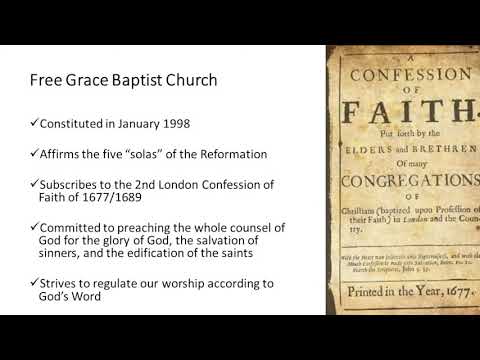
Introduction to the 1689 Second London Baptist Confession of Faith
Why should a church bind itself to a confession of faith? This introductory lesson on the Second London Baptist Confession of 1677/1689 grounds the answer exegetically in Ephesians 4 — where Christ gives gifted men to the church so that the body attains doctrinal unity and is no longer tossed about by every wind of teaching — and then traces the historical origins of the 1689 among the Particular Baptists, distinguishing them from Anabaptists, Presbyterians, and Congregationalists. Four functions of a confession are developed: defining, defending, discriminating, and disciplining with reference to the doctrine of the church. The lesson closes by distinguishing Reformed theology (Calvinism plus covenant theology plus the regulative principle) from mere five-point Calvinism, and by defending the confession's silence on matters of Christian liberty as a feature, not a defect.

The Royal Wedding
Psalm 45 presents a royal wedding between the divine-human Messiah and his church, and the sons of Korah compose it as a song of love that the New Testament apostles and the entirety of the Old Testament prophetic witness sustain. The sermon works through the psalm's four sections — the psalmist's intention, the perfections and person of King Messiah, the instruction to the bride, and the closing declaration — demonstrating that a divine Messiah was not a novelty invented by John or Paul but was anticipated in the Hebrew Scriptures. Christ is celebrated as fairer than the sons of men, committed to truth and righteousness, triumphant over his enemies, fully God and fully man in the hypostatic union, and the one who clothes his bride in imputed righteousness received through faith alone. The appropriate response of the church is repentance, exclusive allegiance, worship, and gladness before her great King.

The Mission of the Word, Part 1
John 1:6–9 introduces John the Baptist not as an independent figure but as a divinely commissioned witness whose entire ministry exists to point to the Word made flesh. This sermon examines the origin, nature, and function of that witness ministry, demonstrating that the Baptist's testimony belongs to a network of overlapping witnesses — Father, Son, Holy Spirit, Scripture, and signs — that ground saving faith in historical reality rather than a blind existential leap. The function of John's witness is inseparable from its purpose: that sinners would believe on Christ as the Lamb of God who takes away the sin of the world, not merely imitate him as a moral example. The sermon closes with a call to keep law and gospel in their proper places, so that sinners driven by the law's killing power may look by grace to the one who is both the true light and the only hope of the world.

The Divine Savior and His Afflicted People
Matthew 14:22–33 confronts the church with the Christological reality that the presence of Christ does not guarantee the absence of trial. Working through the storm on the Sea of Galilee, Christ walking on the water, Peter's sinking, and the disciples' confession of Christ as the Son of God, this exposition presses the claim that the 'I Am' of Exodus and the Psalms is the same Lord who meets his afflicted people in the middle of their storm-tossed sea. The sermon closes with a direct rebuke of health-and-wealth theology and a call to displace the fear of man with a robust fear of God grounded in Christ's sovereign lordship over creation.

The Ethics of Motherhood
Titus 2:3–5 sets older women in the church as instructors of younger women in the domestic virtues that honor the created order and adorn the doctrine of God. Against a cultural moment that treats the word 'mother' as offensive and obliterates God-wrought gender distinction, the passage calls women to love husbands and children, to exercise discretion, chastity, and diligence in the home, and to submit to their own husbands — not as cultural accommodation but as a reflection of the eternal created order grounded in Genesis and reaffirmed by Christ's redemption. The overarching rationale Paul supplies is theological: the conduct of women in household and church either blasphemes or adorns the Word of God before a watching world. The sermon closes by grounding every duty in grace alone through faith alone in Christ alone, warning that no degree of faithful motherhood constitutes grounds for justification.

The Trial before Pilate, Part 2
Matthew 27:15–23 records Pilate's attempt to grant amnesty to Jesus through the Passover prisoner-release custom, a device that exposes the cowardice of the Roman governor, the envious malice of the Jewish religious leaders, and the terrifying moral bankruptcy of mob rule. The passage is expounded under five heads — the custom of amnesty, the leaders' motivation of envy, the warning of Pilate's wife, the demand of the multitudes, and Pilate's cross-examination — each of which illuminates the comprehensive reach of human depravity. The substitution of Barabbas for Jesus is treated as emblematic of definite atonement: the just going to the cross in the place of the unjust, securing both the forgiveness of sins and the imputed righteousness of Christ received by faith alone. Hearers are urged not to be carried along by ungodly leaders, to flee to Christ without delay, and to eat the Lord's Supper as a memorial of the blood atonement and active obedience of the Second Person of the Trinity wrought entirely on behalf of his people.

The Christian Sabbath, Part 2
The Christian Sabbath, grounded in both creation and redemption, does not cease in the New Covenant but is transformed by the resurrection of Christ from the seventh day to the first day of the week. Working through the ministry of Christ in Matthew 5 and 12, the resurrection accounts across all four Gospels, and the apostolic teaching in Hebrews 4, Acts 20, 1 Corinthians 16, and Revelation 1, this exposition argues that the moral obligation of one day in seven for the worship of God remains perpetually binding on the church. The shift from Saturday to Sunday Sabbath is grounded in Christ's completed redemptive work, which mirrors the Father's rest at the close of creation, establishing the Lord's Day as the Christian Sabbath. Believers are called to receive this day not as a legal burden but as a gracious gift from God, a weekly foretaste of the consummate rest that awaits the people of God.

The Trial before Pilate, Part 1
Matthew 27:11–14 records the first stage of Jesus' trial before Pontius Pilate — his interrogation by the Roman governor. The passage unfolds in three movements: Pilate's opening question and Christ's guarded affirmation that he is indeed King of the Jews, the formal accusations brought by the chief priests and elders against which Jesus remains silent, and Pilate's astonished second question met again with silence. Christ's silence before Pilate is not passivity but purposeful obedience — fulfilling the fourth servant song of Isaiah 53 and accomplishing the active righteousness that is imputed to his people in justification. The sermon drives toward the twin realities of forgiveness and positive imputation: Christ's silence secured not only the remission of sins but the righteousness that avails with God, so that his people stand before the Father clothed in another's merit rather than their own.

Bible Study - Exodus 8
Exodus 8 records the second, third, and fourth plagues against Egypt — frogs, lice, and flies — each following a recurring pattern: divine command, Pharaoh's refusal, the plague's execution, a show of compliance, and a return to hardness of heart. The plagues are not merely natural disasters but a direct assault upon the gods of Egypt, demonstrating that Yahweh alone is the true and living God in the midst of the land. The hardening of Pharaoh's heart is an act of divine justice against an already guilty sinner, not arbitrary cruelty, and the distinction God draws between Goshen and Egypt anticipates the covenant blessing that separates his people from those under his wrath. The repeated failure of miracles to produce repentance in Pharaoh — even when his own magicians confess 'this is the finger of God' — establishes that new birth, not spectacle, is what makes a believer.

The Victory of David Over Goliath, Part 1
1 Samuel 17:1–37 is not a psychological self-help story about facing personal obstacles; it is a narrative of the glory of God. Goliath defies the armies of the living God, and David — a type of Christ — meets that defiance not with natural courage but with faith grounded in the proven faithfulness of Yahweh. The sermon traces the contrast between Israel's faithless paralysis and David's God-centred confidence, showing that apostasy produces cowardice while faith in the living God produces boldness. The practical summons is to walk by faith rather than by sight, to serve faithfully in ordinary providential callings, and to draw confidence for present trials from remembered past mercies.

The Lord's Arrest in the Garden
Matthew 26:50–56 records the arrest of Jesus in Gethsemane, and this exposition works through four movements in the passage: Peter's misguided sword-stroke, Christ's rebuke concerning the nature of the messianic kingdom, his rhetorical indictment of the mob's hypocrisy, and the disciples' desertion. The sermon shows that Christ's surrender was entirely voluntary, governed by the covenant of redemption and the fulfillment of prophetic Scripture, not by any inability to resist. Hearers are warned against mistaking external proximity to Christ for saving grace, called to zeal tempered by theological knowledge, and directed to the Lord's Supper as an occasion to 'kiss the Son' in faith rather than in the betrayal of a Judas.

Sunday School - Biblical view of self-defense, part 2
Matthew 5:38–42 is frequently misread as a blanket prohibition against self-defense, capital punishment, and just war — three instances of justifiable homicide that Scripture plainly upholds. This exposition argues that Jesus is not contradicting the lex talionis (the law of retribution found in Exodus, Leviticus, and Deuteronomy) but is correcting the Pharisaic misapplication of a civil-judicial principle to everyday interpersonal conduct. The passage addresses four specific situations — insult, litigation, conscription, and benevolence — and calls believers to a disposition of forbearance in personal relations, while leaving entirely untouched the legitimacy of lawful self-defense, just war, and capital punishment as administered by the civil magistrate.

Sunday School - Sept 6 - Self-Defense, Part 1/2
What does Scripture teach about the right of individuals to use lethal force in self-defense? Working through Exodus 22:2–3, a range of Old Testament illustrations, and the teaching of Jesus in the Gospels, this study argues that defensive homicide is not murder and is consistent with the whole counsel of God's law. The session also draws on Francis Turretin's four conditions for lawful self-defense and the Westminster Larger Catechism's treatment of the sixth commandment, situating the biblical case within the broader Reformed and historic Christian tradition. The study closes by distinguishing private revenge — which Scripture forbids — from necessary defense of life, family, and property, which Scripture assumes and authorizes.

Pressing On In Christ for Sanctification

Philippians 3:10–21 sets out the doctrine of sanctification as the necessary and purposeful continuation of justification — not its cause. The justified believer, having been conformed to Christ's death by the Spirit's regenerating work (Romans 6), is called to press forward in mortification of the old nature and vivification of the new, never resting in past attainments. Christ's purpose in saving sinners is not merely to deliver them from hell but to conform them to his image for the glory of God — the ordo salutis moving through justification and sanctification toward final glorification. The sermon calls believers to disciplined, Christ-dependent pressing on through Word, prayer, church attendance, and zealous good works, while warning that those who corrupt the gospel by mingling works with grace are enemies of the cross whose end is destruction.

All Of Christ For Justification
Philippians 3:1–9 presents the apostle Paul's radical revaluation of every religious credential he possessed, moving them all from the gain column to the loss column so that Christ alone might occupy the place of righteousness before God. This sermon expounds what it means to have no confidence in the flesh: that justification rests on Christ's perfect active obedience imputed to the believer, not on any combination of works, faith, and sincere effort. The loss column of sin is dealt with equally fully — Christ bearing the certificate of debt and nailing it to the cross, cancelling the debt in its entirety. Hearers are called to count all self-generated merit as rubbish and to rest, passively and completely, in Christ's righteousness received through faith alone.

The Third Missionary Journey, Part 1
Acts 19:1–10 opens Paul's extended ministry in Ephesus on the third missionary journey. The sermon works through three exegetical questions: the identity of the disciples Paul encounters (argued to be genuine Christian believers, not pre-Christian inquirers), the relationship between John's baptism and Christian baptism (argued to be one and the same ordinance), and the significance of the Spirit's coming with tongues and prophecy (argued to be a salvation-historical confirmation of Pentecost's fulfillment, not a normative pattern for all believers). The exposition concludes by drawing out Paul's ministry at the school of Tyrannus as a model of bold, reasoned, expositional gospel preaching that God uses to spread the word across an entire province.

The Lord's Instruction on Prayer
Matthew 6:5–13 contains Jesus' instruction on three aspects of prayer that the disciples must get right: the motivation that drives them to the closet, the manner they adopt when they arrive, and the model that frames their petitions. The sermon works through each in turn, contrasting godly prayer with the exhibitionism of the hypocrite and the manipulative vain repetition of the heathen — illustrated at length from the contest on Mount Carmel in 1 Kings 18. It closes with eight reasons why the sovereignty of God, far from making prayer unnecessary, is the very ground on which the believer brings every petition in faith.