
Cited in sermons
C. H. Spurgeon
239 sermons · All people cited

The Conclusion of Jesus's Public Ministry, Part 2

John 12:44–50 records the conclusion of Jesus' public ministry, and in it He reiterates the three controlling themes of the entire Gospel: His identity as the eternal Son who is consubstantial with the Father, His mission as the Light of the world who came not to judge but to save those abiding in darkness, and His authority as the one who speaks the very words of God. The unbelief described in the surrounding context — including the merely historical faith of rulers who loved the praise of men — sets the stage for Jesus' final public proclamation. Those who reject the Son reject the Father; those who receive Him by grace through faith pass from darkness into everlasting life.

Restrictions on Levitical Priesthood
Leviticus 21–22 sets out restrictions governing the Levitical priesthood: whom priests may mourn, whom they may marry, what physical conditions disqualify them from service, who may eat from their food, and what animals are acceptable for sacrifice. The underlying logic in every category is the same — the holy God who dwells among his people demands a priesthood, a sacrifice, and a manner of worship that reflect his holiness and are not corrupted by defilement or defect. These chapters point typologically beyond themselves to the Lord Jesus Christ, who alone fulfils what the Levitical order only approximated: the perfect high priest who is holy, harmless, and undefiled, and the perfect sacrifice offered once for all. The superiority of the new covenant is seen precisely here — the exclusions of the old order (eunuchs, the maimed, the lame) give way to the great invitation of Christ to the broken and outcast to come to the wedding feast.

The Psalmist's Prophetic Anticipation of the Apostolic Proclamation of Christ

Psalm 19 is read not merely as a declaration of general and special revelation but as a prophetic anticipation, interpreted by the Apostle Paul in Romans 10, of the apostolic proclamation of the gospel of Jesus Christ. Working through seven points across the psalm's three movements, the sermon traces the symbol, referent, and message of each image: heavens and firmament pointing to the apostles, the sun pointing to Christ the Bridegroom and Son of Righteousness, and the law, testimony, statutes, and judgments pointing to the gospel itself. The Word of God is shown to be perfect, sure, right, pure, clean, true, and righteous — qualities that belong to the gospel, not the Mosaic law — and its effects of conversion, wisdom, rejoicing, and enlightenment call both believer and unbeliever to rest in Christ, the Son of Righteousness, whose glory has gone out to the ends of the earth.
The Husband and Wife Relationship, Part 1
Ephesians 5:22–24 presents the duty, reason, and practice of a wife's submission to her husband within the covenant of marriage. The passage is expounded within the broader Pauline household code of Ephesians 5:21–6:9, which itself flows from the Spirit-filled life commanded in verse 18. The sermon grounds wifely submission in both the created order (the husband as head by divine indicative, not negotiation) and in the analogical relationship of Christ and the church. Husbands and wives are called to embrace their respective obligations — loving leadership and willing, comprehensive submission — as an act of obedience to God, knowing that the grace enabling this obedience flows from the gospel of Jesus Christ alone.

The Good Fight of Faith
The Christian life is not ease but warfare, and 1 Timothy 6:11–12 summons every believer to flee wickedness, pursue righteousness, fight the good fight of faith, and maintain steadfast perseverance. The sermon is careful to frame these imperatives not as conditions for acceptance with God but as the necessary marks of one already conquered by sovereign grace and effectually called. Paul's martial language is grounded in the objective content of the faith once delivered to the saints and in the subjective grip the believer must not release. The passage receives its sharpest application at a baptism service, where the public confession of Tabea and Benjamin illustrates that the effectual call comes by the same sovereign grace whether a person is seized dramatically on a road to Damascus or nurtured quietly in the home of a Eunice and a Lois.

Sunday School Confession Study - 2LCF 2.2
God's external relations to the created order — his independence, omniscience, holiness, and the creature's obligation to him — are the subject of 2LCF Chapter 2, Paragraph 2. The confession's insistence that God is entirely self-sufficient and derives no glory from creatures corrects any notion that God created the world out of need or incompleteness. The omniscience of God is infinite, infallible, and independent of the creature, so that nothing is contingent or uncertain to him. The study closes by grounding the creature's obligation of worship, service, and obedience in what God is — holy in all his counsels, works, and commands.

The One Thing Needful
Luke 10:38–42 presents two sisters whose contrasting postures before Christ expose a perennial danger for the people of God: the distraction of much serving to the neglect of the one thing needful. The sermon works through Martha's fourfold complaint — impugning Christ's care, demanding he redirect Mary, mingling grumbling with service, and collapsing into self-pity — before turning to Christ's gentle double-named rebuke and his commendation of Mary's humble discipleship. The passage does not condemn service, family, work, or daily necessity, but it does condemn the disordering of priorities that allows lawful things to crowd out devotion to the word of Christ. The lasting and untakeable benefit Christ promises to those who sit at his feet is the governing application: seek first the kingdom, receive the word with a noble heart, and trust that all other things will be added.

Introduction to the 1677/1789 2nd London Baptist Confession of Faith
The 1689 London Baptist Confession of Faith — formally composed in 1677 and adopted by particular Baptist churches in 1689 — stands in deliberate continuity with the Westminster Confession and the Savoy Declaration, adapting their language to reflect distinctively Baptist convictions while maintaining solidarity with the broader Reformed tradition. This introductory session traces the Confession's historical origins, its relationship to the First London Confession of 1644–46, and the legal and ecclesiastical context in which particular Baptists operated under the Act of Toleration. Six reasons are then advanced for why a 21st-century church should subscribe to a 17th-century confession: to define, defend, discriminate, discipline, distinguish matters of Christian liberty, and develop an appreciation for the history of the church. The session closes by urging that confessionalism, rightly understood, is not proud biblicism but the humble reception of gifts Christ has given to his church across the ages.

The Gifts Given by the Ascended Christ, Part 4
Ephesians 4:15–16 concludes Paul's treatment of the gifts given by the ascended Christ by setting out the positive influence those gifts are designed to produce in the church: spiritual maturity through truth spoken in love, and corporate edification flowing from union with Christ the head. The sermon argues that the Christian ministry is not a free-for-all of entertainment or emotional stimulation but is governed by Christ himself, who gave pastor-teachers to equip the body for growth into the fullness of Christ. Against the twin dangers of internal spiritual complacency and external false teachers, the church is called to the use, consistent use, and persevering use of the ordinary means of grace — preaching, prayer, and the gathered assembly — as the God-ordained path to maturity.

The Good Shepherd, Part 2
John 10:7–10 presents Christ as the door of the sheep and the giver of abundant life, set in deliberate contrast to the false shepherds — thieves and robbers who steal, kill, and destroy. The sermon works through three movements: the identification of Christ as the exclusive door of access to God, the condemnation of corrupt religious leadership in Israel, and the commendation of Christ's ministry as one that saves, sustains, and enriches his sheep with life abundantly. Drawing on Jeremiah 23, Ezekiel 34, Isaiah 55, and Psalm 23, the sermon argues that the abundant life Christ promises is rooted in Old Testament prophecy, is grounded in definite atonement and the perseverance of the saints, and calls both unbelievers to come through the door and believers to respond with worship and gratitude.

The Practice of the Early Church
Acts 2:41–47 describes the irreducible practices of the early church — the apostles' doctrine, fellowship, the breaking of bread, and prayer — and this sermon argues that those practices are not merely historical description but prescription for the church in every age. The gospel that created the church (sovereign grace working through proclamation to bring dead sinners to faith and repentance) also defines what the church does when it gathers. The sermon presses both the unconverted (to seek the Lord Jesus Christ in whom alone there is forgiveness and an imputed righteousness) and the congregation (to continue steadfastly in the ordained means of grace rather than chasing experience, ecstasy, or entertainment).

The Future King of Zion
Micah 5:2–5a prophesies a coming king whose identity encompasses both true humanity and eternal divinity — a king born in the obscure village of Bethlehem, yet whose goings forth are 'from of old, from everlasting.' This sermon traces two movements in the passage: first, the identification of the king in verse 2, where the hypostatic union is set forth in prophetic form through the doctrines of incarnation and eternal generation; second, the mission of the king in verses 3–5a, where Christ is shown to be the Shepherd who feeds and protects his remnant people, and himself their peace. The congregation is pressed to nourish perseverance through the ordained means — reading Scripture, prayer, and corporate worship — trusting the covenant faithfulness of the God who announced his Son seven centuries before he arrived.
The Astonishment of the Apostle
Paul's opening salvo in Galatians 1:6–9 registers apostolic astonishment at the speed with which the Galatian churches were deserting the gospel of free grace for a Judaizing supplement of circumcision and Mosaic law-keeping. The sermon expounds why any addition to the finished work of Christ — however small — is not a variation of the gospel but its outright denial, because a man must choose either perfect law-keeping or the wholly sufficient righteousness of Christ received by faith alone. The anathema Paul pronounces in verses 8–9, drawn out through the Hebrew concept of ḥērem and its New Testament cognate anathema, exposes the perverter of the gospel not merely to church discipline but to the judicial wrath of God. The sermon closes with an urgent call to doctrinal vigilance: to resist indifference, imprecision, compromise, and novelty, and to hold fast to justification by faith alone as the very heart of the Christian religion.

The Need for Gospel Ministers
Matthew 9:35–38 presents Christ surveying the multitudes of Galilee and responding not primarily to their political oppression but to their spiritual destitution — harassed and scattered like sheep without a shepherd because Israel's religious leaders had failed and become predators of the very flock they were charged to keep. The sermon traces the shepherd-and-harvest imagery through Numbers 27, 1 Kings 22, Jeremiah 23, and Micah 5 to demonstrate that God's remedy for faithless shepherds has always been the raising up of faithful men under the Messiah's authority. Christ's compassion, exercised according to his human nature, issues not in mere sympathy but in effective action: commanding his disciples to pray the Lord of the harvest to send out laborers, then immediately appointing and commissioning the Twelve. The congregation is called to share Christ's own compassion for the spiritually destitute, to believe that the harvest is genuinely plentiful across every tribe and nation, and to pray, give, identify, train, and send qualified men into gospel ministry.

The Conduct of a Faithful Minister
Paul's charge to Timothy in 1 Timothy 4:12–16 sets forth the pattern for every faithful gospel minister: exemplary character, diligent public ministry, ongoing personal growth, and tenacious perseverance to the end. Preached at an ordination service for a newly commissioned pastor, this exposition works through each element of the apostle's command — from the six spheres of a minister's example (word, conduct, love, spirit, faith, purity) to the three pillars of public ministry (reading, exhortation, doctrine). The sermon insists that Christian virtue, however admirable, cannot save souls; it is the word of God, proclaimed boldly and accurately, that the Spirit uses as the instrument of salvation. The congregation is charged alongside the minister: receive the word with joy, reject heresy, prize the public means of grace, and honour those who watch for your souls.

The Feeding of the Five Thousand
John 6:1–15 presents the feeding of the five thousand as a sign — a theological event designed to reveal who Jesus is, not merely a remarkable act of provision. The miracle is set against the backdrop of the Passover and the Mosaic exodus, inviting comparison between the manna in the wilderness and Jesus as the living bread come down from heaven. The crowd's response — declaring him the prophet of Deuteronomy 18 and then attempting to seize him as a political king — exposes the persistent confusion between a physical, temporal messianic expectation and the spiritual, eternal salvation Christ actually came to accomplish. The sermon calls hearers to see in the bread and fish the One who supplies all things abundantly, who has both the compassion and the omnipotence to save every sinner who comes to him in faith.

The Gracious Purpose of the Father
Ephesians 1:3–6 opens with what the Apostle Paul calls a 'barakah' — a formal blessing of God followed by specific reasons for that praise. This sermon expounds the Father's role in the covenant of redemption: His sovereign, unconditional election of sinners in Christ before the foundation of the world, and His predestinating purpose that those chosen would be made holy and blameless. Election is the cause, not the consequence, of faith and repentance — sinners dead in trespasses and sins are chosen not because of foreseen merit but according to the good pleasure of God's will alone. The sermon calls believers to respond to the doctrine of election not with defensive polemic but with the doxological posture Paul himself models: praise, blessing, and adoration to God Most High.

The 6th Command, Part 2
The sixth commandment's prohibition against murder extends far beyond the physical act of killing to encompass the internal disposition of the heart — unwarranted anger, bitterness, and character assassination. Drawing from Exodus 20:13, Matthew 5:21-26, Leviticus 19:17-18, and the Westminster Larger Catechism, this study traces the biblical distinctions between murder and lawful homicide (capital punishment, just war, and self-defense), demonstrates that all human beings at every stage of life bear the image of God and therefore possess inviolable dignity, and applies the commandment's positive duty to preserve life. Hearers are called to deal faithfully with relational sin rather than harbor grudges, to resist the culture of abortion and euthanasia as violations of the image of God, and to understand the civil use, pedagogical use, and normative use of this commandment.

The Introduction to Ephesians
Ephesians 1:1–2 introduces one of the richest doctrinal letters in the New Testament canon, and this sermon surveys the authorship, historical context, and theological purpose of the epistle before examining Paul's greeting to the saints. The apostle's self-identification as one sent by Christ 'by the will of God' grounds his authority not in self-appointment but in sovereign divine commission, while his description of the recipients as 'saints' and 'faithful in Christ Jesus' defines sainthood in purely biblical terms — all who are justified by grace alone through faith alone in Christ alone. The sermon traces Paul's founding ministry in Ephesus through Acts 18–19, showing how the gospel's triumph over witchcraft, idolatry, and the cult of Diana provides the backdrop for the letter's emphasis on Christ's supremacy over all powers. The epistle is previewed as a two-part structure — doctrinal foundation (chapters 1–3) followed by practical application (chapters 4–6) — aimed at grounding believers in both the indicatives and imperatives of redemption.

The Empty Tomb and the Risen Lord
The resurrection of Jesus Christ is the crowning proof that the Father accepted the Son's atoning work as a full satisfaction for sin. Expounding Matthew 28:1–10, this sermon works through the discovery of the empty tomb — the arrival of the women, the descent of the angel, and the commission given to the first witnesses — and then the appearance of the risen Lord to those same women. The resurrection is not myth or fable but attested history, with details such as the folded burial cloth, the terrified guards, and the forthright identification of women as the primary witnesses all serving the integrity of the gospel record. The empty tomb grounds the Christian's confidence in the forgiveness of sins and the imputed righteousness of Christ, and it calls every hearer to seek the risen Lord without fear.
The Burial of Jesus
The burial of Jesus in Matthew 27:57–66 is examined across two movements: the burial proper (vv. 57–61) and the security measures taken at the tomb (vv. 62–66). Against both the swoon theory and ancient Jewish counter-testimony that the disciples stole the body, the sermon marshals the apologetic force of the sealed, guarded, newly-hewn tomb to demonstrate that the resurrection overcame every human precaution. The burial also carries weight in four theological categories: it confirms the reality of Christ's death, marks the final act of his humiliation as the last Adam, demonstrates his conquest of death, and strips the grave of its paralyzing power for all who belong to him.
Clip: Flyover of Covenant Theology (2LCF Chapter 7 - Of God's Covenant)
Covenant theology serves as the central hermeneutical architecture of Scripture, and this introductory flyover situates it against competing systems — dispensationalism and New Covenant theology — before tracing its practical consequences for continuity between the Testaments, the role of ethnic Israel, the subjects of baptism, and the law of God in the new covenant. Two key distinctions between the 1689 London Baptist Confession and the Westminster Confession are noted: the particular Baptists' omission of an explicit covenant of works statement in Chapter 7, and their refusal to identify the Old Covenant as an administration of the covenant of grace. The sermon locates covenant theology not merely in academic method but in pastoral comfort, grounding the blood-bought people of God in the assurance that God is in Christ reconciling the world to himself.
Chapter 7 - Of God's Covenant
1689 London Baptist Confession chapter 7 traces the biblical and theological architecture of God's covenant: from the necessity of divine condescension (paragraph 1), through the gracious character of the covenant of grace (paragraph 2), to the three theological covenants — grace, redemption, and works — and their progressive historical unfolding (paragraph 3). The session contrasts covenant theology with dispensationalism and New Covenant theology as competing hermeneutical frameworks, argues that the Old (Mosaic) Covenant functioned as a republication of the covenant of works rather than an administration of the covenant of grace, and demonstrates from Genesis 3:15 through Jeremiah 31 and Matthew 26 that all historical covenants advance a single promise of redemption finally and fully disclosed in the new covenant inaugurated by Christ. The practical payoff is a robustly confessional case for believers-only baptism: the new covenant community is defined by inward regeneration, universal knowledge of the Lord, and definitive forgiveness — marks that exclude the external-and-internal covenant structure required to justify paedobaptism.

The Promise of the Coming King
Isaiah 9:6–7 presents the promised Messianic King in language that exceeds any earthly monarch — a child born yet mighty God, a son given yet everlasting Father, the Prince of Peace who secures shalom through conquest. This exposition sets the passage in its historical context of Assyrian devastation and prophetic hope, then works through the fourfold identification of the King and the fourfold character of His kingdom. The central application is that this King presently reigns at the right hand of the Father, and entrance into His eternal, covenantal, just, and secure kingdom is by grace through faith alone in the Lord Jesus Christ.

The Conversion of the Philippian Jailer
Acts 16:16–34 presents the arrest and imprisonment of Paul and Silas as the God-ordained means by which a Roman jailer was brought to saving faith in Jesus Christ. The sermon traces two movements: the exorcism of a python spirit that provoked false charges and a severe beating, and the subsequent earthquake and gospel conversation that issued in the jailer's conversion and household baptism. Paul and Silas's midnight prayers and hymns amid unjust suffering demonstrate that Christ is worth all suffering, while the jailer's question — 'What must I do to be saved?' — receives the apostolic answer: believe on the Lord Jesus Christ. The sermon closes with three baptisms that embody the same gospel the Philippian jailer heard, illustrating that believers' baptism by immersion is the fitting public sign of union with Christ in His death and resurrection.

2LCF Chapter 4 - Of Creation
The 2nd London Confession of Faith Chapter 4 sets forth the biblical doctrine of creation: that the triune God — Father, Son, and Holy Spirit — freely called all things into being ex nihilo in the space of six literal days for the manifestation of His glory. The study examines the Trinitarian authorship of creation, the doctrine of appropriations, the nature of man as a dichotomous image-bearer possessing knowledge, righteousness, and holiness, and the probationary command given to Adam as positive law. A sustained application presses the church to hold the doctrine of six-day creation and the historical integrity of Genesis 1–3, recognizing that capitulation on creation undermines Christian ethics across every domain — marriage, sexuality, human dignity, and ecclesial order.

The Conduct of a Faithful Minister
What does faithfulness look like in the life and ministry of a gospel minister? Expounding 1 Timothy 4:12–16 as a capstone to a study of elder qualifications in 1 Timothy 3:1–7, this sermon examines four dimensions of ministerial conduct: the minister's example before the congregation, his public ministry of reading, exhortation, and doctrine, his personal growth through sustained meditation on the Word, and his perseverance in both personal piety and sound teaching. The closing application extends these same marks to the congregation, calling the saints to receive the Word with joy, reject heresy with discernment, pursue Christian virtue, and prize the public means of grace.

The Qualifications of Elders, Part 4
The elder's qualification 'able to teach' (1 Timothy 3:2) is not an arbitrary requirement but the inevitable expression of a word-centered religion. This sermon traces the centrality of the proclaimed Word from the Mosaic covenant through the prophetic institution, the earthly ministry of Christ, the apostolic mission, and the pastoral epistles, demonstrating that teaching and governing in the church have always been inseparable. The third main point applies this theology practically: men aspiring to eldership must demonstrate proven faithfulness as churchmen before the church recognizes, tests, and formally approves them by common suffrage according to 2nd London Confession chapter 26, paragraph 9.

The Crucifixion of Jesus, Part 3
Matthew 27:45–46 records the fourth of Christ's seven words from the cross — the cry of dereliction, 'My God, my God, why have you forsaken me?' — and its interpretation demands both exegetical precision and doctrinal care. The darkness from the sixth to the ninth hour was not a solar eclipse but a supernatural sign of divine judgment, recapitulating the ninth plague pattern and marking the moment the Passover antitype was slain. The cry itself does not imply any ontological division within the Trinity, any dissolution of the hypostatic union, or the suffering of all three persons; rather, it expresses the withdrawal of divine consolation from the Son according to his true humanity as he bore, in our place as surety, the full weight of penal wrath. Believers are called to ground their assurance not in felt divine presence but in the covenant faithfulness of the God to whom Christ still cried 'my God' even in the depth of his substitutionary suffering.
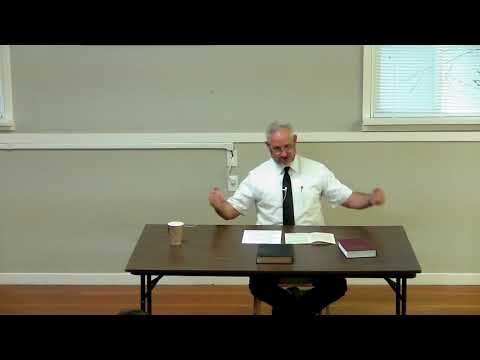
2LCF Chapter 1 - Of the Holy Scriptures, Part 2
Hermeneutics — the science of biblical interpretation — stands at the center of this study through paragraphs 5 to 10 of Chapter 1 of the 1689 London Baptist Confession of Faith. The session works through five principles: the scope of Scripture (Christ as its organizing center), the sufficiency of Scripture (including good and necessary consequences), the perspicuity of Scripture, the availability of Scripture through faithful translation, and the two classical interpretive rules — the analogy of Scripture and the analogy of faith. The study closes by defending the proper use of creeds, confessions, and the writings of faithful theologians as gifts Christ has given to his church, while insisting that Holy Scripture alone is the supreme and final judge in all controversies of religion.