
Cited in sermons
Augustine
153 sermons · All people cited

2LCF Chapter 8 - Of Christ the Mediator, Part 3

The incarnation of the Son of God — that the eternal, divine Son took to himself a true and complete human nature without ceasing to be God — stands at the centre of the Christian religion and is inseparable from the doctrine of salvation. This confession study works through 2LCF Chapter 8, paragraphs 2 and 7, first clearing away eight historical errors about what the incarnation is not (mutation, docetism, a heavenly body, a bodyless appearance, an animal soul without a human soul, a mixing of natures, a divestiture of divine attributes, and a Nestorian conjunction of persons), then positively establishing the language of assumption, union, and incarnation as the church's consistent witness from the apostolic era forward. The Son did not subtract from nor add to himself; he took to himself that which he was not while remaining fully what he eternally is, and the Trinity — Father, Son, and Spirit — acts undividedly in this work, though it terminates on the Son alone.

The Riches and Poverty of Christ

2 Corinthians 8:9 presents the Incarnation as the supreme pattern for Christian charity: the eternal Son of God, rich in every divine perfection, took upon himself genuine human poverty without divesting himself of a single divine attribute. This sermon examines the riches of Christ — his eternal divine nature as Creator, Sustainer, and Son by nature — and the poverty of Christ, meaning his true assumption of human nature with all its essential properties and common infirmities, yet without sin. The hypostatic union is defended against kenotic error: Christ's humiliation consisted not in the emptying of divinity but in the addition of humanity to the one person. These riches secured through Christ's impoverishment — justification, sanctification, and glorification — are received through faith alone and visibly proclaimed in Christian baptism.

2LCF Chapter 8 - Of Christ the Mediator, Part 2
The deity of Jesus Christ is not a late ecclesiastical imposition but the irreducible confession of Scripture, the early church, and the Reformed confessional tradition. This lesson, the second in a series through 2LCF Chapter 8, opens by reading paragraphs 1–2 of the confession before working through both what the orthodox doctrine of Christ's deity does NOT mean — rejecting polytheism, social trinitarianism, homoiousian subordinationism, modalism, and kenoticism — and what it positively asserts: that Christ is very and eternal God, of one substance with Father and Spirit, equal to the Father, personally distinct within the Godhead, and unchanging in deity through the incarnation. The biblical witness is then marshalled under five categories — explicit statements, Christ's self-witness, NT application of OT divine texts, divine perfections predicated of Christ, and divine works ascribed to Him — to demonstrate that the deity of Christ is axiomatic rather than argued in Scripture itself.

The Psalmist's Prophetic Anticipation of the Apostolic Proclamation of Christ
Psalm 19 is read not merely as a declaration of general and special revelation but as a prophetic anticipation, interpreted by the Apostle Paul in Romans 10, of the apostolic proclamation of the gospel of Jesus Christ. Working through seven points across the psalm's three movements, the sermon traces the symbol, referent, and message of each image: heavens and firmament pointing to the apostles, the sun pointing to Christ the Bridegroom and Son of Righteousness, and the law, testimony, statutes, and judgments pointing to the gospel itself. The Word of God is shown to be perfect, sure, right, pure, clean, true, and righteous — qualities that belong to the gospel, not the Mosaic law — and its effects of conversion, wisdom, rejoicing, and enlightenment call both believer and unbeliever to rest in Christ, the Son of Righteousness, whose glory has gone out to the ends of the earth.

2LCF Chapter 8 - Of Christ the Mediator, Part 1
What does it mean to confess that Jesus Christ is very God and very man, and why does the precision of that confession matter for eternal life? This introductory session on 2LCF Chapter 8 surveys the doctrine of Christ the Mediator by establishing both the necessary posture and the interpretive rules required for sound Christology, then sets out seven reasons why the study of Christ stands at the center of all Christian theology. The session moves from the scope of Scripture as Christ-centered revelation, through the connection of eternal life to a right knowledge of Christ, to the comprehensiveness of all redemptive benefits being located in union with Him, calling the hearer to pursue a high Christology as the only safe and saving confession.

2LCF Chapter 4 - Of Creation
Creation is not a brute fact but a deliberate act of the undivided Trinity — Father, Son, and Holy Spirit — for the manifestation of His eternal power, wisdom, and goodness. This study of 2LCF Chapter 4 traces what creation is (all things not God, made ex nihilo and from previously created matter), who created (the triune God whose immutability and eternality mean creation produced no change in Him), and what man is within creation (a being made male and female, bearing reasonable and immortal souls, the image of God in knowledge, righteousness, and true holiness). The chapter culminates in the covenant of works: man was not created in covenant but was brought into covenant by God's voluntary condescension, establishing the pre-fall communion whose loss in Adam and recovery in the second Adam frames the entire remainder of the confession.

2LCF Chapter 2 - Of God and of the Holy Trinity
The doctrine of the Trinity is the capstone of the confession's treatment of God, asserting that the one divine and infinite being eternally exists as Father, Son, and Holy Spirit — three subsistences of one substance, power, and eternity, each possessing the whole divine essence undivided. This session works through six confessional affirmations: that Trinitarian monotheism excludes tritheism; that confessing one God in three persons is no contradiction; that the persons do not collectively comprise God in fractional parts; that the persons are distinguished solely by their eternal relations of origin; that Father, Son, and Holy Spirit are fully co-equal, co-eternal, and consubstantial; and that the doctrine of the Trinity is not a cold academic exercise but the very foundation of all communion with God and comfortable dependence on Him.

2LCF Chapter 2 - Of God and of the Holy Trinity, Part 1
Eternal life consists in knowing the only true God and Jesus Christ whom he has sent (John 17:3), which means the knowledge of God is not optional for Christians but is the very substance of their salvation. This session opens a multi-week confession study of 2LCF Chapter 2 (Of God and of the Holy Trinity) by establishing what theology proper is — the study of the being, attributes, and works of the triune God — and why it is primary: it is grounded in God's creative purpose, commanded in Scripture, promised in the New Covenant (Jeremiah 31:31-34), and urgently needed in the face of false religion and bad theology. Six preliminary interpretive helps are then introduced to prepare the mind for rigorous and reverent engagement with the doctrine of God, including the necessity of recognising the ontological chasm between Creator and creature, God's revelatory condescension, and the joint propriety of affirmations and denials.

The Resurrection and the Life, Part 1
What does it mean that Jesus delayed coming to Lazarus while professing love for him? John 11:1–16 opens the account of the resurrection of Lazarus by pressing the question of how dark providence coexists with the love of Christ. The death of Lazarus is shown to serve a purpose higher than the welfare of one family: the glorification of God through the display of the Son's omniscience and omnipotence. The passage calls every hearer to reckon with what makes Jesus glad — the belief of sinners — and to confess with Martha that he is the Christ, the Son of God.

Introduction to the 1677/1789 2nd London Baptist Confession of Faith
The 1689 London Baptist Confession of Faith — formally composed in 1677 and adopted by particular Baptist churches in 1689 — stands in deliberate continuity with the Westminster Confession and the Savoy Declaration, adapting their language to reflect distinctively Baptist convictions while maintaining solidarity with the broader Reformed tradition. This introductory session traces the Confession's historical origins, its relationship to the First London Confession of 1644–46, and the legal and ecclesiastical context in which particular Baptists operated under the Act of Toleration. Six reasons are then advanced for why a 21st-century church should subscribe to a 17th-century confession: to define, defend, discriminate, discipline, distinguish matters of Christian liberty, and develop an appreciation for the history of the church. The session closes by urging that confessionalism, rightly understood, is not proud biblicism but the humble reception of gifts Christ has given to his church across the ages.

The Attempted Murder of the Good Shepherd
John 10:31–42 presents the religious leadership of Jerusalem responding to Christ's declaration 'I and my Father are one' not with worship but with stones. This exposition traces three movements: the revelation of Christ's divine glory in verse 30, the attempted murder by the Jewish leaders in verses 31–39, and the fruitful reception of Christ in the Transjordan in verses 40–42. Central to the passage is Christ's appeal to Psalm 82 and the argument from lesser to greater — if God calls earthly magistrates 'Elohim,' on what grounds do they stone the One whom the Father sanctified and sent? The sermon closes with an encouragement to the people of God: where Jerusalem rejects, the Transjordan receives, and the Good Shepherd will gather His sheep from every tribe and nation.

2LCF Chapter 31 - Of the State of Man After Death, and of the Resurrection of the Dead
The doctrine of the intermediate state — the condition of the soul between death and the final resurrection — is examined through 2LCF Chapter 31 and the key Scripture passages that ground it. The confession teaches a sharp dichotomy: at death, the body returns to dust while the immortal soul either goes immediately to be with Christ in paradise or is cast into hell, with no third option such as purgatory or soul sleep. The resurrection of both the just and the unjust on the last day is treated in paragraphs 2 and 3, with 1 Corinthians 15 providing the clearest statement that Christ's coming is followed immediately by the end — a structure that complicates dispensational premillennialism. The lesson closes with a call to find comfort and ethical urgency in the simplicity of biblical eschatology rather than in elaborate prophetic systems.
The Gifts Given by the Ascended Christ, Part 3
Ephesians 4:13–16 specifies the duration, goal, and effect of the teaching gifts Christ gives to the church — the pastor-teachers who continue until the Lord returns. The goal of that ministry is threefold: the unity of the faith, the knowledge of the Son of God, and the corporate maturity of the church measured against the fullness of Christ. A faithful preaching ministry functions as preventative maintenance, guarding the congregation against spiritual immaturity, doctrinal instability, and susceptibility to deceitful men. The sermon closes by calling the church to pray for the ascended Christ to raise up qualified men, and to receive their teaching as the God-ordained means of growth and stability.

The Healing of a Blind Man, Part 2
John 9:13–34 records the formal interrogation of a man born blind by the Pharisees following his healing by Jesus. The passage exposes the willful unbelief of Israel's religious leadership — men who suppress plain evidence, commit perjury, and wield coercion against a helpless witness — while simultaneously tracing the healed man's growing confession of Christ, from 'he is a prophet' to 'if this man were not from God, he could do nothing.' The sermon argues that opposition to the Son of God is always opposition to the Father who sent him, and that the courage to confess Christ in the face of exclusion and shame is the mark of genuine discipleship.

The Freedom in Receiving the Son, Part 2
John 8:33–36 sets two irreconcilable conditions before every person: slavery to sin or freedom in the Son. Working through Jesus' response to the objecting Jews — His declaration of spiritual slavery in verse 34, His illustration from the household in verse 35, and His promise of true liberty in verse 36 — this sermon argues that sin's bondage is total, that the sinner is constitutionally blind to his own condition, and that freedom comes exclusively through the only-begotten Son who abides in the Father's house forever. The law of God must be pressed upon the conscience so that sinners know their malady before they can receive the remedy: the Son who makes men free indeed.
The Danger of Rejecting the Son
John 8:21–29 records Jesus warning a hostile religious leadership that they will die in their sins if they do not believe that He is the great I Am — the divine Son eternally generated from the Father, sent into the world in the economy of redemption. The sermon works through the passage in three movements: the announcement of Christ's departure and the condemnation it implies, the question of His identity and the slander levelled against Him, and the reference to His crucifixion as the moment of disclosure. The central doctrinal burden is that a deficient Christology — whether ancient Arianism, Sabellianism, or modern proposals of eternal functional subordination — amounts to the very unbelief Christ condemns, and that the church's primary calling is to preach the triune God with particular weight on who the Son is and what He has done for sinners.

The Reaction to Jesus and His Words
John 7:40–53 records the sharply divided public reaction to Jesus's preaching at the Feast of Tabernacles and the private opposition of the Sanhedrin to him and his followers. The crowd fractures over whether Jesus is the promised prophet of Deuteronomy 18 or the Christ himself, while the religious leadership responds not with argument but with contempt, attempting to silence him through force and scorn. The temple officers sent to arrest Jesus return empty-handed, confessing that no man has ever spoken as he has — a testimony that magnifies Christ's divine authority even as the Sanhedrin descends into lawlessness. The sermon calls hearers to abandon the confusion of the crowd and the hardness of the Sanhedrin, and instead to come to Christ in faith, receiving the everlasting life he freely offers.

The Bread of Life Discourse, Part 1
John 6:22–34 records the opening exchange of the bread of life discourse, in which Jesus confronts a crowd whose pursuit of Him is driven entirely by physical appetite rather than spiritual need. The sermon works through three movements: the exposed motive of the people (vv. 22–26), the Savior's exhortation to labor for food that endures to everlasting life (vv. 27–29), and the crowd's demand for a sign to rival Moses (vv. 30–34). Central to the exposition is Jesus' declaration that the 'work of God' is faith in the One the Father has sent — a faith that is itself God's gift — and His identification of Himself as the true bread of God who comes down from heaven to give life to the world, surpassing the manna of the wilderness and extending to every tribe, tongue, people, and nation.

2LCF Chapter 8 - Of Christ the Mediator, Part 1
Chapter 8 of the 1689 London Baptist Confession opens with the pre-temporal appointment of Christ as mediator in the covenant of redemption, then moves to the historical stages of that mediatorial work, beginning with the incarnation. The confession affirms that the Son of God, consubstantial and co-eternal with the Father, took on true human nature — with all its essential properties and common infirmities, yet without sin — so that two whole and distinct natures are inseparably united in one person: the hypostatic union. Drawing on John 1, Hebrews 2, 4, and 7, Galatians 4, and the Chalcedonian Definition of 451, the study traces the biblical and creedal foundations of Reformed Christology, and shows how the confession's language connects the Reformed Baptist tradition to the settled Christological consensus of the ancient church.

The Riches of Christ
How can the eternal, omnipotent Son of God be said to have 'become poor'? Expounding 2 Corinthians 8:9, this sermon traces the riches of Christ to His divine nature and works as the second person of the Trinity, and His poverty to the Incarnation, His lowly life, and His sufferings and death. The hypostatic union — two whole natures inseparably joined in one person — is shown to be not merely a speculative doctrine but the theological ground on which the Apostle Paul appeals to the Corinthians for generous giving. The riches believers receive through Christ's poverty are spiritual: justification, sanctification, glorification, and adoption, purchased by His obedience, suffering, and resurrection.

Introduction to the Decalogue
Exodus 20:1–2, the preface to the Decalogue, reveals God as the sovereign Lawgiver who redeems before He commands — a pattern in which grace precedes obligation that runs from Sinai through the new covenant. The sermon examines three classical uses of the Ten Commandments (civil, pedagogical, and normative) and the threefold division of the law (moral, ceremonial, judicial), demonstrating that the moral law alone abides in its full binding force for all people and all ages. Believers are not justified by the law but are directed by it as the objective standard of sanctification, so that love for God and neighbor is never left undefined or sentimental.

2LCF Chapter 3 - Of God's Decree, Part II
God's decree, as confessed in 2LCF Chapter 3, encompasses both predestination unto life and the reprobation of the non-elect — a distinction the confession handles with care but which Scripture addresses with directness in passages such as Proverbs 16:4, Matthew 11:25-28, and Romans 9:17-23. The sermon distinguishes three theological frameworks integral to understanding the decree in salvation: the Pactum Salutis (the pre-temporal, intra-Trinitarian covenant of redemption), the Historia Salutis (the unfolding of redemption in space and time), and the Ordo Salutis (the application of redemptive benefit to the elect). God ordains not only the end — the salvation of a definite number — but also all the means, grounding the church's obligation to preach the gospel, make disciples, and pursue the lost. The doctrine, rightly received, produces praise, reverence, admiration, humility, diligence, and abundant consolation rather than either hyper-Calvinist passivity or Arminian nervousness.

2LCF Chapter 3 - Of God's Decree
God's decree — his eternal, comprehensive, and unchangeable purpose over all things — is the subject of 1689 London Baptist Confession Chapter 3. The confession affirms that God has foreordained whatsoever comes to pass, including the free and sinful actions of men, without becoming the author of sin or violating the will of the creature. Paragraph 2 refutes the Molinist and Arminian claim that God's decree is grounded in his foreknowledge of human choices, insisting instead that election puts sinners in Christ rather than finding them there. The doctrine is shown to be practically consoling, doxologically oriented, and inseparable from the character of God as defined in Chapter 2.

2LCF Chapter 2 - Of God and of the Holy Trinity, Part 3
The Holy Spirit as the third subsistence of the one divine essence is the subject of this study in Chapter 2, Paragraph 3 of the 1689 London Baptist Confession of Faith. The session traces the Spirit's presence and deity through both Testaments, works through the meaning of eternal procession from the Father and the Son (the filioque), and engages the historical debates at the councils of Nicaea, Constantinople, and Toledo that shaped confessional Trinitarian language. The practical conclusion drawn from the Confession is that the doctrine of the Trinity is not abstract speculation but the foundation of all communion with God and the believer's comfortable dependence upon Him.

2LCF Chapter 2 - Of God and of the Holy Trinity
What does Scripture reveal about God's relationship to his creation, and how does that shape the creature's obligation to the Creator? Working through paragraphs two and three of Chapter 2 of the 1689 London Baptist Confession of Faith, this study expounds three perfections of God in his external relations: his aseity (independence and self-sufficiency), his omniscience, and his holiness. From Acts 17, 1 Kings 8, Psalm 113, Psalm 115, Daniel 4, Ephesians 1, and Romans 9, the instructor demonstrates that God is the sole fountain of all being, exercises most sovereign dominion over all creatures, and is morally pure in all his counsels, works, and commands — and that these perfections ground the creature's comprehensive obligation of worship, service, and obedience to the Creator.
The Departure of Paul
Paul's farewell words in 2 Timothy 4:6–8 — poured out as a drink offering, having fought the good fight, finished the race, and kept the faith — are examined as a model of faithful perseverance unto death. The sermon argues that the confidence Paul expresses at the 11th hour of his life was inseparable from the faithfulness he exercised throughout every preceding hour, and that the crown of righteousness he anticipates is entirely a gift of God's grace, not a payment for services rendered. Believers are called to examine whether they are now fighting, running, and keeping the faith so that they may, by grace, make the same confession at the end of their days; and unbelievers are warned to consider the infinite worth of Christ, the certainty of judgment, and the righteousness the righteous Judge freely offers in the gospel.

The Defense of the Faith
Jude 3 commands every believer — not merely pastors or theologians — to contend earnestly for the faith once for all delivered to the saints. This sermon examines the exhortation itself, the internal threat posed by sneaky, ungodly apostates who pervert grace and deny Christ, and the practical preparedness Jude prescribes: remembering apostolic warning, building up on the most holy faith through Scripture and prayer, and resting in the assurance that God himself preserves his people. The defense of the faith is not pessimistic trench-holding but confident advance grounded in Christ's promise to build his church against which the gates of Hades shall not prevail.
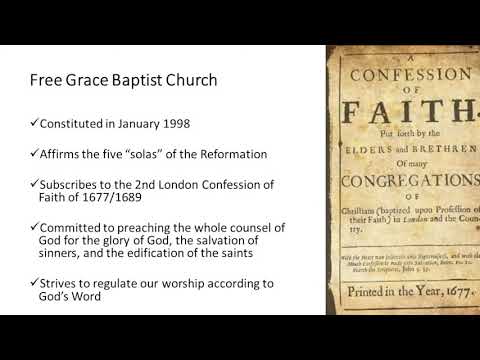
Introduction to the 1689 Second London Baptist Confession of Faith
Why should a church bind itself to a confession of faith? This introductory lesson on the Second London Baptist Confession of 1677/1689 grounds the answer exegetically in Ephesians 4 — where Christ gives gifted men to the church so that the body attains doctrinal unity and is no longer tossed about by every wind of teaching — and then traces the historical origins of the 1689 among the Particular Baptists, distinguishing them from Anabaptists, Presbyterians, and Congregationalists. Four functions of a confession are developed: defining, defending, discriminating, and disciplining with reference to the doctrine of the church. The lesson closes by distinguishing Reformed theology (Calvinism plus covenant theology plus the regulative principle) from mere five-point Calvinism, and by defending the confession's silence on matters of Christian liberty as a feature, not a defect.

The Divinity of the Word, Part 2
John 1:3–5 teaches that the eternal Word is the creator of all things, establishing Christ unmistakably on the divine side of the creator-creature distinction. The sermon works through the Trinitarian doctrines of inseparable operations and appropriations, showing from Genesis 1, Psalm 33, Job 26, Colossians 1, and Hebrews 1 that creation is the undivided act of the one God, yet scripture distinctively attributes it to the Son. Because Jesus is creator, sustainer, and enthroned Lord, his people need not be paralyzed by circumstance — and the darkness, however violently it resists the light, cannot overcome it.

The Lord's Betrayal in the Garden
Matthew 26:47–50, read alongside John 18:1–11, presents the betrayal of the Son of God in Gethsemane as the arrival of the cup of divine wrath — the hour for which he came. The sermon traces three aspects of the betrayal: its significance as the fulfillment of prophecy and the onset of Messianic suffering, the diabolical plan coordinated by Judas and the religious leaders, and the execution of that plan through a hypocritical kiss. The exposition then turns to John 18 to show that even as Christ surrendered, he revealed his divine identity by the words 'I Am,' causing the armed mob to draw back and fall to the ground — a display of the glory that will be fully manifested at his return. The central application is twofold: believers are called to stand in awe of the active obedience and voluntary self-surrender of Christ whose righteousness is imputed to them, and unbelievers are warned that the only preparation for facing that glory is faith in the Lord Jesus Christ.