
Cited in sermons
Athanasius
56 sermons · All people cited
The Consubstantiality of the Son, Part 2

John 5:24–30 presents Jesus responding to the Jewish charge that he made himself equal with God — not by retreating, but by affirming it through two divine functions: authority over life and authority over judgment. This sermon works through the declaration of that authority in eternal life (vv. 24–25), the rationale grounded in the eternal generation of the Son from the Father (vv. 26–27), and the promise of his authority on the final day of judgment (vv. 28–30, previewed). Central to the argument is the doctrine of consubstantiality — that the Son shares the one simple undivided divine essence with the Father from all eternity — which grounds both his power to effectually call dead sinners to life and his right to preside as judge of all the earth. The sermon calls hearers to receive Christ by faith, since only God himself can save sinners, and it is the voice of the Son of God alone that awakens the spiritually dead.

The Consubstantiality of the Son, Part 1
John 5:16–23 records the Jewish charge that Jesus made himself equal with God — and Christ's unequivocal affirmation of that charge. Working through verses 16–23, this sermon demonstrates that Jesus responds not by correcting a misunderstanding but by confirming, through four lines of argument, that he is consubstantial with the Father: sharing the same works, the same love, the same life-giving power, and the same sovereign rule. The stakes are ultimate — to dishonor the Son is to dishonor the Father, and to lack the Son is to lack God entirely.

2LCF Chapter 2 - Of God and of the Holy Trinity, Part 3
The doctrine of the Trinity is not a mathematical formula but a carefully defined confession of one divine being eternally subsisting as three distinct persons — Father, Son, and Holy Spirit. This session works through 1689 London Baptist Confession of Faith chapter 2, paragraph 3, examining the unity and equality of the persons, their distinction by eternal relations of origin, and the contemporary crisis caused by the abandonment of eternal generation. The denial of threeness is as heretical as the denial of oneness, and a recovery of Nicene Trinitarianism is essential not only for theological orthodoxy but for the health of the soul and the vitality of corporate worship.

The Defense of the Faith
Jude 3 commands every believer — not merely pastors or theologians — to contend earnestly for the faith once for all delivered to the saints. This sermon examines the exhortation itself, the internal threat posed by sneaky, ungodly apostates who pervert grace and deny Christ, and the practical preparedness Jude prescribes: remembering apostolic warning, building up on the most holy faith through Scripture and prayer, and resting in the assurance that God himself preserves his people. The defense of the faith is not pessimistic trench-holding but confident advance grounded in Christ's promise to build his church against which the gates of Hades shall not prevail.

The Conversion of Cornelius
Acts 10:34–48 records the official inclusion of Gentiles in the covenant promises of God — a watershed moment in redemptive history. Peter's sermon before Cornelius and his household sets forth the peace, person, work, and prophetic witness of Jesus Christ, culminating in the declaration that through His name, whoever believes will receive remission of sins. The sovereign Holy Spirit falls upon the hearers before Peter has even finished speaking, confirming that salvation is of the Lord and that divine initiative — not human free will — drives the conversion of sinners. The passage concludes with the baptism of the entire household, a commanded public identification with the Triune God that pictures, but does not accomplish, the inward work already wrought by grace through faith.

The Incarnation of the Word, Part 1
John 1:14 — 'the Word became flesh and dwelt among us' — is the hinge on which all Christian theology turns. This exposition works through the identification, the incarnation proper, and the indwelling presence of the Word, establishing that the eternal Son assumed a true human nature (body and soul) without ceasing to be the second person of the Trinity — the doctrine the church confesses as the hypostatic union. The sermon draws on the active and passive obedience of Christ to show that the incarnation was not primarily exemplary but redemptive: the Word took flesh to render the perfect obedience sinners owe and to shed the blood that purchases their forgiveness. Hearers are pressed to see Christ not only as Redeemer but as reigning King, and the unbeliever is called to receive, by faith alone, that righteousness which comes from God.
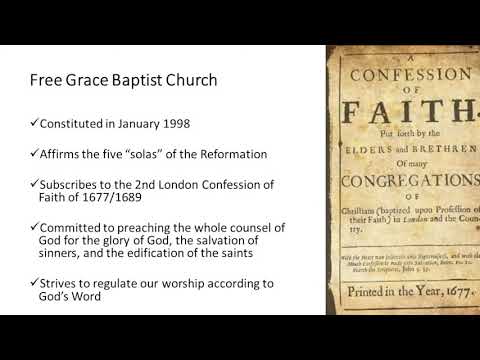
Introduction to the 1689 Second London Baptist Confession of Faith
Why should a church bind itself to a confession of faith? This introductory lesson on the Second London Baptist Confession of 1677/1689 grounds the answer exegetically in Ephesians 4 — where Christ gives gifted men to the church so that the body attains doctrinal unity and is no longer tossed about by every wind of teaching — and then traces the historical origins of the 1689 among the Particular Baptists, distinguishing them from Anabaptists, Presbyterians, and Congregationalists. Four functions of a confession are developed: defining, defending, discriminating, and disciplining with reference to the doctrine of the church. The lesson closes by distinguishing Reformed theology (Calvinism plus covenant theology plus the regulative principle) from mere five-point Calvinism, and by defending the confession's silence on matters of Christian liberty as a feature, not a defect.

The Incarnation of the Word
John 1:14 declares that the eternal Word — the second person of the Trinity, who was in the beginning with God and was God — became flesh and dwelt among men. This sermon expounds the incarnation under two heads: first, the identity and reality of the Word taking on true humanity (the hypostatic union of two complete natures in one person), and second, the glory of that Word as the only begotten of the Father, full of grace and truth. The incarnation is shown to be the indispensable ground of redemption — whatever is not assumed is not redeemed — and sinners are urged to flee to a mediator who is full, not miserly, in grace and truth.
The Glory of the Father and the Son
John 17:1–5 opens Christ's high priestly prayer with a petition that the Father glorify the Son so that the Son may glorify the Father — a reciprocal glorification whose goal is the glory of God Most High. The sermon works through three grounds for this petition: the salvation of the elect given to the Son in the covenant of redemption, the accomplishment of Christ's active and passive obedience as the basis of justification, and the restoration of the Son's pre-incarnate glory. The full deity of Christ is defended against subordinationist readings by surveying New Testament texts where the title theos is applied directly to Jesus, and the sermon closes with the call to pursue the knowledge of God and Christ as the very essence of eternal life — through Scripture reading, prayer, and faithful attendance upon the means of grace.

The Deliberation of the Council
Acts 4:13–22 records the Sanhedrin's deliberation over Peter and John following the healing of a lame man and the apostolic proclamation of Christ's resurrection. The council faces an insoluble dilemma: the miracle is undeniable and publicly known, yet to leave the apostles unchallenged is to permit the gospel to spread unchecked. This sermon traces two broad movements — the deliberation of the council (vv. 13–17) and the attempt to silence the apostles (vv. 18–22) — and draws out the benefits of being with Jesus as seen in the apostles' boldness and wisdom, alongside the liabilities that attend any attempt to suppress the word of God. The application presses believers to pray for men of gospel courage and to resist every pressure, civil or ecclesiastical, to silence the name of Christ.

The Defense of the Faith
Jude 3 issues a universal call—addressed not to clergy alone but to every believer, the 'beloved'—to contend earnestly for the faith once for all delivered to the saints. The sermon works through three movements: the exhortation itself and its five implications, the reason for that exhortation in the apostates of verse 4, and the practical preparedness of the contender outlined in verses 20 and 21. Doctrinal fidelity is not optional maintenance for specialists; it is the privilege and duty of every member of the covenant community, sustained by Scripture reading, prayer, and a constant looking to Christ. The sermon closes with a direct call to the unconverted to flee to the Lord Jesus Christ, in whom alone forgiveness of sins and the imputation of his righteousness are received by faith alone.
2 Kings 2:1-25
2 Kings 2 presents the translation of Elijah and the public authentication of Elisha as his prophetic successor. The chapter divides into two broad movements: Elijah's assumption into heaven by whirlwind (vv. 1–12) and Elisha's manifestation as the new man of God through miracle-working (vv. 13–25). The parallels to Moses and Joshua, the divided Jordan, the healing of Jericho's water, and the covenant curse executed through two bears all establish that Elisha stands in an unbroken line of authorized prophetic ministry — and that God's Word, not any individual instrument, is the true power sustaining His kingdom. The controlling application is that when God removes an Elijah, a Calvin, or a Spurgeon, His Word and His kingdom march on, calling His people to fix their confidence on the strength of God's arm rather than the charisma of His servants.
Of Christ the Mediator 1 (2LCF 8)
The person and work of Christ as mediator stands at the center of Christian theology, as this study of 2nd London Baptist Confession chapter 8 makes clear. Working through all ten paragraphs of the chapter in overview, the session traces the pre-temporal appointment of Christ as mediator in the covenant of redemption, the historical stages of his mediatorial work, and the necessity of his threefold office as prophet, priest, and king. Particular attention falls on paragraph 2's account of the incarnation — the eternal Son taking true human nature with all its essential properties yet without sin — and paragraph 7's careful rule for reading Scripture passages that attribute what belongs to one nature to the other, guarding against both a divinized humanity (Lutheran ubiquitarianism) and a humanized deity. Hearers are called to hold fast the church's historic confession of Christ as one person in two natures, whole, perfect, and distinct, without conversion, composition, or confusion.
The Baptisms of Jesus Christ
Christ's two baptisms in Matthew 3 and Matthew 20 illuminate the two pillars of the gospel: His active obedience, by which He fulfilled all righteousness on behalf of His people, and His passive obedience, by which He endured the cross as a substitutionary ransom for many. The water baptism in Matthew 3 marks the public inauguration of Christ's life of perfect law-keeping, while the 'baptism' He anticipates in Matthew 20 refers to His immersion in suffering and divine wrath at Calvary. Together these two baptisms demonstrate that sinners need not only the forgiveness of sins secured by Christ's death, but also an alien righteousness — His own perfect obedience imputed to them by faith alone. The sermon calls both unbelievers and the baptized congregation to rest in the full sufficiency of what Christ accomplished, rejecting any gospel that offers the crown without the cross.
2LCF Chapter 2 - Of God and of the Holy Trinity

The doctrine of God and the Holy Trinity, as confessed in 2LCF Chapter 2, is approached here through three progressive affirmations drawn from Scripture and the Reformed confessional tradition: God is, God is one, and God is one in three persons. The incomprehensibility of God frames the entire study — not that He cannot be known, but that He cannot be exhaustively comprehended by any creaturely mind. Moving from general revelation through the law of nature to the biblical witness of monotheism and finally to the Trinitarian distinctions of unbegottenness, eternal generation, and eternal procession, the sermon demonstrates that the doctrine of the Trinity is not speculative theology but the very foundation of all communion with God and comfortable dependence upon Him.

Sola Scriptura: The Bible Alone

Hebrews 1:1–3 opens with the declaration that God has spoken — a claim the author of Hebrews treats not as background noise but as the controlling fact of redemptive history. This sermon works through six attributes of Scripture drawn from those opening verses: its divine source, its authority, its finality in the Son, its intended beneficiaries, its perspicuity, and its sufficiency for faith and life in the new covenant community. The Reformation's sola scriptura is shown to be not a negative protest but a positive testimony: Scripture alone is God's last, best, and sufficient word, complete in Christ, requiring no supplement from tradition, continuing prophecy, or moralistic self-help.
2LCF Chapter 8 - Of Christ the Mediator, Part 3
What role did the Holy Spirit play in the earthly ministry of Christ, and why does it matter for the doctrine of salvation? Expounding 2LCF Chapter 8, Paragraph 3, this session traces the Spirit's work across every stage of the Mediator's mission: the virginal conception, the public ministry, the cross, and the resurrection. Because Christ executed his mediatorial office in his human nature — not merely by the immediate operation of his divine nature — the Father's gift of the Spirit without measure to the man Christ Jesus is essential to orthodox Christology and to the assurance that a genuinely human Mediator has met every demand of the covenant on behalf of the elect.
Samson's Victory at Jawbone Height
Judges 15 narrates Samson's campaign against the Philistines — the burning of their grain fields, his arrest by three thousand men of his own tribe of Judah, and his Spirit-empowered slaughter of a thousand Philistines with a fresh jawbone at Lehi. The sermon works through the chapter under four considerations: the wickedness of the oppressing enemy, the cowardice of the covenant people (who acquiesce to bondage and hand their own deliverer over to his enemies), the faithfulness of the nation's deliverer, and the graciousness of Israel's God who sustains and vindicates his servant even when his people never cry out for rescue. Samson is presented not as a bumbling brute governed by passions but as a man of faith, filled with the Spirit, whose deliverance-unto-death typifies the greater Champion who would be handed over by his own nation to a foreign power and accomplish a far greater victory.
2LCF Chapter 1 - Of the Holy Scriptures
The doctrine of Scripture (1689 LBCF Chapter 1) is examined through twenty aspects drawn from paragraphs 1–10, arguing that the Holy Scriptures alone are the sufficient, certain, and infallible rule of all saving knowledge, faith, and obedience. Beginning with the principium cognoscendi — Scripture as the epistemological foundation of all theology — the study moves through the limits of general revelation, the cessation of special revelation, the canon, the self-attesting authority of Scripture, and the role of the Spirit in producing genuine belief. The session closes with the Reformation axiom that Scripture is its own infallible interpreter and the supreme judge of all religious controversy, against Rome's claim that the magisterium validates the canon.
The Word Became Flesh
John 1:14 presents one of the most concentrated statements of Christology in all of Scripture: the eternal Word, who was God and was with God in the beginning, became flesh and tabernacled among men. This sermon expounds the incarnation under two heads — the fact of the Word becoming flesh, and the glory beheld in that incarnate Word — with sustained attention to the doctrine of eternal generation, the Shekinah-tabernacle background of John's prologue, and the covenantal purpose of the incarnation in redemption. The hearer is called to rest in the Christ who perfectly fulfilled the law, bore the wrath due to sinners in their stead, and rose for their justification, and to hold fast to a sound Christology as the very ground of salvation.
Revelation 1:4-6
Revelation 1:4–6 introduces the book of Revelation not with mystery or doom but with a carefully structured doxological greeting that grounds suffering believers in the triune God as the source of all grace and peace. The sermon works through the threefold office of Christ — prophet (faithful witness), priest (firstborn from the dead), and king (ruler over the kings of the earth) — demonstrating from Psalm 89, Acts 2, and Colossians 1 that Christ's royal reign is a present reality, not a future hope. The atonement is shown to be the irreducible distinction of Christianity: unlike every competing religion, the gospel is rooted in blood redemption, not moral example. Believers are called to resist anxiety and despair by fixing their gaze on the enthroned Lamb, whose sovereignty over all earthly powers has not diminished by one degree.
The Messenger of the Covenant
Malachi 2:17–3:5 exposes what the sermon calls 'practical atheism' — the sin of those who acknowledge God's existence yet, through grumbling and discontentment, functionally deny his justice, goodness, and holiness. The oracle's divine reply is a two-part announcement: a forerunner (John the Baptist) will prepare the way, and then the Messenger of the Covenant (the Lord Jesus Christ, identified with Yahweh himself) will come — not to settle Israel's grievances against the Persians, but to refine, judge, and purify. The sermon presses the most fundamental eschatological question past all speculative curiosity: are you prepared to stand before the God of justice when he appears?
The Christian Doctrine of the Trinity
The Christian doctrine of the Trinity — one God eternally subsisting in three distinct persons, Father, Son, and Holy Spirit — is defined, defended against historic and contemporary errors, and displayed across the whole of Scripture. The sermon works through three movements: first defining the doctrine precisely (one in essence, three in person), then defending it against polytheism, Arianism, and modalism, and finally displaying its pervasive witness throughout both Testaments. The doctrine is shown to be not a cold theological abstraction but the very foundation of salvation, worship, and the believer's communion with the triune God.
The Plan of Salvation
Two verses in 2 Timothy 1 contain a concentrated summary of the entire plan of salvation, and this sermon unpacks five observations from that text: God alone saves, the effectual call is the means employed, the basis is divine purpose and grace rather than human works, the plan originates before time began in the counsel of the triune God, and it is executed in history through the doing, dying, and rising of Jesus Christ. The sermon sets monergism against every form of synergism, argues that Athanasius's soteriological defense of Christ's deity depends on the incapacity of man to save himself, and traces the pactum salutis through John 17, Romans 16, and Ephesians 1. The hearer is pressed to rest all assurance on the finished work of Christ alone and to give God all praise for a salvation that is his from first to last.
The Beauty of Christ
Psalm 45 is a royal love song that the New Testament, in Hebrews 1:8, applies directly to the Lord Jesus Christ as the eternal God-man. The sermon works through four observations: the beauty of the Savior as stated by the psalmist, the beauty of his person as both fully human and fully divine, the beauty of his attributes or perfections, and the beauty of his works in advancing his kingdom. The closing application presses both believer and unbeliever: the same arrows of Christ's word that subdue sinners to saving faith will, for the impenitent, become the instrument of final judgment — the only question is whether one falls under him now in submission or later in condemnation.
2LCF Chapter 2 - Of God and of the Holy Trinity
The doctrine of the Trinity — one God eternally existing in three distinct persons, Father, Son, and Holy Spirit, the same in substance and equal in power and glory — is not a peripheral curiosity but the beating heart of Christian confession. This sermon defines the doctrine precisely, distinguishes it from the ancient heresies of Arianism, polytheism, and modalism, and then marshals Old and New Testament evidence to demonstrate that the entire canon is Trinitarian to its core. The deity of the Son and the personality and deity of the Holy Spirit receive particular attention, since these are the contested points, and the sermon closes by showing that a right understanding of the Trinity grounds our communion with God, shapes our worship, and patterns our treatment of one another.