
Cited in sermons
Andrew Fuller
6 sermons · All people cited

Ask FGBC Batch 7: Anabaptists, Calvinism, Sincere Offer & More | Reformed Baptist Theology

This panel discussion brings together three Reformed Baptist pastors to address questions submitted to Free Grace Baptist Church on confessional identity, soteriology, covenant theology, and Lord's Day worship. The conversation distinguishes Particular Baptists from Anabaptists on historical-documentary grounds, examines the relationship between Calvinism and confessional Reformed Baptist identity, and evaluates the free and sincere offer of the gospel against what the panelists regard as the theological liabilities of well-meant-offer language. The discussion also treats the threefold division of the law, prosopological exegesis, and the scriptural rationale for two Lord's Day services, consistently grounding each answer in the 1689 Second London Baptist Confession and the exegetical tradition of the Particular Baptists.
The Use of the 2nd London Confession
A confession of faith is not a human addition to Scripture but a tool the church uses to define, defend, discriminate, discipline, and delimit its doctrine. Drawing on passages from the Pastoral Epistles, Jude, and Ephesians 4, this Sunday School address argues that the Second London Baptist Confession of 1689 serves the local church in six concrete ways: it establishes doctrinal boundaries, equips members for apologetics, vets candidates for ministry, grounds church discipline, protects Christian liberty by identifying what lies outside its purview, and anchors the church in the catholicity of the Reformed tradition. The session closes with a call to reject autonomous biblicism in favour of confessional theology understood as the fruit of the Spirit's ongoing work in the teaching ministry of Christ's church.

Introduction to the 1677/1789 2nd London Baptist Confession of Faith
The 1689 London Baptist Confession of Faith — formally composed in 1677 and adopted by particular Baptist churches in 1689 — stands in deliberate continuity with the Westminster Confession and the Savoy Declaration, adapting their language to reflect distinctively Baptist convictions while maintaining solidarity with the broader Reformed tradition. This introductory session traces the Confession's historical origins, its relationship to the First London Confession of 1644–46, and the legal and ecclesiastical context in which particular Baptists operated under the Act of Toleration. Six reasons are then advanced for why a 21st-century church should subscribe to a 17th-century confession: to define, defend, discriminate, discipline, distinguish matters of Christian liberty, and develop an appreciation for the history of the church. The session closes by urging that confessionalism, rightly understood, is not proud biblicism but the humble reception of gifts Christ has given to his church across the ages.
Introduction to the 1689 Second London Baptist Confession of Faith
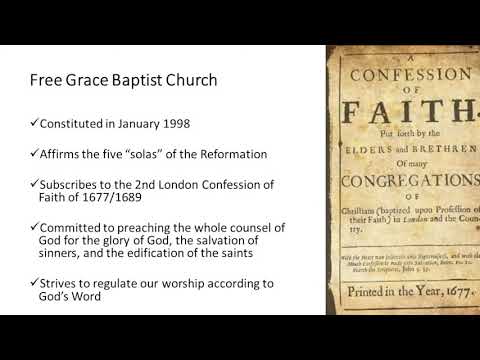
Why should a church bind itself to a confession of faith? This introductory lesson on the Second London Baptist Confession of 1677/1689 grounds the answer exegetically in Ephesians 4 — where Christ gives gifted men to the church so that the body attains doctrinal unity and is no longer tossed about by every wind of teaching — and then traces the historical origins of the 1689 among the Particular Baptists, distinguishing them from Anabaptists, Presbyterians, and Congregationalists. Four functions of a confession are developed: defining, defending, discriminating, and disciplining with reference to the doctrine of the church. The lesson closes by distinguishing Reformed theology (Calvinism plus covenant theology plus the regulative principle) from mere five-point Calvinism, and by defending the confession's silence on matters of Christian liberty as a feature, not a defect.

The Utility of Confessions and Introduction to the Second London Baptist Confession
Confessions of faith are not competitors to Scripture but are faithful summaries of biblical doctrine, and the church has historically depended on them for good reason. This address introduces the Second London Baptist Confession of 1689, tracing its historical origins among the Particular Baptists of the 17th century and its relationship to the Westminster Confession and the Savoy Declaration. Five interlocking uses of a confession are then examined: defining church doctrine, defending it against error, discriminating between members and officers on doctrinal grounds, disciplining departures from orthodoxy, and distinguishing confessed doctrine from matters of Christian liberty. The goal is not confessional enslavement but confessional clarity — guardrails that protect the church and free her members to worship and grow in the grace and knowledge of Christ.
2LCF Chapter 20 - Of the Gospel and of the Extent of the Grace Thereof

The gospel is necessary, revealed only through special revelation, and made effectual solely by the sovereign work of the Holy Spirit — natural law and general revelation are wholly insufficient for salvation. This session expounds 2LCF Chapter 20, tracing why John Owen and the Congregationalists added this chapter to address both the rise of salvation-through-natural-law teaching and the false charge that Reformed and Baptist churches were anti-missional. The sermon argues that the gospel advances to the ends of the earth through preaching, according to God's sovereign will, as the Spirit regenerates the elect who are dead in trespasses and sins. The practical burden is confidence and perseverance in gospel proclamation, grounded not in human ability or ecclesial authority but in the sovereignty of God.