
Cited in sermons
A.W. Pink
97 sermons · All people cited

2LCF Chapter 3 - Of God's Decree, Part II

God's decree, as confessed in 2LCF Chapter 3, encompasses both predestination unto life and the reprobation of the non-elect — a distinction the confession handles with care but which Scripture addresses with directness in passages such as Proverbs 16:4, Matthew 11:25-28, and Romans 9:17-23. The sermon distinguishes three theological frameworks integral to understanding the decree in salvation: the Pactum Salutis (the pre-temporal, intra-Trinitarian covenant of redemption), the Historia Salutis (the unfolding of redemption in space and time), and the Ordo Salutis (the application of redemptive benefit to the elect). God ordains not only the end — the salvation of a definite number — but also all the means, grounding the church's obligation to preach the gospel, make disciples, and pursue the lost. The doctrine, rightly received, produces praise, reverence, admiration, humility, diligence, and abundant consolation rather than either hyper-Calvinist passivity or Arminian nervousness.

The Testimony Concerning the Bridegroom
John 3:22–30 presents the final recorded testimony of John the Baptist in the Fourth Gospel, in which John responds to his disciples' anxious complaint that all are coming to Jesus rather than to him. John's response is structured around four declarations: the sovereignty of God governs the origin and success of every ministry; his own role was never to be the Christ but the forerunner sent before him; his joy is that of the friend of the bridegroom who delights simply to stand in the presence of the bridegroom and hear his voice; and therefore Christ must increase while he must decrease. The sermon draws out both the Christological weight of the bridegroom image — rooted in the Old Testament covenant between God and Israel and fulfilled in Christ and his church — and its practical implications for how ministers and all God's people resist pride by being increasingly occupied with Christ rather than with themselves.

2LCF Chapter 2 - Of God and of the Holy Trinity
What does Scripture reveal about God's relationship to his creation, and how does that shape the creature's obligation to the Creator? Working through paragraphs two and three of Chapter 2 of the 1689 London Baptist Confession of Faith, this study expounds three perfections of God in his external relations: his aseity (independence and self-sufficiency), his omniscience, and his holiness. From Acts 17, 1 Kings 8, Psalm 113, Psalm 115, Daniel 4, Ephesians 1, and Romans 9, the instructor demonstrates that God is the sole fountain of all being, exercises most sovereign dominion over all creatures, and is morally pure in all his counsels, works, and commands — and that these perfections ground the creature's comprehensive obligation of worship, service, and obedience to the Creator.

The Enthronement of the Priest-King
Psalm 110, the most frequently cited Old Testament passage in the New Testament, presents the Messiah as the divinely enthroned Priest-King whose universal dominion is secured by the oath of God. This exposition traces three movements in the psalm: the enthronement and government of Christ the King (vv. 1–3), his eternal priesthood after the order of Melchizedek (v. 4), and the triumphant conquest of his enemies (vv. 5–7). The sermon draws on Peter's argument in Acts 2, Paul's application in 1 Corinthians 15 and Ephesians 1, and the author of Hebrews to show that Christ's present session at the right hand of the Father is not passive but active — he reigns, subdues, and intercedes. Christians living in tumultuous times are urged to resist despair by fixing their confidence in the sovereign rule of the enthroned Priest-King rather than in the shifting circumstances of earthly politics.

The First Disciples of Jesus
John 1:35–51 records the calling of the first disciples of Jesus — Andrew, Simon Peter, Philip, and Nathanael — and the passage frames their coming to Christ as the inevitable fruit of John the Baptist's preparatory ministry and the sovereign grace of God. The sermon traces how each disciple is drawn to Christ, how each immediately brings another, and how the accumulating titles given to Jesus in this section — Lamb of God, Rabbi, Messiah, Son of God, King of Israel, Son of Man — build a Christological portrait that mirrors the prologue's declaration that the Word was God. Christ's omniscience in knowing Nathanael and his royal authority in renaming Simon Peter underscore that these disciples are not choosing a teacher but being conquered by a divine Savior. The pattern of Andrew fetching Peter and Philip fetching Nathanael becomes the sermon's model for evangelism: those saved by sovereign grace become, without coercion or manipulation, propagators of that same grace.

The Testimony of John the Baptist, Part 2
John 1:29 records the Baptist's singular declaration — 'Behold the Lamb of God who takes away the sin of the world' — a phrase saturated with the weight of Old Testament redemptive history. This sermon works through the theological freight of that title, tracing the Lamb through Genesis 22, Leviticus 16, and Isaiah 53 to show that Christ's mission is substitutionary blood atonement: he takes up the sin of his people in order to take it away entirely. The 'world' from which sin is removed is not every individual without exception but men and women without ethnic or national distinction, saved by grace alone through faith in Christ alone.

The Neglect of Weighty Matters
Jesus condemns the scribes and Pharisees in Matthew 23:23–24 not for tithing mint, anise, and cumin, but for doing so while neglecting the weightier matters of the law: justice, mercy, and faith. The Pharisaic imbalance is neither ancient nor extinct — the same tendency to obsess over religious minutiae while bypassing the moral and covenantal substance of God's law persists in the church today. Drawing on Micah 6:8, Hosea 6:6, and the broader prophetic tradition, this exposition argues that genuine obedience to God is universal and balanced, not selective and performative.

The Incarnation of the Word, Part 2
John 1:15–17 presents the preeminence of the incarnate Word and the fullness of grace and truth that flows from Him to needy sinners. The testimony of John the Baptist — that Christ ranks before him because He was before him — is an affirmation of Christ's co-eternity, distinctness, and consubstantiality with the Father, in accord with the Nicene Creed. Verse 17 is not a sharp antithesis between Moses and Jesus but a contrast in the mode of divine revelation: the law was mediated through Moses, while grace and truth came through the mediator Himself, who is the very embodiment of God's glory. The sermon calls hearers to stand in awe of the preeminent Redeemer, to find every spiritual need met in His inexhaustible fullness, and to close with Christ without delay.

The Elements of Family Worship
Deuteronomy 6:6–7 commands parents to teach God's word diligently to their children in every season of daily life, and this sermon traces that mandate across both Testaments — from Abraham's household religion in Genesis 18, through the Psalms and Proverbs, to Paul's charge in Ephesians 6:4 and the example of Timothy's mother and grandmother. The preacher argues that family worship is a clear biblical obligation whose specific form is left to the conscience, and that failure to instruct children in the fear of God — illustrated negatively by Eli and Samuel's sons — leaves them unguarded against a culture actively hostile to Christ. Fathers and mothers are exhorted to commit first to public Lord's Day worship, to honour the sanctification of the Sabbath, and then to establish a family altar consisting of Scripture reading, prayer, and singing — scaled appropriately for their household — as the primary means of passing covenant knowledge to the next generation.
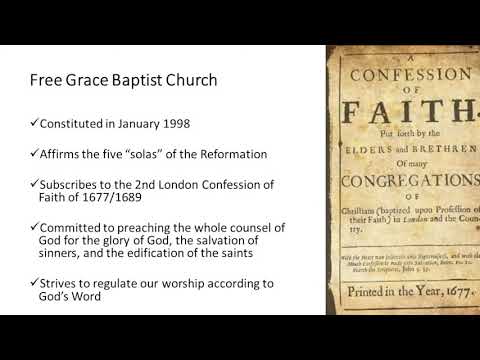
Introduction to the 1689 Second London Baptist Confession of Faith
Why should a church bind itself to a confession of faith? This introductory lesson on the Second London Baptist Confession of 1677/1689 grounds the answer exegetically in Ephesians 4 — where Christ gives gifted men to the church so that the body attains doctrinal unity and is no longer tossed about by every wind of teaching — and then traces the historical origins of the 1689 among the Particular Baptists, distinguishing them from Anabaptists, Presbyterians, and Congregationalists. Four functions of a confession are developed: defining, defending, discriminating, and disciplining with reference to the doctrine of the church. The lesson closes by distinguishing Reformed theology (Calvinism plus covenant theology plus the regulative principle) from mere five-point Calvinism, and by defending the confession's silence on matters of Christian liberty as a feature, not a defect.

The Mission of the Word, Part 2
John 1:10–13 presents two contrasting responses to the mission of the incarnate Word: the rejection of the world and of Israel, and the reception of those upon whom Christ confers the right to become children of God. The sermon works through the threefold use of 'world' in verse 10, the parallel between Israel's ancient rebellion and their rejection of the Messiah, and the sovereign grace underlying faith and new birth in verses 12–13. Central to the exposition is the Reformed insistence that regeneration precedes faith — those who receive Christ by believing do so because they have first been born of God — against both Pelagian and Arminian construals of conversion.

The Christian Sabbath, Part 2
The Christian Sabbath, grounded in both creation and redemption, does not cease in the New Covenant but is transformed by the resurrection of Christ from the seventh day to the first day of the week. Working through the ministry of Christ in Matthew 5 and 12, the resurrection accounts across all four Gospels, and the apostolic teaching in Hebrews 4, Acts 20, 1 Corinthians 16, and Revelation 1, this exposition argues that the moral obligation of one day in seven for the worship of God remains perpetually binding on the church. The shift from Saturday to Sunday Sabbath is grounded in Christ's completed redemptive work, which mirrors the Father's rest at the close of creation, establishing the Lord's Day as the Christian Sabbath. Believers are called to receive this day not as a legal burden but as a gracious gift from God, a weekly foretaste of the consummate rest that awaits the people of God.

The Enthronement of the Messiah
Psalm 110 presents the enthroned Messiah as divine King, eternal Priest, and triumphant Conqueror — a vision the early church clung to precisely because they suffered under Rome and unbelieving Israel. This exposition traces the three offices of the Mediator through seven verses, showing that Christ's present session at the right hand of the Father is not a passive waiting but an active subjugation of all enemies. The sermon rebukes a domesticated, sentimental Christology and calls believers to confident, volunteer service under the sovereign who must reign until every enemy is made his footstool.

Genesis 12:10-20
Genesis 12:10–20 records the first major moral failure of Abram after receiving the Abrahamic covenant promises: fearing Pharaoh more than God, he deceives the Egyptians by presenting Sarai as his sister, thereby jeopardizing both the seed promise and his wife's honor. The passage exposes the weakness of the patriarch — the father of the faithful walking by pragmatism rather than faith — while demonstrating that the fulfillment of God's covenant promises rests on divine faithfulness, not human faithfulness. The account also foreshadows the later Exodus narrative, as famine, Egyptian affliction, divine plagues, and departure with wealth prefigure Israel's bondage and deliverance. The take-home message is neither license nor despair, but confidence: God's promises are yea and amen in Christ, irrespective of the feebleness of those to whom they are given.

The Royal Purpose in the Incarnation
John 18:37 records Jesus declaring before Pontius Pilate, 'For this cause I was born,' identifying the incarnation with a royal purpose — he entered the world as king. This sermon expounds John 18:33–40, tracing the nature of Christ's kingdom (not originating from this world, yet encompassing it), the method by which that kingdom advances (through truth, not military force), and the prophecy of Isaiah 9:6–7 that illuminates both the king and his everlasting dominion. The listener is called to receive the truth Christ embodies rather than dismiss it as Pilate did.

The Prophet Under the Broom Tree
What was Elijah actually doing under the broom tree — fleeing in faithless self-pity, or acting out of zealous grief for the glory of God? Working through 1 Kings 19:1–18, this sermon challenges the dominant commentatorial tradition that reads Elijah's flight and depression as a crisis of faith, arguing instead that his despondency was provoked by legitimate covenantal grief over Israel's continued apostasy after the contest at Carmel. God's response — rest, food, a journey to Horeb, and a formal covenant lawsuit — vindicates the prophet and reveals the divine program of justice and grace through Hazael, Jehu, Elisha, and a reserved remnant of 7,000. The pastoral application is direct: faithful people suffer depression, and those who minister to them must respond with the same patience, kindness, and provision that Yahweh himself showed to Elijah.

The Replacement for Judas
The replacement of Judas Iscariot in Acts 1:12–26 raises questions about the nature of apostolic authority, the sovereignty of God over human treachery, and the continuing rule of the risen Christ over his church. Peter's leadership in securing Matthias as the twelfth apostle demonstrates that the apostolic college was not dissolved by Judas's defection but reconstituted by Christ's own direction — through prayer, Scripture, and the casting of lots. The sharp contrast between Peter, restored by grace after his denial, and Judas, who went to his own place as a reprobate, anchors the sermon's gospel appeal: no sin is too great for the pardoning mercy of God in Christ, and sinners are urged to look to Christ and live.

The Sacrifice Remembered

What does it mean to remember the death of Christ at the Lord's Supper? Examining 1 Peter 1:18–20, this sermon traces three dimensions of that remembrance: the incomparable value of Christ's precious blood over all corruptible earthly things, the eternal and love-driven divine purpose behind the atonement foreordained before the foundation of the world, and the singular historical reality of the incarnation and sacrifice. The congregation is called to prize Christ above every earthly attachment and to observe the Lord's Supper with the gravity and joy befitting so great a Savior.

The Contest at Carmel
The contest on Mount Carmel in 1 Kings 18 is not merely a dramatic episode from Israel's monarchic period — it is a confrontation between the living God of Israel and the futility of every false god. Elijah's challenge to a compromised people, 'How long will you falter between two opinions?', exposes the recurring temptation to blend true religion with idolatry, whether in ancient Israel's Baalism or in the subtler syncretism of today. The sermon traces the theological case for why Baal attracted Israelite worship — royal sanction, tradition, relevance to felt needs, and sensual appeal — before showing how God's consuming fire rendered that attraction indefensible. The application presses toward total allegiance: no halting between God and money, God and self, God and any competing lord.

1 Kings 19:8-21
Elijah's journey to Horeb in 1 Kings 19:8–21 is not a story of prophetic cowardice or self-pity, but of a faithful covenant prosecutor bringing a formal lawsuit against Israel for her apostasy before the God of the covenant. The divine theophany at Horeb — wind, earthquake, and fire yielding to a still small voice — teaches that God's redemptive purposes advance not through spectacular display but through the prophetic word, historical providence, and sovereign grace. God's answer to Elijah's complaint is both judgment (through Hazael, Jehu, and Elisha) and mercy (a reserved remnant of seven thousand), affirming that God will always preserve a people for Himself. The call of Elisha that follows illustrates the decisive break from natural relations, familiarity, financial security, and self-advancement that marks genuine response to God's call.

1 Kings 18:41 - 19:8
When Elijah calls for rain after the contest at Carmel, he prays persistently through seven divine silences before a small cloud rises from the sea, demonstrating that God's sovereignty over nature does not remove the necessity of prayer but rather grounds it. The passage then traces Elijah's flight from Jezebel's death threat, and the study mounts a careful exegetical defense of Elijah: his departure is not a crisis of faith or narcissistic self-pity, but the brokenness of a prophet grieved over Israel's covenant unfaithfulness, directed to Horeb by divine prompting, and met there by a God who feeds, rests, and commissions rather than rebukes. God's varied ways of answering prayer — immediately, after extended pleading, or not at all — resist reduction to any formula, and his tender provision for an exhausted prophet reveals a character utterly unlike Baal.
1 Kings 18:1-40
1 Kings 18:1–40 presents the contest on Mount Carmel as a divinely ordained demonstration that Yahweh alone is the living and true God, and that Baal is no god at all. The chapter sets Elijah's bold, public confrontation against Obadiah's quiet, behind-the-scenes faithfulness, showing that God deploys His servants in different ways toward the same kingdom purpose. Elijah's challenge — 'How long will you falter between two opinions?' — indicts both ancient syncretism and every form of divided allegiance, insisting that God demands total loyalty and is not manipulated by religious frenzy. The sermon closes by warning that a Baal-worship mentality — doing religious duty in order to extract blessing from God — can infiltrate even Reformed churches.
The Preeminence of Christ
John 3:22–30 records John the Baptist's final official testimony concerning Christ, and in it the preeminent greatness of a man whose greatness lay entirely in his humility. Confronted by disciples troubled that Jesus was drawing larger crowds, John offers four responses grounded in God's sovereignty: the origin of his ministry was from heaven, its purpose was always to announce the Messiah, his joy was fulfilled precisely when the bridegroom's voice was heard, and Christ must increase while he must decrease. The sermon applies this pattern to every believer, arguing that humility is not directly cultivated but is the byproduct of being increasingly occupied with Christ, and that the cross is the only path to that self-forgetful life.

Free Grace Baptist Church - December 4, 2016 AM
Philippians 2:8–11 presents the obedience of Christ as the crux of the gospel: the Son of God, fully God and fully man, humbled himself unto the cross death in substitutionary obedience to the law of God in the place of all who believe. This sermon works through three movements — the reality, the crux, and the result of Christ's obedience — grounding each in the theology of the two Adams: as Adam's disobedience plunged mankind into sin and condemnation, so Christ's perfect obedience as the second Adam restores and surpasses all that was lost. The obedience of Christ is not merely a doctrinal category but a free gift of righteousness received by faith alone, the very lifeblood of the gospel, received with joy and answered in humble service to others after the pattern of the Lord.

Free Grace Baptist Church - November 20, 2016 AM
Philippians 2:6–11 contains one of the richest Christological confessions in all of Scripture, composed within two decades of the resurrection and already rehearsing Christ's pre-incarnate divine majesty, his voluntary humiliation, and his subsequent exaltation. This sermon opens the 'anatomy' of Paul's hymn to Christ as to God, establishing two foundational realities: the structural movement of the text from loftiness to lowliness to supreme exaltation, and the full, unqualified deity and equality of the Son with the Father. The church is called to hide these truths in their hearts against every heresy that diminishes Christ, and to find in his condescension the very ground and pattern of Christian humility and unity.
Hebrews 13:3
Hebrews 13:3 commands believers to 'remember the prisoners as if chained with them' — not merely to recall that persecuted saints exist, but to remember them with a view to action, prayer, and tangible aid. This study traces the command through its immediate context of brotherly love (Hebrews 13:1-3), the Old and New Testament witness to the normalcy of suffering for the cause of Christ, and the reasons why remembering persecuted believers is both a duty and an expression of the church's solidarity in one body. The practical application presses the congregation to move beyond apathy toward the persecuted church through prayer, correspondence, giving, visitation, and the conscious redirecting of attention away from self toward those who suffer for the name of Christ.

An Encouragement to Look unto Jesus
Hebrews 12:2 calls the struggling Christian to run with endurance by looking unto Jesus — not merely as a moral example, but as the author and finisher of faith, the one who both originates and secures the believer's perseverance to the end. The sermon works through five aspects of Christ presented in the verse: his person, his work as author and finisher of faith, his resolve in enduring the cross for the joy set before him, his shame and suffering in the crucifixion, and his present exaltation at the right hand of God. The cloud of witnesses in Hebrews 11 testifies unanimously that God is faithful, but the believer's gaze must ultimately rest on Christ himself, in whom all hope, trust, and confidence are grounded. The practical summons is to use the means of grace — Scripture, prayer, the Lord's Supper, and the gathered assembly — to keep the eyes of faith fixed on Jesus and to press on without coasting.

The Practice of Family Worship
God commands parents to instruct their children in His Word — not occasionally, but diligently, formally and informally, in every setting of daily life. This sermon surveys the biblical warrant for family worship across both Testaments, from God's covenantal purpose for Abraham in Genesis 18 through Paul's charge to fathers in Ephesians 6, establishing that the propagation of biblical religion through the home is not optional but normative for the covenant community. The elements of family worship are then treated in order: commitment to public worship as the irreducible foundation, the sanctification of the Lord's Day, the use of the family altar (including psalm-singing, prayer, Scripture reading, and catechism), and the usefulness of historic creeds and confessions. The sermon closes with a direct charge to recognize the importance of family worship, implement it without delay, and persevere in it as a primary means of evangelism toward one's own children.

The Purpose of the Incarnation
Jesus' declaration before Pontius Pilate — 'For this cause I was born, and for this cause I have come into the world' (John 18:37) — frames the Incarnation not as a seasonal sentiment but as the entry of the eternal Son into his mediatorial kingship. The sermon expounds Christ's kingdom as non-terrestrial in origin yet universal in scope, advancing not by armed revolt but by the truth he himself embodies and proclaims. Pilate's cynical shrug — 'What is truth?' — is set as a mirror before the hearer: indifference to the truth of Christ is indifference to the only ground of liberation from the wrath of God. The sermon calls every listener to receive the King through faith in the gospel, and every Christian household to press children toward Christ through diligent engagement with Scripture.
2LCF Chapter 21 - Of Christian Liberty and Liberty of Conscience, Part 1
Christian liberty, as defined in 2LCF Chapter 21, is not primarily about what believers are permitted to do but about what Christ has accomplished for them — freedom from the guilt, power, and punishment of sin, as well as freedom from the ceremonial yoke of the Old Covenant. The chapter also guards the conscience from two opposing errors: the tyranny of ecclesiastical or civil impositions that bind the conscience beyond God's Word, and the antinomian perversion that treats liberty as license for sin. The sermon calls believers to live under God's Word alone as the Lord of the conscience, neither adding to it nor subtracting from it, walking in holiness and righteousness without fear.